Kaspersky’s Industrial Control Systems (ICS) Emergency Response Team’s latest data shows that ICS computers in critical regions of the Asia-Pacific continue to face a large number of cyberattacks. Adrian Hia, Managing Director of Kaspersky Asia Pacific, revealed that in the first quarter of 2025, Southeast Asia ranked second globally in the percentage of malicious objects intercepted on ICS computers, Central Asia ranked third, and South Asia ranked sixth.
On August 5, Kaspersky held the 2025 Cybersecurity Conference in Da Nang, Vietnam. At the conference, official data from Kaspersky indicated that the era of independently managing Information Technology (IT) and Operational Technology (OT) has ended. With the acceleration of digital transformation in the Asia-Pacific region, the once-isolated fields of IT and OT are increasingly merging. This integration has brought about new cybersecurity vulnerabilities, which can only be addressed through smarter, multi-layered defense systems.
Currently, the valuation of the IT/OT integration market in the Asia-Pacific region is $13.41 billion. Market forecasts indicate that by 2030, this market is expected to grow to $62.17 billion, with a compound annual growth rate (CAGR) of 24.5%. Market predictions show that by 2030, this market is expected to grow to $62.17 billion, with a compound annual growth rate (CAGR) of 24.5%.
The Asia-Pacific region has been leading global digital transformation. Various industries in the region widely adopt automation technologies, real-time data systems, and interconnected infrastructures, making the deep integration of IT and OT systems a key driver for enhancing operational efficiency and business outcomes.
On the other hand, this integration has also brought new cybersecurity risks. As the boundaries between IT and OT systems blur, the attack surface expands, presenting new challenges for organizations in the region.
The Asia-Pacific Region Becomes One of the Highest Regions for Virus Detection Rates
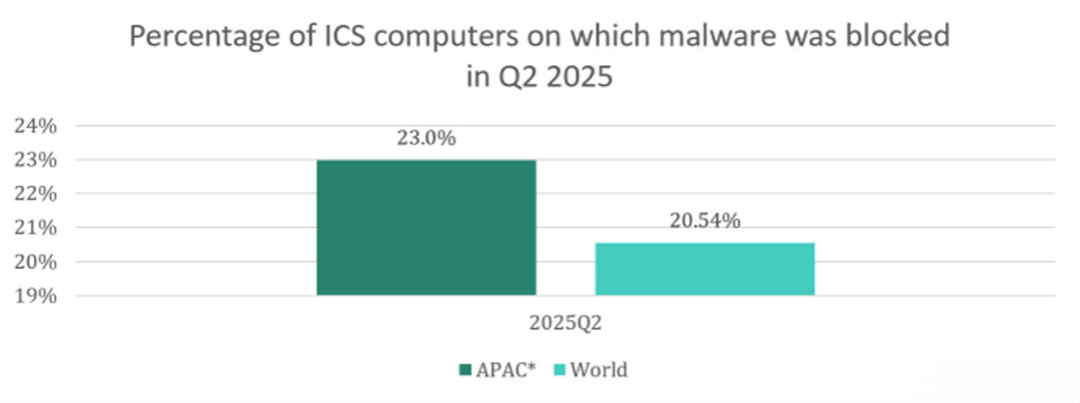
In terms of the overall percentage of malicious objects intercepted on ICS computers, the Asia-Pacific region reached 23% in the second quarter of 2025, nearly 3% higher than the global average of 20.54%.
In the second quarter of 2025, the industries in the Asia-Pacific region most affected by virus threats include power energy, building automation, oil and gas, manufacturing, and industrial control systems (ICS) engineering and integration.
In the second quarter of 2025, the countries most severely affected by virus attacks on industrial control systems (ICS) include Vietnam, Afghanistan, China, Bangladesh, Pakistan, Myanmar, Laos, Cambodia, Indonesia, and Nepal.
IT and OT Integration Requires Smart Security Operations Centers (SOC)
To address the increasingly severe cybersecurity threats facing critical infrastructure in the Asia-Pacific region, Kaspersky calls for the establishment of a multi-layered cybersecurity protection framework centered around Smart Security Operations Centers (SOC).
In the presentation, Hia explained that this framework begins with prevention, using threat intelligence tools such as brand protection, threat attribution engines, and intrusion indicators to identify potential risks before threats occur.

The second level of protection focuses on comprehensive protection through advanced threat detection tools, including Endpoint Detection and Response (EDR), Managed Detection and Response (MDR), and Extended Detection and Response (XDR) platforms. Some of these solutions now support both IT and OT environments. These solutions are designed to detect, contain, and respond to threats across hybrid infrastructures.
To protect industrial enterprises from various threats, Kaspersky experts propose the following six recommendations:
1. Regularly conduct security assessments of OT systems to identify and eliminate potential cybersecurity issues.
2. Timely update critical components of the enterprise’s OT network; applying security patches or implementing remediation measures as soon as technically feasible is crucial to preventing significant incidents that could result in millions of dollars in losses due to production interruptions.
3. Enhance the response capabilities to new and advanced malicious technologies by establishing and strengthening the team’s incident prevention, detection, and response skills. Providing specialized OT security training for IT security teams and OT personnel is one of the key measures to achieve this goal.
4. Deploy dedicated solutions—Kaspersky offers a unique ecosystem for industrial enterprises that seamlessly integrates professional-grade OT technologies, expertise, and valuable practical experience. As the cornerstone of this OT ecosystem, Kaspersky Industrial Cybersecurity (KICS) provides advanced asset inventory, security auditing, and extended threat and anomaly detection capabilities, and can flexibly scale across distributed infrastructures.
5. For businesses that overlap in protecting industrial and enterprise environments, comprehensive solutions like Kaspersky Next XDR Expert Edition can be used, which supports operational scenarios including seamless interaction with third-party solutions, thereby enhancing investigation and response capabilities.
6. Establish a unified Security Operations Center (SOC) that can simultaneously monitor IT and OT systems. This includes advanced solutions and services such as SIEM, threat intelligence, and training courses to help analysts identify industrial threats. These measures help establish clear incident response procedures while addressing business and operational technology threats.
“When security incidents occur, response capability is crucial. Every minute of delay can mean economic loss. We observe that enterprises in the Asia-Pacific region are increasingly relying on professional services such as incident emergency response, vulnerability assessments, penetration testing, and cyber offense and defense drills to minimize losses and achieve rapid recovery. To truly protect the integrated environment of IT and OT, it is essential to organically integrate these protective layers through an intelligent Security Operations Center (SOC) that integrates SIEM systems and real-time threat intelligence. Such systems provide global visibility monitoring and collaborative response capabilities, enabling security teams to comprehensively grasp the threat landscape in IT/OT hybrid environments,” Hia explained.
 He added that as the integration of IT and OT continues to accelerate in the coming years, cybersecurity strategies in the Asia-Pacific region must continue to evolve, bridging the gap between these two areas to ensure operational safety and resilience in an increasingly interconnected world.8 Steps to Achieve Industrial Network Resilience UpgradeIEC 62443 Series Standards: How to Defend Against Infrastructure Network AttacksAnalyzing the Industrial Control Security Situation from the Ukraine Power Grid IncidentIntroduction to Kaspersky’s Industrial Control Security SolutionsFor more details on Kaspersky’s industrial control security solutions, please contact:Lu Wenjie – 156 6269 0813Gao Jin – 186 6376 1060