
In the field of embedded development, the C language holds a crucial position, but this does not mean that mastering C is a prerequisite for learning embedded systems. However, C does have irreplaceable advantages and is the preferred programming language for the vast majority of embedded developers.
 The Role of C Language in Embedded Systems
Embedded systems typically require direct manipulation of hardware resources, and C language can directly access hardware registers and control memory precisely. For example, when writing drivers for microcontrollers, C allows for easy setting of register values to control the operating modes of peripherals.
Moreover, the code compiled from C is compact and executes quickly, which is a critical feature for embedded devices with limited resources (such as memory and processing speed).
Additionally, C language has high portability; the same C code often requires minimal or no modification to run on different processor architectures. For instance, many open-source embedded project codes are written in C and can run on various architectures like ARM and AVR.
In terms of applicability and widespread use, C language is undoubtedly the core programming language in embedded development. According to industry surveys, over 80% of embedded projects extensively use C for development. However, this does not mean that one cannot enter the embedded field without knowledge of C. In certain specific scenarios, scripting languages like Python are also beginning to shine in embedded development.
For example, in some embedded applications where real-time requirements are not high and rapid development, debugging, and interaction with upper-level systems are prioritized, Python’s concise syntax and rich libraries can enhance development efficiency. However, overall, such scenarios account for a relatively small proportion of embedded development.
If you plan to delve deeper into embedded development, mastering the basic syntax of C language is essential. Next, we will briefly introduce the basic syntax of C language.
Basic Syntax
1. In C language, variables are containers for storing data and must be defined before use. When defining a variable, you need to specify the data type and name of the variable. For example:
char grade; // Define a character variable grade float salary; // Define a floating-point variable salary int age; // Define an integer variable age2. C language supports various basic data types, including integers (such as int, short, long, long long), floating-point types (such as float, double, long double), and character types (char). For example:
int a = 10; // Integer long c = 100000L; // Long integer short b = 20; // Short integer float d = 3.14f; // Single precision floating-point char f = 'A'; // Character double e = 3.1415926; // Double precision floating-point3. Variable naming also has certain rules; it can only consist of letters, numbers, and underscores, cannot start with a number, cannot be a C language keyword (such as int, float, if, etc.), and is case-sensitive. For example:
int age; // Legal int 1age; // Illegal, cannot start with a number int float; // Illegal, float is a keyword4. Operators: C language provides a rich set of operators, including arithmetic operators (such as +, -, *, /, %), relational operators (such as ==, !=, >, <, >=, <=), logical operators (such as &&, ||, !), and bitwise operators (such as &, |, ^, ~, <<, >>). For example:
int a = 10, b = 3; int sum = a + b; int diff = a - b; int prod = a * b; int quot = a / b; int rem = a % b;5. Control flow statements: Control flow statements are used to control the execution flow of the program, mainly including conditional statements and loop statements. Conditional statements like if – else are used to execute different code blocks based on conditions. For example:
int score = 85; if (score >= 60) { printf("Pass\n"); } else { printf("Fail\n"); } Loop statements include while, for, etc. For example, using a for loop to calculate the sum from 1 to 10: int sum = 0; for (int i = 1; i <= 10; i++) { sum += i; } printf("The sum from 1 to 10 is: %d\n", sum); 6. Functions: Functions are blocks of code in C language that implement specific functionalities and can enhance code reusability. Functions need to be declared before they are defined. For example:
// Function declaration int add(int a, int b); int main() { int result = add(3, 5); printf("The result of adding 3 and 5 is: %d\n", result); return 0; } // Function definition int add(int a, int b) { return a + b; }Although learning embedded development does not absolutely require mastering C language, its advantages in direct hardware manipulation, efficiency, and portability make it the mainstream programming language in the field of embedded development.
To develop deeply in the embedded field, mastering the basic syntax of C language and related programming skills will give you a significant advantage.
Follow “Learning Embedded from Scratch” to obtain relevant embedded materials.From 51 microcontrollers to STM32 and Raspberry Pi development projects, you can learn at your own pace!!!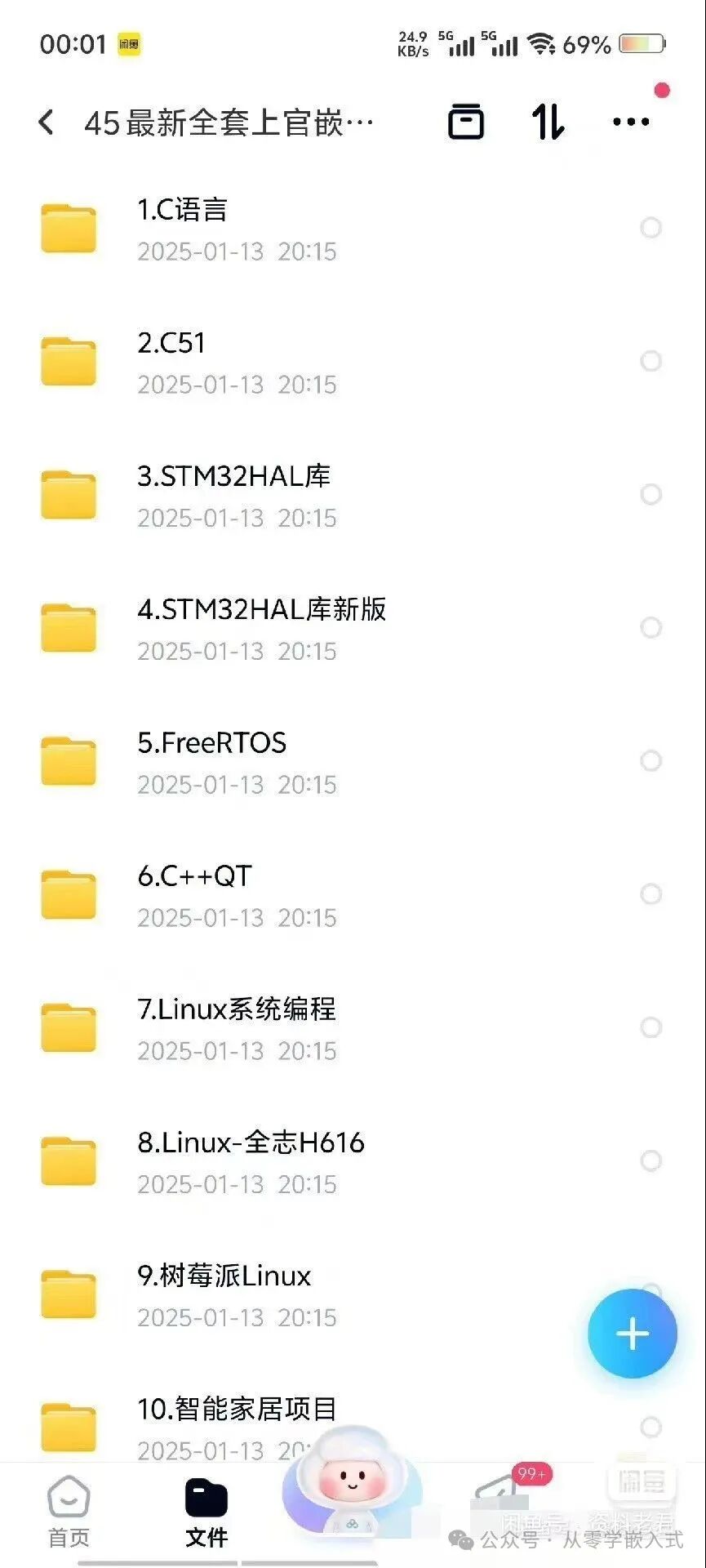
Next Issue: “Is Learning C Language Essential for Embedded Development? Core Syntax Quick Guide (Pointer Edition)”“