Sensors Lead the Intelligent Era
According to the national “14th Five-Year Plan” outline, sensors are listed alongside high-end chips, operating systems, and key algorithms of artificial intelligence as critical technologies for building a digital China. Sensors are known as the “eyes of the Internet of Everything,” capable of accurately measuring various information such as pressure, temperature, and concentration, serving as the source of data collection. As a detection device, a sensor can perceive the information being measured and can transform the sensed information into electrical signals or other required forms of information output according to certain rules, to meet the requirements for information transmission, processing, storage, display, recording, and control. Its working principle is shown in the figure below.
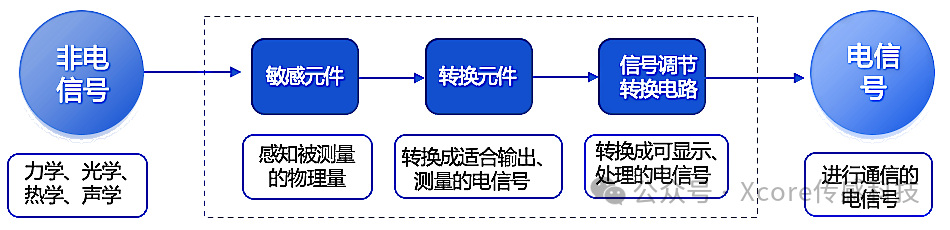
Figure 1 Sensor Working Principle
Components of a Sensor
Sensors typically consist of a sensitive element, a conversion element, and a conversion circuit (signal processing circuit).
——Sensitive Element is the core part of the sensor, responsible for sensing the physical quantity being measured. It usually employs a special material or structure, possessing high sensitivity, stability, and durability. The sensitive element can convert physical quantities such as temperature, humidity, pressure, and light intensity into electrical signals or other forms of signals. Common types include thermosensitive elements, photosensitive elements, and force-sensitive elements.
——Conversion Element is responsible for converting the signal output from the sensitive element (the measured physical quantity) into an electrical signal. Common types of conversion elements include resistive, capacitive, inductive, piezoresistive, photoelectric, piezoelectric, and electromagnetic sensors. The conversion principle and performance of the conversion element will directly affect the accuracy and stability of the sensor.
——Signal Processing Circuit is responsible for amplifying, filtering, and digitizing the electrical signals output from the conversion element. This improves the accuracy and stability of the signals, facilitating subsequent data processing and analysis. The signal processing circuit typically includes amplifiers (such as preamplifiers and main amplifiers), filters, and analog-to-digital converters. In addition to these three basic components, sensors may also include other auxiliary components, such as auxiliary power supplies, enclosures, and connecting wires, which help ensure the normal operation and stability of the sensor.
Classification of Sensors
Sensors can be classified in various ways.
ByMeasured Physical Quantity, including pressure sensors, displacement sensors, temperature sensors, humidity sensors, image sensors, light sensors, flow sensors, gas sensors, microphones, and inertial sensors (accelerometers, gyroscopes), etc.
ByWorking Principle, there are resistive, capacitive, inductive, piezoresistive, photoelectric, and electromagnetic sensors.
ByApplication Field, they can be divided into consumer electronics, automotive electronics, industrial electronics, and medical electronics sensors, with consumer sensors occupying the largest market share.
Development of Sensors
The global sensor technology has undergone years of development, which can be roughly divided into three generations.
The first generation isStructural Sensors, which utilize changes in structural parameters to sense and convert signals. Early structural sensors were represented by resistive sensors, mainly used in weighing applications. Resistive sensors measure by changes in the conductivity of metal materials; when pressure or weight is applied to the object, the deformation of the metal material leads to a change in resistance, which in turn causes a change in current. This type of sensor has a simple structure and low cost, becoming a mainstream product in the 1950s.
The second generation is the 70 developed Solid Sensors, which are composed of solid elements such as semiconductors, dielectrics, and magnetic materials, utilizing certain properties of materials, such as thermoelectric effect, Hall effect, and photosensitivity, to create thermocouple sensors, Hall sensors, and photosensitive sensors.
The third generation of sensors isIntelligent Sensors, which are products of the combination of microcomputer technology and detection technology. Intelligent sensors are multi-component integrated circuits with functions of information collection, processing, exchange, and storage, integrating sensors, communication chips, microprocessors, and software algorithms into a system-level product, characterized by high precision, high resolution, high reliability, high adaptability, and high cost-effectiveness. MEMS Sensors are representative of intelligent sensors.
Sensor Industry Chain
——Upstream of the Sensor Industry Chain includes materials and components, covering semiconductor materials, ceramic materials, organic materials, and metal materials. The upstream sensitive elements and conversion elements belong to the semiconductor industry chain, occupying a major part of the value chain, forming a division of labor pattern of design-manufacturing/contract manufacturing-packaging-testing. International leaders generally adopt the IDM (Integrated Device Manufacturer) production model, while domestic companies mainly focus on Fabless (without a wafer fab, only focusing on design) + contract manufacturing.
——Midstream of the Sensor Industry Chain involves the assembly of sensor modules, which need to package components into parts that are easy to install into systems, generally with enclosures, wiring harnesses, and other auxiliary components.
——Downstream of the Sensor Industry Chain refers to terminal devices, IoT system integration, consumer electronics, automotive electronics, industrial electronics, medical electronics, etc. Module assembly and terminal devices are in the mid to downstream, where domestic companies already have foundational advantages.
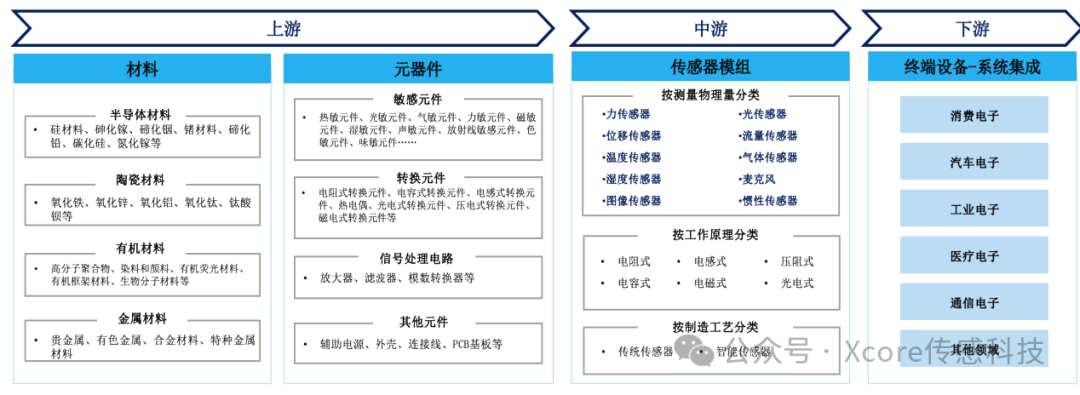
Figure 2 Sensor Industry Chain
★ Source:Xcore Sensor Technology ↑ Reprint must indicate the above source Statement: This article is for informational purposes only and is for reference only. If there are issues related to the content, copyright, and other matters, please contact us, and we will handle it immediately. If this article is reprinted on any platform, the responsibility lies with the reprinting party, and Xiangrun Instrumentation is not responsible for secondary dissemination caused by reprints.