1. Overview of IoT Platforms
The IoT platform is the core infrastructure for connecting, managing, and analyzing IoT devices, providing enterprises with end-to-end services from device access to data analysis. It serves as a bridge between the physical and digital worlds, supporting key operations such as device interconnection, data collection, remote control, and intelligent analysis.
1.1 Core Value of IoT Platforms
- Device Interconnection: Supports multiple protocols to achieve unified access and management of massive devices.
- Data Collection and Storage: Efficiently collects, stores, and manages time-series data, event data, and more from devices.
- Remote Control and Operations: Enables remote monitoring, configuration, upgrades, and fault diagnosis of devices.
- Data Analysis and Visualization: Provides real-time and historical data analysis and visualization capabilities for business decision-making.
- Security Assurance: Offers end-to-end security mechanisms to ensure the safety of devices and data.
2. Core Functional Modules of IoT Platforms
A complete IoT platform should typically include the following core functions:
2.1 Device Access and Management
- Supports various mainstream protocols (e.g., MQTT, CoAP, HTTP, LwM2M, etc.)
- Device registration, authentication, grouping, and lifecycle management
- Batch device access and remote configuration
2.2 Communication and Message Routing
- Efficient messaging middleware that supports message communication between devices and the platform, as well as between devices
- Topic/tag subscription mechanism for flexible data routing
2.3 Rule Engine and Event Processing
- Supports rule-based real-time data processing, event triggering, and linkage control
- Visual rule configuration for easier participation by business personnel
2.4 Data Storage and Management
- Supports various data storage methods such as time-series databases and relational databases
- Data compression, archiving, and partition management to reduce storage costs
- Data permissions and security management
2.5 Data Analysis and Visualization
- Real-time/historical data querying, aggregation, and statistical analysis
- A rich set of data visualization components and dashboards
- Supports integration with external analysis systems such as BI and AI
2.6 Application Development and Integration
- Provides open APIs and SDKs to support third-party application development
- Integrates with existing enterprise business systems (e.g., ERP, MES, SCADA, etc.)
- Supports low-code/no-code development tools
2.7 Operations and Monitoring
- Health monitoring, log management, and alert notifications for the platform itself
- Supports multi-tenant, distributed deployment, and elastic scaling
- Device firmware upgrades and remote maintenance
2.8 Security and Compliance
- Device identity authentication, data encryption, and access control
- Security auditing and compliance support
- Supports localized deployment and local data storage
3. Architectural Layers of IoT Platforms
A typical IoT platform architecture includes:
- Connection Layer: Device access and protocol adaptation
- Communication Layer: Message routing and data transmission
- Processing Layer: Rule engine, event processing, and data transformation
- Storage Layer: Various data storage methods for time-series data, relational data, etc.
- Analysis Layer: Data analysis and visualization
- Application Layer: Application development and business integration
3.1 Detailed Layered Architecture Diagram
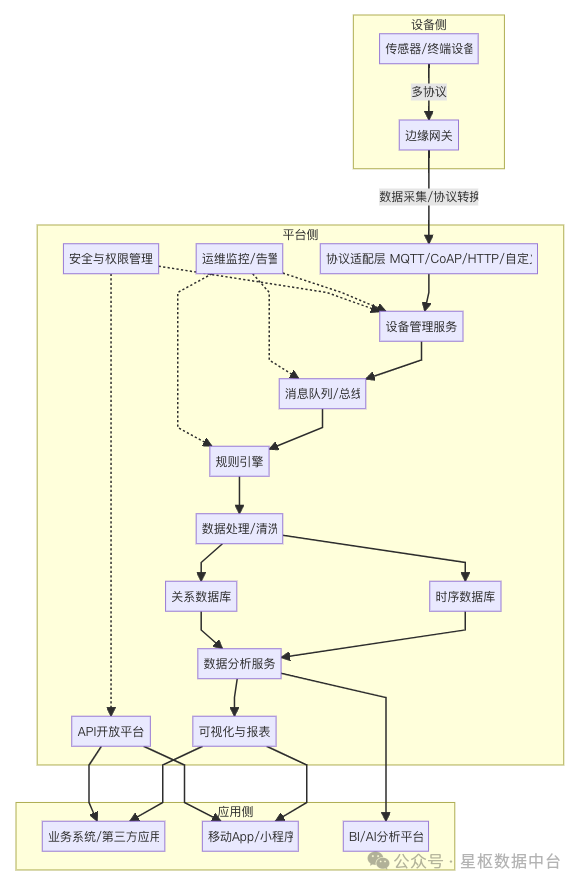
Note:
- Device side: Sensors and terminal devices connect to the platform through edge gateways, supporting multiple protocols.
- Platform side: Protocol adaptation, device management, message queues, rule engines, data processing, storage, analysis, visualization, APIs, operations, security, and other modules work together.
- Application side: Business systems, mobile clients, and BI/AI platforms obtain data and capabilities through APIs or data services.
3.2 Data Flow and Processing Flowchart
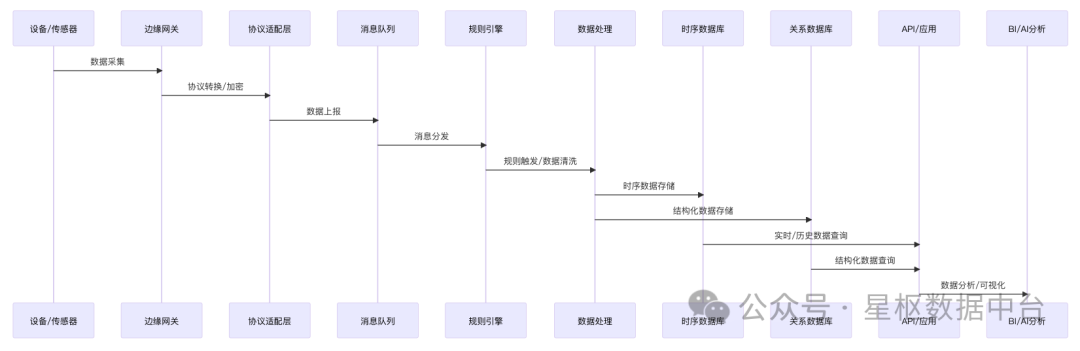
Note:
- Shows the complete data flow path from device data collection, protocol adaptation, message queues, rule engines, data processing, storage to API/BI analysis.
- Each step can be expanded into independent microservices or modules, facilitating elastic scaling and maintenance of the platform.
4. Industry Development Trends
- AIoT Integration: Deep integration of AI and IoT to achieve device intelligence and data intelligence
- Edge Intelligence: Computing power moving to the edge for lower latency and higher autonomy
- Digital Twin: Mapping and interaction between the physical and digital worlds
- 5G Empowerment: Massive connections and low-latency applications enabled by 5G networks
- Security and Compliance: Increasing demands for data security, privacy protection, and compliance
5. Conclusion
The IoT platform is a crucial infrastructure for enterprises’ digital transformation, and the completeness and usability of its core functions directly impact the success or failure of IoT projects. When selecting and building an IoT platform, enterprises should focus on the platform’s device access capabilities, data processing capabilities, openness, security, and operational capabilities to ensure that the platform can support current and future business development needs.
– END –