
Introduction
As autonomous driving systems advance to Level 3 and above, safety validation has become a core challenge in the industry. Traditional real-vehicle road tests are not only costly but also difficult to reproduce and cover all risk scenarios when dealing with extreme situations (Corner Cases) and systemic failures. Fault Injection Testing has emerged as a solution—by actively introducing controllable faults, it assesses the system’s fault tolerance and functional safety under failure modes such as sensor anomalies and data errors.
Among these, Image Fault Injection (IFI) is a specific method targeting image data in autonomous driving systems. The core of image fault injection is to artificially inject faults into the raw data stream from the camera, simulating sensor image anomalies or communication errors to test the response capability of the autonomous driving system’s perception module. The goal is to construct a closed loop of “fault modeling—injection—observation” to identify system vulnerabilities and quantify safety boundaries.
Image fault injection is a crucial part of the AI Li Guang HIL feedback testing solution. This article will explain how AI Li Guang’s feedback system automates the simulation of real driving image fault scenarios through hardware-software collaboration, assisting users in efficiently completing image system functional validation and performance optimization.
01
Software-Level Fault Injection: Focusing on Camera Image Quality Anomalies
Software-level fault injection primarily targets the images output by the camera, simulating various image quality issues through software algorithms to accurately reproduce anomalies that may occur during image acquisition and processing. The core is to directly intervene in the image data without relying on physical changes in the hardware link.
The AI Li Guang ALG HIL SYSTEM injection testing management software provides fault injection capabilities, allowing users to inject controllable faults into image data through a simple interface without programming or complex operations, enabling both novice users and experienced testers to quickly get started and efficiently validate the system’s fault detection and safety response mechanisms, thereby assessing functional safety performance.
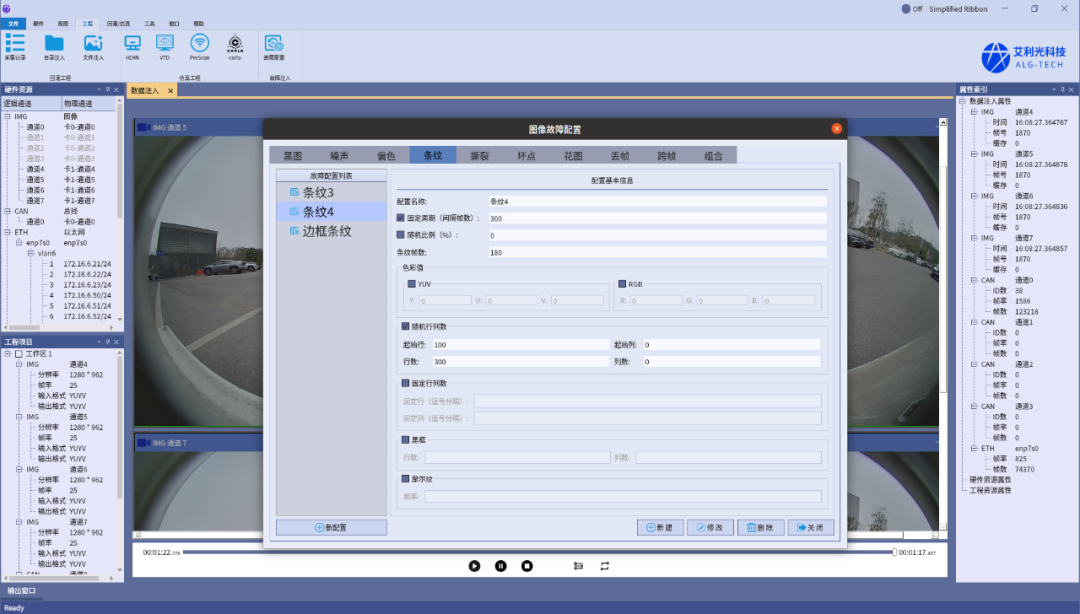
ALG HIL SYSTEM Image Fault Configuration Interface
ALG HIL SYSTEM supports 9 major categories of image fault injection, including black images, noise, color distortion, stripes, tearing, bad pixels, flower images, frame loss, and cross-frame; among which, for noise types, 8 types of detailed noise injections can be implemented, comprehensively covering various typical fault scenarios that may occur during image acquisition and transmission.
1. Black Image: Can simulate a completely black scene due to camera power failure or severe obstruction, supporting periodic or random triggering, allowing for the setting of continuous injection quantities and custom color values to meet diverse testing needs.
Random Color Black Image Fault Injection Effect
2. Noise: Provides 8 types of digital noise algorithms for injection, covering Gaussian noise, salt-and-pepper noise, Poisson noise, speckle noise, uniform noise, Rayleigh noise, gamma noise, and impulse noise, meeting the needs of different testing scenarios.
Gaussian Noise Injection Effect
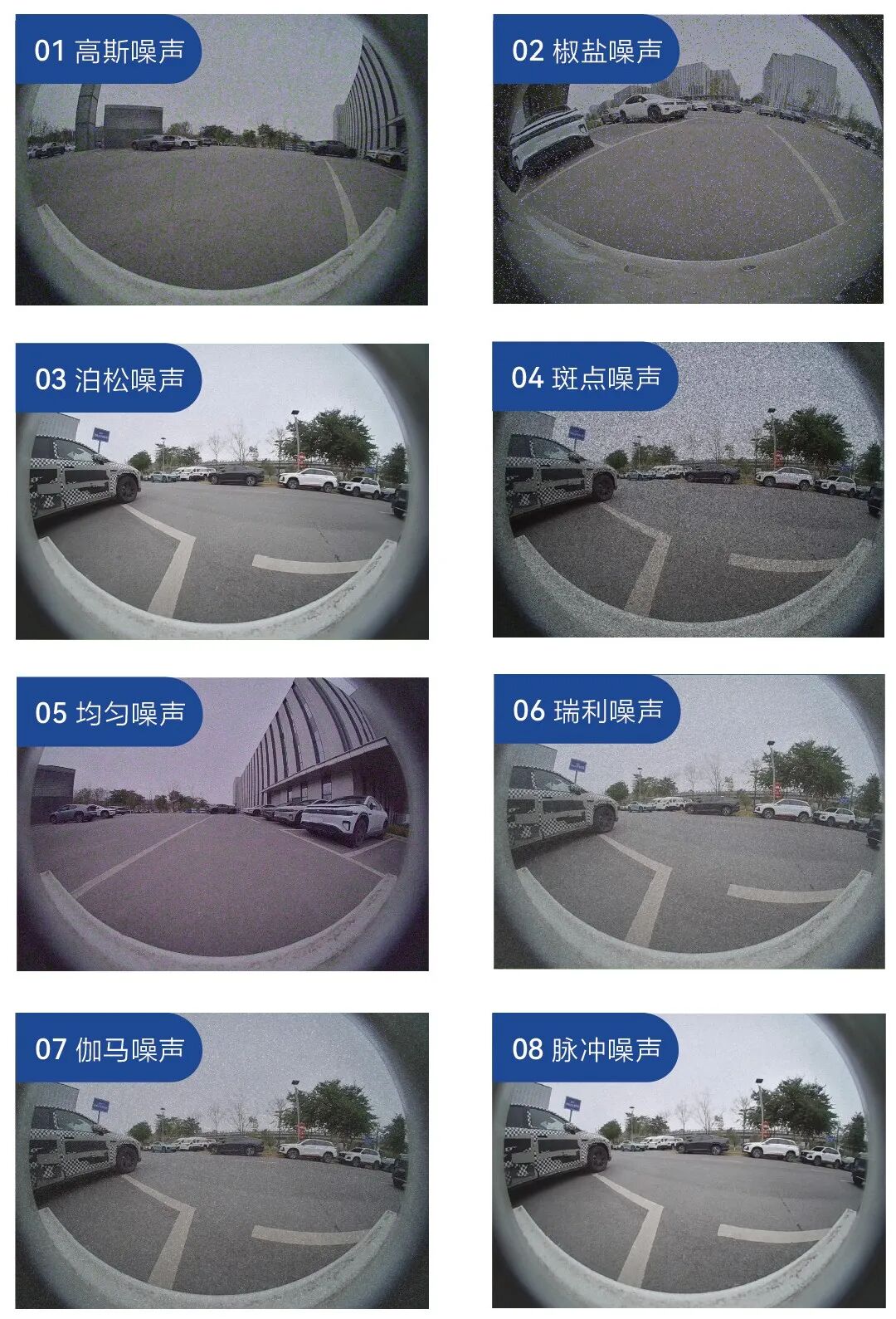
8 Types of Noise Fault Injection Effects
3. Color Distortion:Can achieve overall color tone shifts (e.g., reddish, bluish, etc.), supporting frame-by-frame settings, adjusting by adding/subtracting preset color values to meet fine testing needs.
Color Distortion Fault Injection Effect
4. Stripes: Supports periodic or random triggering, simulating black edges, fixed row and column stripes, and random row and column stripes with color values.
Random Color Value Stripes Fault Injection Effect
5. Tearing: Simulates screen tearing and misalignment caused by display or transmission errors, supporting single-region, multi-region half, and diagonal tearing effects.
Half Tearing Fault Injection Effect
6. Bad Pixels: Can configure the number of bad pixels to view effects, supporting the export and import of bad pixel locations in project configurations.
Bad Pixel Fault Injection Effect
7. Flower Image:Randomly scrambles pixel position data, resulting in large areas of color confusion, misalignment, or mosaic phenomena in the image.
Flower Image Fault Injection Effect
8. Frame Loss: Randomly or continuously discards video frames, simulating packet loss or processing delays during transmission.
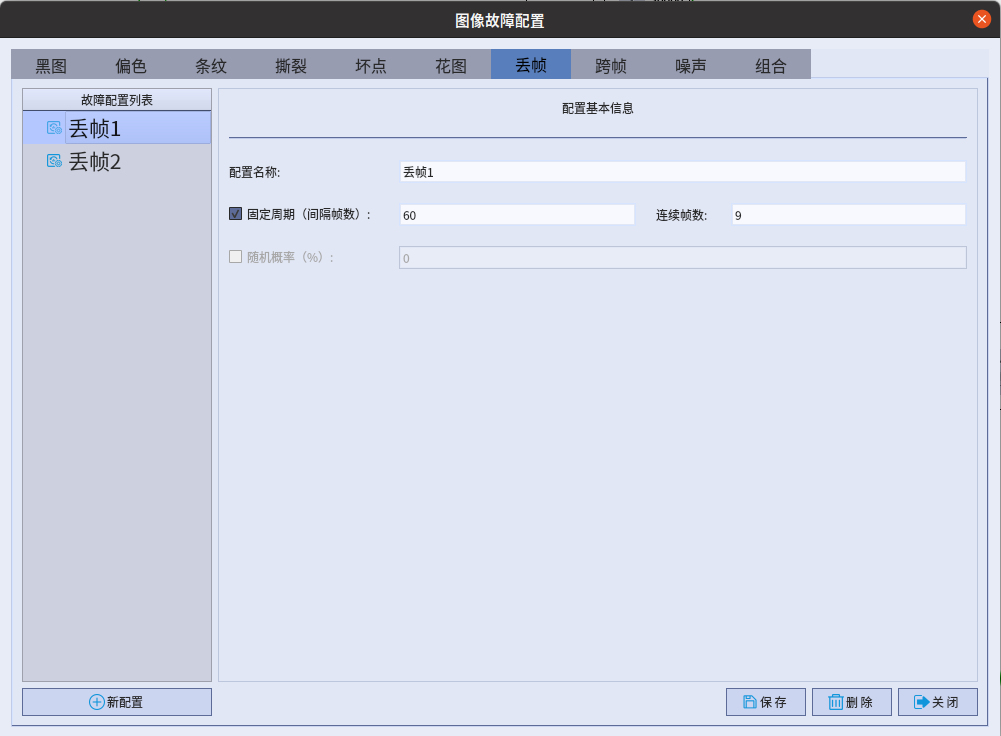
Frame Loss Fault Configuration Interface
9. Cross-Frame: Incorrectly mixes the image content of different frames for display.
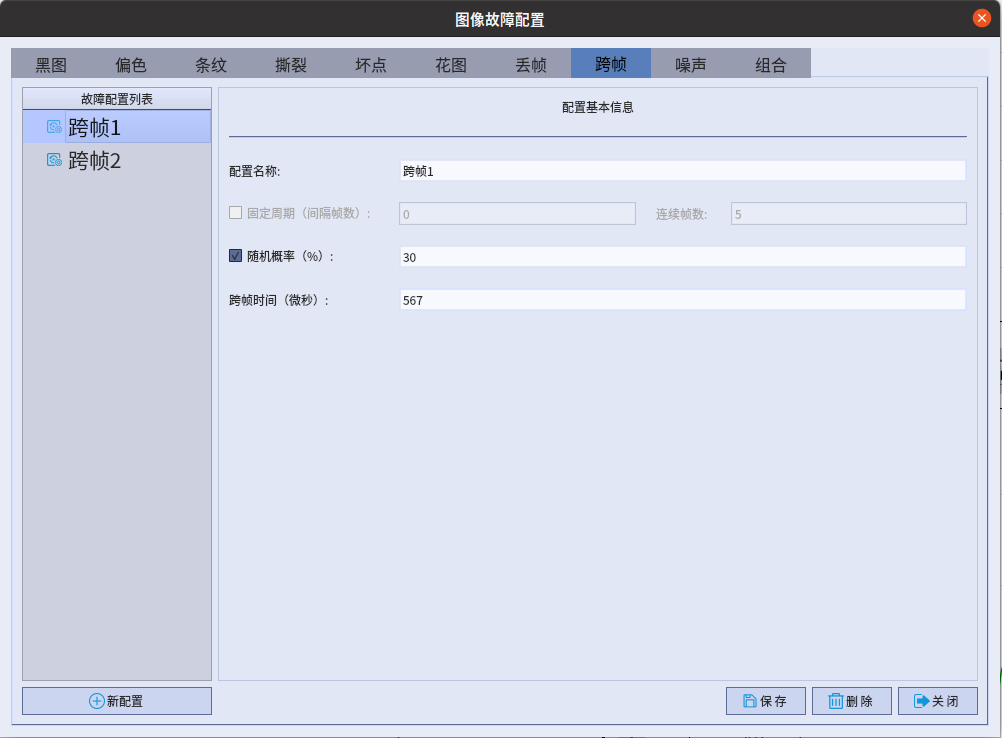
Cross-Frame Fault Configuration Interface
In addition, the ALG HIL SYSTEM also possesses powerful real-time dynamic testing capabilities, supporting real-time fault injection during system operation without interruption or reboot, significantly improving testing efficiency and scene authenticity; at the same time, users can dynamically adjust noise algorithm parameters (such as intensity, distribution, frequency) online, instantly observing changes in system responses, thus providing a more comprehensive and in-depth assessment of performance and problem localization, offering precise basis for optimizing the image system.
02
Hardware Communication Link-Level Fault Injection: Simulating GMSL Link Transmission Anomalies
Hardware communication link-level fault injection focuses on the image data transmission phase, targeting the physical communication links (such as MIPI CSI-2/GMSL) and their I²C control protocols between sensors and processing units (e.g., SoC), accurately reflecting the impact of link anomalies on image transmission by simulating physical or logical layer faults during the transmission process.
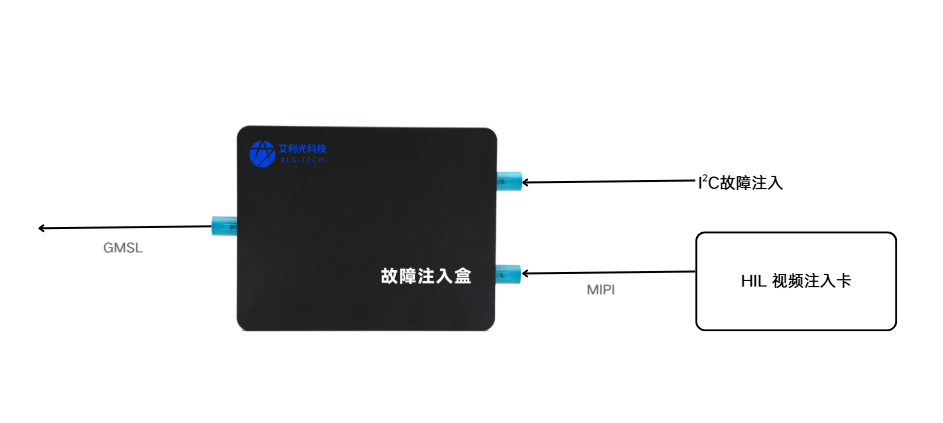
The dedicated fault injection box launched by AI Li Guang can indirectly and efficiently simulate GMSL link faults by injecting I²C faults or tampering with commands. The typical fault scenarios covered include:
-
Camera Stream Interruption: Simulates sudden interruption of the link leading to termination of image data transmission, used to test the system’s alarm mechanism and recovery capability after the link is disconnected.
-
Black Frame: Makes the transmitted image frame appear completely black, simulating effective image data loss due to signal attenuation or synchronization loss in the link.
-
Frame Loss: Controls random or periodic loss of transmitted image frames, reflecting data loss issues caused by insufficient link bandwidth or interference, testing the system’s ability to handle video stream continuity.
-
Stalling: Image frames experience stalling or repetition during transmission, simulating link congestion or hardware response delays, assessing the system’s fault tolerance for image stuttering.
-
Delay: Increases the transmission time of image frames from acquisition to reception, testing the system’s time synchronization and processing capabilities in scenarios with high real-time requirements.
-
Multi-Camera Desynchronization: Causes multiple cameras connected via GMSL link to output frame sequences with time differences, used to verify the synchronization mechanism of multi-camera collaborative systems and the stability of data fusion algorithms.
-
Calibration Anomalies: Simulates missing or incorrect calibration parameters, reflecting issues that may arise during the camera calibration process, used to test the system’s recognition, alarm, and fault tolerance capabilities under abnormal calibration parameters.
03
Hardware Electronic Load Fault Injection: Simulating Camera Power Supply Stress Testing
Hardware load fault injection is a method targeting the hardware connection layer in image system fault testing, simulating various connection faults that may occur during actual use of the camera by introducing external loads, thereby assessing the system’s stability and fault tolerance under abnormal hardware connections.
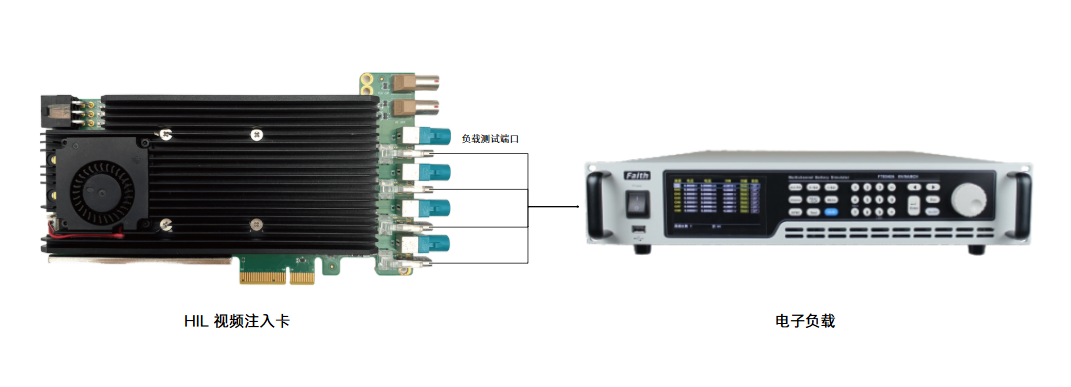
The AI Li Guang HIL video injection card integrates a load testing port, supporting connection to external electronic load devices, dynamically adjusting the power input (such as current, power, resistance) of the injection interface (Fakra interface), simulating various extreme or abnormal power supply conditions that may occur during real vehicle operation, such as voltage drops, high current surges, or insufficient power.
On this basis, further simulation injection of hardware faults can be achieved, accurately reproducing various image fault situations caused by abnormal power supply loads, providing a testing environment close to real working conditions for the R&D testing, performance optimization, and fault troubleshooting of autonomous driving systems.
Conclusion
The AI Li Guang HIL image fault injection solution, relying on hardware-software collaboration capabilities, provides strong support for the development of fault tolerance algorithms, diagnostics, and recovery mechanisms for autonomous driving vision systems, assisting developers in efficiently covering diverse image anomaly scenarios in laboratory environments, and accurately advancing the stability development of intelligent driving systems under complex real-world scenarios.

More about autonomous driving
↓ Click to learn more ↓
About AI Li Guang
Shenzhen AI Li Guang Technology Co., Ltd. is a high-tech enterprise providing professional image vision products and solutions for automotive autonomous driving, industrial automation, and other fields.
Relying on the founding team’s years of development experience and self-developed core technology capabilities, AI Li Guang Technology has developed three major product series: onboard visual sensors, image data acquisition systems, and simulation hardware closed-loop testing systems, providing a complete high-level autonomous driving testing data closed-loop solution and service, meeting the full process needs of R&D testing in the autonomous driving field.