According to a report by Electronic Enthusiasts Network (Author: Wu Zipeng), the strategy of “surrounding the city from the countryside” is a core strategic thought with distinct Chinese characteristics, referring to establishing a base in the difficult conditions of rural areas, gradually accumulating strength, and ultimately seizing large cities and achieving greater victories. In recent years, RISC-V has been developing in the industry like the strategy of “surrounding the city from the countryside”.At the fifth RISC-V China Summit, Hu Zhenbo, founder of Chiplet Technology, stated in an exclusive interview with Electronic Enthusiasts Network: “In the past few years, RISC-V has rapidly risen in vertical fields due to its open standards, showing potential in scenarios such as IoT, automotive, and AI, and has formed a significant influence in the ‘countryside’, but this is far from enough.”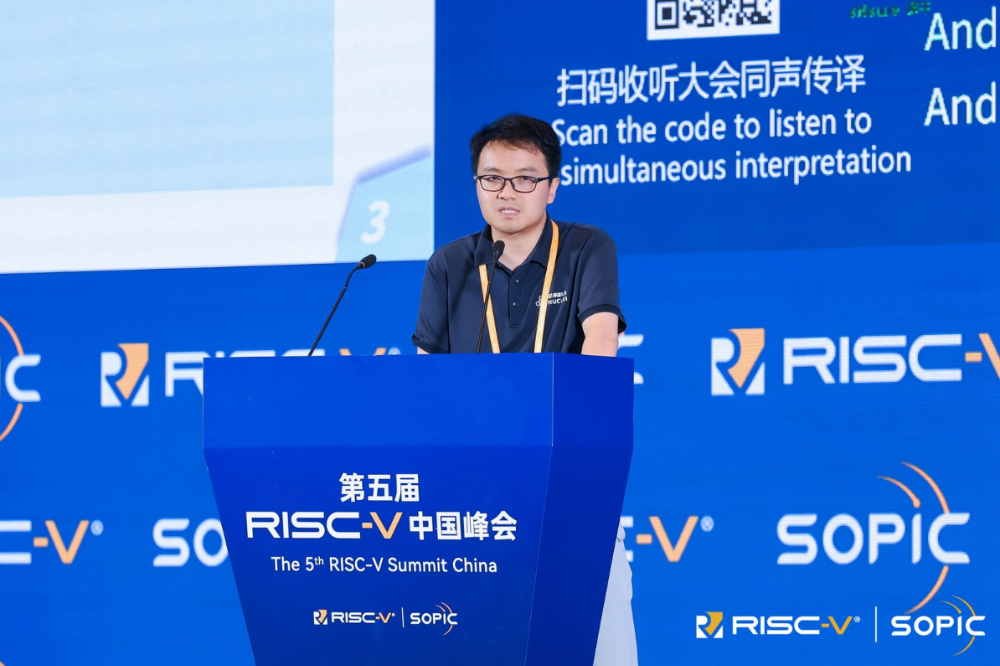 Hu Zhenbo, founder of Chiplet TechnologyChiplet Technology was established in 2018 and has been focusing on the research and development of RISC-V CPU IP and corresponding platform solutions, representing the local RISC-V field. Currently, over 300 domestic and international officially authorized customers are using Chiplet Technology’s RISC-V CPU IP, covering multiple fields such as AI, automotive electronics, 5G communication, cybersecurity, storage, industrial control, MCU, and IoT. Therefore, in the process of RISC-V implementation, Chiplet Technology’s IP and solutions have played an important role. With the release of the latest processor IP products such as the UX1030H supporting the RVA23 Profile, RISC-V will further move towards the general market.
Vertical fields should not be the mainstream route for RISC-V development
According to SHD Group’s forecast, by 2031, the global shipment of RISC-V based SoC chips will reach 20 billion units, accounting for 25% of the global market share. At that time, RISC-V’s share in six major fields: consumer, computing, automotive, data centers, industrial, and networking will exceed 26%, with the consumer market share reaching as high as 39%.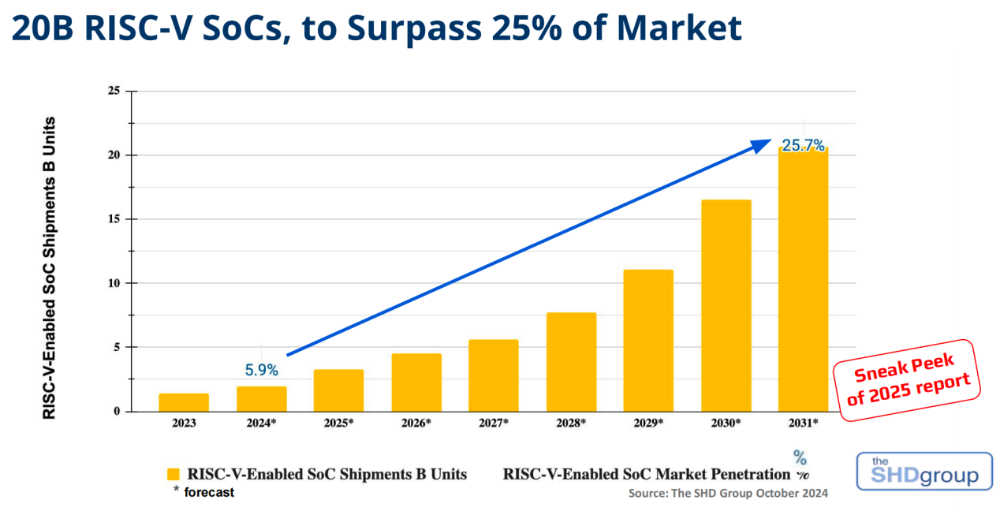 Image source: RISC-V InternationalHu Zhenbo pointed out that compared to proprietary architectures like x86 and ARM, RISC-V has the advantages of being open, streamlined, scalable, and low-cost. However, RISC-V will not replace x86 and ARM, but will ultimately form a “tripartite division” pattern, becoming an important pillar of industry development.The RISC-V instruction set architecture (ISA) needs to be converted into commercially viable hardware through CPU IP, so IP is the starting point for RISC-V commercialization. Currently, Chiplet Technology has developed four general CPU IP product lines: N/U, NX/UX, and three vertical CPU IP product lines: NS, NA, NI, covering all scenarios from low power to entry-level high performance.
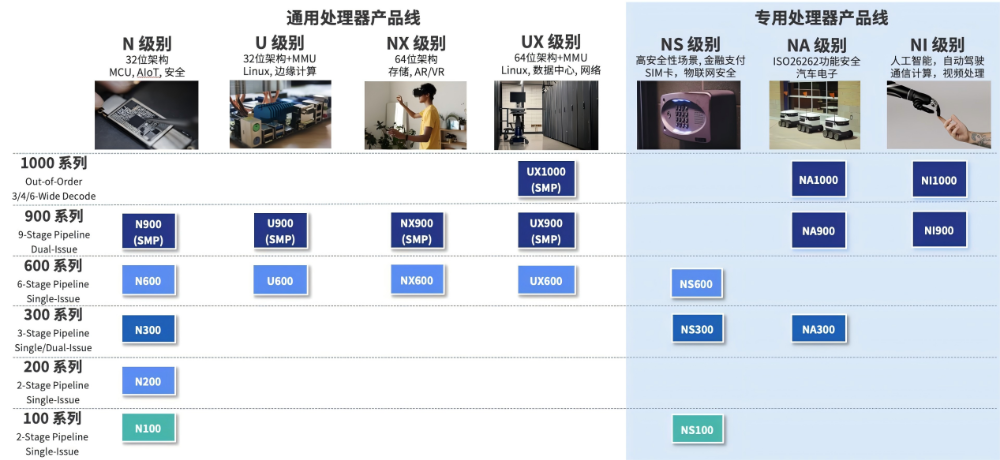 Image source: Chiplet TechnologyHu Zhenbo believes that the IP business needs to cover all scenarios, similar to a “restaurant menu” that meets diverse needs. After 7 years of development, Chiplet Technology has become one of the global suppliers with the most comprehensive IP shelf. Currently, in the vertical scenarios of information security, automotive electronics, functional safety, and artificial intelligence, Chiplet Technology has achieved relatively leading results relying on its self-developed system and engineering methodology.RISC-V is easier to implement in vertical scenariosbecause the software ecosystem in vertical fields is strongly closed, and the demand is relatively clearer, which is more conducive to RISC-V’s implementation. Chiplet Technology has many representative IP products in vertical fields, such as the NA900 automotive-grade processor, which is the world’s first RISC-V CPU IP to pass ISO26262 ASIL-B/D product certification, providing self-developed STL to meet different usage scenarios of ASIL-B; the NI900, based on the 900 series processor, has undergone multiple feature optimizations for AI applications and has been adopted by several domestic AI chip companies.However, Hu Zhenbo stated that while RISC-V IP in vertical fields is highly recognizable, the ecological effect and market capacity are limited, and it should not be mistakenly regarded as the mainstream development path of the RISC-V industry. The RISC-V industry still needs to vigorously develop “general RISC-V CPU IP”. The so-called “general RISC-V CPU IP” refers to CPU IP with standardized interfaces and general specifications that can be applied across fields, rather than being limited to a specific industry or application. In the general RISC-V CPU IP market, Chiplet Technology’s IP also has strong competitiveness, capable of covering low power, high efficiency, high performance, and ultra-high performance scenarios, as follows:
- Low power scenarios:Since its establishment, Chiplet Technology has been rooted in the low power field, where the 100 series is one of the smallest RISC-V cores in the world; the 200 series is the world’s first general-purpose MCU based on RISC-V; the 300 series is the most widely used and feature-rich low power core from Chiplet.
- High efficiency scenarios:In recent years, Chiplet Technology’s focus has been on the high efficiency field, with the 600/900 series being the best-selling RISC-V CPU IP from Chiplet, featuring rich configurable characteristics, including support for Linux, multi-core, dual-mode, Vector, etc.
- High performance scenarios:The recently released 1030H is one of the earliest RISC-V commercial CPU IPs to support RVA23; the 1000 series will fully support the RVA23 Profile, with the 1040H and 1060H being released successively.
- Ultra-high performance scenarios:Chiplet’s 2000 series is currently in the research and development stage for the server field.
Hu Zhenbo stated that from the perspectives of market capacity, customer base, lifecycle, and ecological construction, general RISC-V CPU IP is undoubtedly a more sustainable and scalable market direction. Overall, the current major general chip market is still dominated by ARM architecture, and RISC-V still has vast growth potential.In addition to CPU IP, Chiplet Technology has also launched a subsystem model, elevating the IP licensing model to a SoC subsystem customization and licensing model. The subsystem model no longer offers individual CPU IP or independent SoC IP to customers, but a complete SoC subsystem. The subsystem model basically encompasses 80% of the common work in SoC front-end, allowing SoC design companies to only need to do 20% of their own parts, such as integrating third-party or proprietary IP, IO, PLL, process integration (SRAM, IO, PLL, PMU, analog), etc.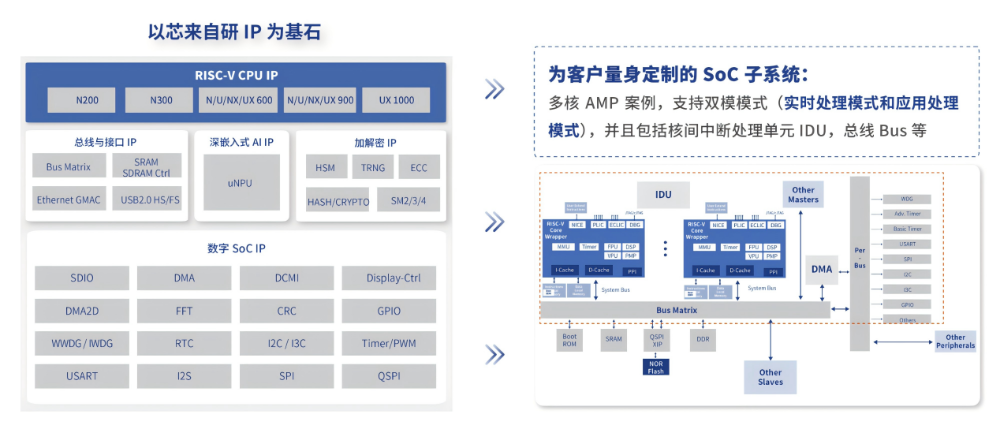 Image source: Chiplet TechnologyHu Zhenbo stated that the richness of self-developed IP is the foundation for Chiplet Technology to launch the subsystem model. In addition to leading the industry in the maturity and richness of RISC-V CPU IP, Chiplet Technology also has 40-50 types of proprietary peripheral IP. The subsystem model is an efficient SoC development model that helps design companies reduce development thresholds, cycles, costs, and risks. At the same time, the subsystem model does not force binding customers, preserving differentiation space for customers.
The Milestone Significance of the RVA23 Profile Launch
The open architecture characteristics of RISC-V make it a collaborative platform for global developers and enterprises. Compared to the proprietary architectures of x86 and ARM, RISC-V lowers technical barriers through open standardization, attracting a large number of IP suppliers, chip manufacturers, and developers to participate.In vertical scenarios (such as automotive and AI), the ecosystem focuses on development tools, operators, and security mechanisms. RISC-V’s open architecture allows manufacturers to customize extensions based on its instruction set (such as dedicated operators for AI chips and security instructions for automotive chips) to adapt to differentiated needs in different scenarios. From the current industrial status, the RISC-V ecosystem in vertical fields has accelerated its implementation through collaborative synergy in the industrial chain, engineer cognition, and market education.Hu Zhenbo believes that in the RISC-V field, discussing the ecological construction achievements of a single manufacturer is a “pseudo proposition”; the accurate statement is that a single enterprise has contributed its strength to the construction of the RISC-V ecosystem. The characteristics of RISC-V ecosystem construction are “many hands make light work”. For example, in the automotive field, the launch of Chiplet’s NA900 automotive-grade processor IP has verified the technical feasibility, boosted confidence in the industrial chain, making automotive-grade one of the three hotspots for RISC-V; at the same time, the foundation’s official website lists automotive-grade as one of the core directions, further consolidating ecological resources and promoting RISC-V automotive technology from technical verification to commercial mass production. Therefore, the RISC-V ecosystem is shared, with no differentiated barriers; the real barrier depends on the competitiveness and commercialization capabilities of each company’s proprietary products.At the same time, he emphasized that ecological construction is divided into “strong software compatibility ecosystem” and “general ecosystem”. RISC-V is currently focused on the “general ecosystem” and has achieved certain results. However, in the general processor field, RISC-V needs to adapt to a strong software compatibility ecosystem, which will have higher requirements for operating system support, binary compatibility, and developer toolchains.In recent years, the performance of IP based on RISC-V architecture has rapidly improved, and RISC-V general processor core IP has already matched ARM architecture’s Cortex-A72 or Cortex-A76. However, large operating systems need to achieve multi-task layering and virtual machine operation through virtualization, while the RISC-V architecture has long lacked standardized definitions for this functionality. In October 2024, RISC-V International announced that the RVA23 Profile Standard has been approved. The RVA23 Profile is an important standard for the RISC-V software ecosystem aimed at 64-bit high-performance general processor scenarios, clearly requiring processors to support key extensions including Hypervisor and Vector. As RISC-V International CEO Andrea Gallo stated: “Software vendors need portability to reduce development and maintenance costs and enable them to successfully sell software and services across various RISC-V products. The approval of RVA23 makes all this possible.”After the launch of the RVA23 Profile, it received positive responses from software ecosystem partners such as Ubuntu, Google, and Red Hat. For example, one of the major Linux distributions, Ubuntu, plans to update the access threshold for RISC-V processors from the previous RVA20 configuration to the latest RVA23 in its upcoming major version 25.10. Hu Zhenbo pointed out: “The launch of the RVA23 Profile will reduce the fragmentation of application processor (AP) level high-performance RISC-V chips, becoming a landmark progress in the industry and laying the architectural foundation for running systems like Linux and Android.”In June 2025, Chiplet Technology will launch its next-generation high-performance processor IP – UX1030H. Chiplet’s UX1030H is one of the earliest RISC-V CPU IP series to support the RVA23 Profile. This product strictly adheres to the RVA23 Profile specifications, fully supports virtualization and vector computing extensions, and further provides support for IOMMU and AIA (Advanced Interrupt Architecture), targeting new generation high-security and high-scalability application scenarios, marking a key step for domestic RISC-V high-performance processor IP in ecological integration and system adaptation capabilities.Hu Zhenbo concluded: “Currently, RISC-V implementation is abundant in vertical scenarios, but insufficient in general scenarios. The construction of a general software ecosystem requires larger-scale investment and further collaboration across the industry to conquer the strategically valuable ‘big cities’. The breakthrough of the RISC-V ecosystem in the true sense requires large-scale applications of RISC-V in general MCUs, MPUs, APs, CPUs, and other core computing platforms.”From his description, it is not difficult to see that the current RISC-V ecosystem construction and commercial implementation are still in the early stages. On one hand, RISC-V still has significant growth potential; on the other hand, RISC-V’s development requires a long-term mindset, avoiding short-sighted thinking.

Disclaimer:This article is original by Electronic Enthusiasts Network, please indicate the source above when reprinting. For group communication, please add WeChat elecfans999. For submission, interview requests, please send an email to [email protected].
More Hot Articles to Read
-
AI glasses are crazy! Meta and Xiaomi are competing, Hengxuan invests 150 million, brain-machine technology is also coming
-
Your phone is listening! The Ministry of National Security exposes that foreign chips may hide “backdoors”
-
OpenAI throws out a “big bomb”: an app can overturn the entire office, ASIC begins to counterattack GPU?
-
Net profit surged by over 100% in half a year! Domestic chips are making money in AI beyond GPUs
-
Another milestone in the RV ecosystem: NVIDIA announces CUDA will be compatible with RISC-V architecture!
Click to Follow and Star Us
Set us as a star to not miss any updates!