
With the rapid development of technologies such as big data and artificial intelligence, data-related majors have become one of the hottest fields of study today. This article will provide a comprehensive analysis for students preparing for the college entrance examination regarding the selection of data-related majors, curriculum design, and future career development paths, helping those aspiring to enter this field make informed academic plans.
01 Overview of Data-Related Majors
We are in an era reshaped by data. From the first news push on our phones in the morning to the sleep monitoring on smartwatches at night, data is everywhere. According to the latest statistics, the global data volume is increasing at an annual rate of about 30%, and it is expected to reach an astonishing 175ZB (zettabytes) by 2025. This flood of data has created a huge demand for data professionals, making data science, big data technology, data governance, and data analysis some of the most sought-after choices in higher education.
Data-related majors typically cover the following main directions:
-
Data Science and Big Data Technology: This is the core direction of data-related majors, focusing on how to extract valuable information from massive datasets. Courses include advanced programming languages, Python programming, data structures, data mining techniques and applications, big data analysis, and in-memory computing. Students will master the full process of big data collection, preprocessing, storage, processing, analysis, and visualization, cultivating the ability to solve complex engineering problems using big data.
-
Data Governance: This is a relatively new but crucial field that focuses on data quality control, compliance management, and security assurance. Learning content includes the basic theories of data governance, laws and regulations, industry standards, as well as knowledge about data openness and sharing, property rights transactions, and security protection. With the implementation of the “Data Security Law” and the “Personal Information Protection Law,” the demand for data governance professionals is becoming increasingly urgent.
-
Data Analysis: This direction leans towards the practical application of data, training students to use statistical methods and professional tools for data insights. Related courses include statistical analysis, machine learning, and data visualization. Graduates in this direction can enter almost any industry, as modern business decisions increasingly rely on data-driven insights.
-
Computer Science and Technology: As the foundational discipline for data-related majors, it provides core skills in programming, database management, and algorithm design. Although it does not focus specifically on data, it provides the necessary technical support for data work.
Students choosing these majors typically need a solid foundation in mathematics, good logical thinking skills, and some interest in programming. Under the new college entrance examination model, most students applying for these majors need to select physics and chemistry subjects. It is worth noting that different institutions may place data-related majors under different colleges, such as the College of Computer Science, College of Statistics, or Business School, reflecting the varying educational focuses of each institution, which candidates should carefully consider when making their choices.
02 Hierarchy of Institutions Offering Data-Related Majors
Choosing the right university is the first step towards success in the data field. There are many institutions in China offering data-related majors, with varying strengths, which can be roughly divided into several tiers. Understanding these tiers can help candidates make optimal choices based on their scores and interests.
First Tier: World-Renowned Top Universities
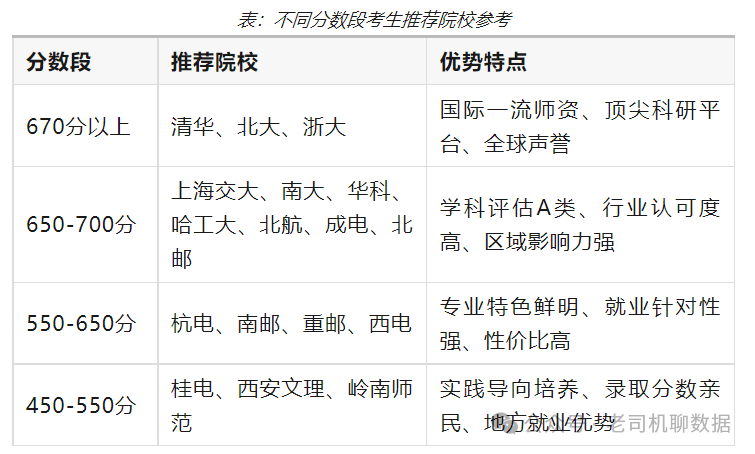
The top universities in the field of data science in China are Tsinghua University, Peking University, and Zhejiang University, all of which received the highest rating of A+ in the fourth round of discipline assessment for computer science and technology.
-
Tsinghua University: A global benchmark for computer science and technology, it surpassed MIT to rank first in the world in the 2018 U.S. News & World Report rankings. Tsinghua has world-class faculty and research conditions, and its research in artificial intelligence and big data processing is at the international forefront. The computer science program at Tsinghua was established in 1956, has a long history, and has trained a large number of industry leaders and academic masters.
-
Peking University: Leveraging a strong foundation in mathematics (ranked first nationally) and geographical advantages, the College of Computer Science at Peking University, although established later, has developed rapidly. As a “Double First-Class” discipline, the computer science program at Peking University maintains close cooperation with international institutions such as Harvard University and the Hong Kong University of Science and Technology, providing students with a broad international platform.
-
Zhejiang University: The computer science discipline ranks in the top 0.1% globally in ESI rankings, at 22nd in the world, and has a national key laboratory for CAD & CG. The computer science college at Zhejiang University has received over 750 million yuan in research funding in the past three years and has produced outstanding talents, including several academicians. The Turing class at the Zhuke College is the most prestigious computer experimental class in East China.
The admission scores for these three universities typically require scores above 670, making them suitable for the top candidates from each province. Graduates are highly competitive whether they continue their studies or enter the industry.
Second Tier: Strong 985 Universities
For candidates with scores between 650-700, the following universities with strong computer science and data science programs are worth considering:
-
Shanghai Jiao Tong University: The computer science program is housed within the strong School of Electronic Information and Electrical Engineering, with ample research funding and notable research in intelligent computing and big data systems. The ACM class at the Zhiyuan College is well-regarded among southern universities.
-
Nanjing University: Home to the only “National Key Laboratory of New Computer Software Technology” in East China, it has a unique position in software research. Nanjing University has a deep accumulation in theoretical computer science and data algorithms.
-
Huazhong University of Science and Technology: The alma mater of WeChat’s father, Zhang Xiaolong, its computer science program is a top discipline with multiple key laboratories. Graduates from Huazhong University are highly sought after by internet companies, and the alumni network is strong.
-
Harbin Institute of Technology: One of the earliest universities to offer computer science in China, it has made significant achievements in computer system architecture and embedded systems. Harbin Institute of Technology is highly recognized in the northern job market.
-
Beihang University: Established a computer research office in 1958, both computer science and technology and software engineering are “Double First-Class” disciplines. Graduates from Beihang University have significant advantages in postgraduate studies and studying abroad.
-
University of Electronic Science and Technology of China: A member of the “Two Electronics and One Post” group, its computer science discipline ranks in the top 0.379% globally in ESI rankings, with strong capabilities in information security. It is known as the “Huangpu Military Academy of the IT industry,” with a supply-demand ratio of 1:10 for graduates.
-
Beijing University of Posts and Telecommunications: Ranked first in information and communication engineering nationally, its computer college has an employment rate close to 100%, having trained well-known scholars such as Fang Binxing, the father of the “Internet Firewall.” BUPT has unique advantages in civilian internet research.
Third Tier: Key Universities with Distinctive Specialties
For candidates with scores between 550-650, the following universities with distinctive specialties are worth considering:
-
Hangzhou Dianzi University: Although not a 211 university, it has a strong computer science program and is known as the “Cradle of IT Entrepreneurs,” with a high proportion of alumni in the top 100 IT companies nationwide. Hangzhou Dianzi University performs particularly well in the job market in Zhejiang Province.
-
Nanjing University of Posts and Telecommunications: A Double First-Class university, its computer science program ranks highly in global ESI rankings, with outstanding research advantages in information science. Nanjing University of Posts and Telecommunications emphasizes cultivating students’ practical innovation abilities.
-
Chongqing University of Posts and Telecommunications: Originally a university directly under the Ministry of Posts and Telecommunications, it specializes in information technology education, with graduates mainly entering companies like ZTE and Huawei. Chongqing University of Posts and Telecommunications holds an important position in the IT job market in Southwest China.
-
Xi’an University of Electronic Science and Technology: Established its computer science program in 1958, it is one of the first three universities in the country to offer this major, with a prestigious reputation in electronic information technology. Graduates from Xi’an University of Electronic Science and Technology have traditional advantages in the military and communications fields.
Fourth Tier: Cost-Effective Applied Universities
For candidates with scores between 450-550, there are also many quality options:
-
Guilin University of Electronic Technology: Originally a university directly under the Ministry of Electronics Industry, its computer science program ranks among the top in the country, with relatively accessible admission scores. Guilin University of Electronic Technology has a good employment reputation in the Pearl River Delta region.
-
Xi’an University of Arts and Science, Baoji University of Arts and Science: Their computer-related majors are provincial-level first-class programs, with admission scores as low as 444. They are suitable for candidates with limited scores but who wish to receive professional education.
-
Lingnan Normal University: Offers a major in data science and big data technology, adopting a “teacher-led + interest-driven + technological innovation” training model, with students winning awards in national computer design competitions multiple times. The university places special emphasis on practical ability cultivation.
When choosing a university, candidates should not only consider the strength of the major and the match with their scores but also pay attention to the geographical location of the school. Universities in provincial capitals and first-tier cities usually have richer corporate resources and internship opportunities. For example, Shenzhen University, although not a traditional strong school, benefits from Shenzhen’s innovation atmosphere and industrial environment, establishing close cooperation with companies like Huawei and Tencent, providing students with significant advantages in internships and employment.
03 Core Courses and Skill Requirements
Choosing the right university and major is just the first step; understanding the specific learning content and skill requirements of data-related majors is equally important. Different directions of data majors have their own focuses in course design, but all emphasize the cultivation of mathematical foundations, programming abilities, and practical experience. Below, we will analyze the core course systems of several typical majors.
Course System for Data Science and Big Data Technology Major
As the most mainstream data-related major, data science and big data technology typically includes the following core courses:
-
Programming Fundamentals: Includes advanced programming languages (usually C or Java), object-oriented programming, and Python programming. Python has become an essential tool for data scientists due to its rich data processing libraries.
-
Mathematical Foundations: Discrete mathematics, linear algebra, probability theory, and mathematical statistics are the mathematical foundations supporting data science. Courses in data analysis and scientific computing teach how to apply mathematical methods to real-world problems.
-
Data Processing Technologies: Courses in data structures, database systems, and big data technologies cultivate students’ abilities to handle large-scale data. Students will learn mainstream big data processing frameworks such as Hadoop and Spark.
-
Analysis and Mining: Courses in data mining techniques and applications, machine learning, etc., teach algorithms and methods for extracting knowledge from data. This includes classic data mining tasks such as classification, clustering, and association analysis.
-
Visualization and System Design: Data visualization technology courses cultivate students’ abilities to transform complex data into intuitive charts; algorithm analysis and design enhance students’ systematic thinking in solving computational problems.
The data science and big data technology major at Lingnan Normal University adopts a training model of “teacher-led + interest-driven + technological innovation + data-driven development,” allowing students to participate in various technological innovation projects and academic competitions starting from their sophomore year. This theoretical and practical combination is becoming increasingly common in applied universities.
Characteristics of Data Governance Major Courses
Data governance is a new direction that has emerged with the improvement of data security regulations, and its course design has distinct characteristics:
-
Theoretical Foundations: Learning the basic concepts, frameworks, and operational logic of digital governance, understanding the connotations and development prospects of digital government, digital society, and digital economy.
-
Integration of Technology and Management: Includes courses on infrastructure such as data warehouses and data pipelines, as well as management content like data quality management and metadata management.
-
Legal Regulations: The legal regulations and industry standards of data governance are specialized courses, including compliance content such as the Data Security Law and the Personal Information Protection Law.
-
Security and Ethics: Courses in cryptography, network security, and system security ensure technical safety; at the same time, through ideological and political education resources, emphasize data ethics and social responsibility.
Data governance practical training courses typically adopt case-based teaching and project-driven methods. Students are required to complete the entire process from project planning, requirement analysis to solution design and implementation, cultivating the ability to solve practical data governance problems. A practical training course may include 20 class hours, with 6 hours specifically dedicated to data governance practical projects, reflecting the emphasis on practical components.
Key Courses in Data Analysis-Related Majors
Data analysis, as the most widely applied data skill, has different focuses in different majors:
-
Statistical Direction: Emphasizes statistical modeling, hypothesis testing, regression analysis, and other traditional statistical methods, suitable for candidates wishing to engage in finance and market analysis.
-
Business Analysis Direction: Combines management and marketing knowledge, training students to apply data analysis to business decision-making.
-
Industry Application Direction: Such as healthcare data analysis, educational data mining, etc., requiring knowledge of specific industry business.
To become excellent data professionals, classroom learning alone is far from sufficient. According to industry demands, successful data professionals typically possess the following combination of abilities:
-
Technical Skills: Proficient in at least one programming language (Python/R/Java), SQL database query language, and commonly used big data tools; understanding machine learning algorithms and statistical modeling methods.
-
Business Understanding: Ability to translate business problems into data problems and use analysis results to guide decision-making. This requires accumulating industry knowledge and business sensitivity.
-
Communication Skills: Ability to clearly explain analysis results to non-technical personnel, with data visualization skills being particularly important.
-
Continuous Learning: The data field is rapidly evolving, requiring a passion for learning to keep up with technological developments.
For incoming freshmen in data-related majors, it is recommended to:
-
Strengthen Mathematical Foundations: Especially in probability statistics, linear algebra, and other core mathematical tools for data science.
-
Start Programming Practice Early: Accumulate practical coding experience by participating in open-source projects or small projects of personal interest.
-
Participate in Competitions and Internships: Competitions like the China College Student Computer Design Competition can rapidly enhance skills; internships provide opportunities to work with real business data.
-
Cultivate Interdisciplinary Perspectives: Data science is an interdisciplinary field, understanding related areas such as business and social sciences can enhance employability.
Studying data-related majors is both challenging and enjoyable. Students need to cultivate patience and attention to detail when facing massive amounts of data; discovering hidden patterns and values within the data can lead to a tremendous sense of achievement. As their studies progress, most students will gradually find their most interesting directions, such as graphics, natural language processing, or predictive modeling.

04 Career Prospects and Employment Directions
Choosing data-related majors is not only based on interest in technology but also on rational judgment of career prospects. With the wave of digital transformation sweeping across various industries, the demand for data professionals is experiencing explosive growth. Understanding the employment prospects and specific positions in this field can help students prepare more targetedly during their university years.
The big data industry is experiencing unprecedented rapid growth. According to statistics, it is expected that by 2025, the scale of China’s big data-related industry will exceed 3 trillion yuan, with the demand for professionals continuing to grow at a rate of 30%-40%, reaching an astonishing total demand of 10 million. This figure fully reflects the market’s thirst for data professionals.
From a global perspective, the growth rate of data volume is equally astonishing—approximately 30% annually, with the total global data expected to reach 175ZB (zettabytes) by 2025. Such a vast data resource requires professionals for management and analysis, creating ample opportunities for data practitioners.
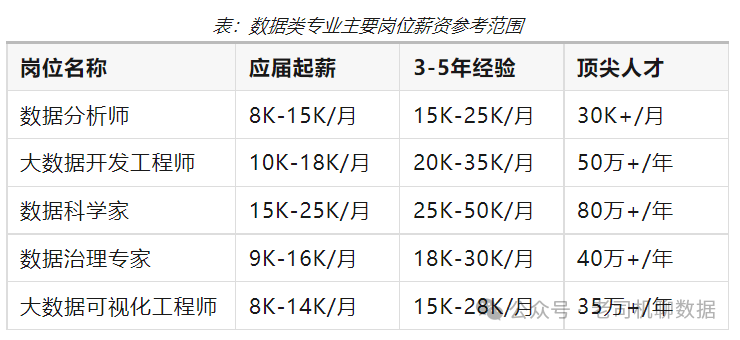
In terms of salary, data positions generally offer higher compensation than other technical positions. Market surveys indicate that the starting salary for Hadoop developers can exceed 8,000 yuan, while experienced individuals can earn between 300,000 to 500,000 yuan annually; big data analysts have an average monthly salary ranging from 10,000 to 20,000 yuan, with some senior positions exceeding 20,000 yuan; in first-tier cities, senior data scientists can earn salaries of 20K-30K or more. High salaries reflect both the technical content of these positions and the supply-demand relationship in the market.
Graduates of data-related majors can choose different career paths based on their interests and expertise:
1. Technical R&D Positions
-
Big Data Engineer: Responsible for building and maintaining big data platforms, achieving automation in data collection, storage, and processing. Proficiency in distributed computing frameworks such as Hadoop and Spark is required.
-
Data Mining Engineer: Uses machine learning algorithms to discover patterns and rules from massive datasets, constructing predictive models. A solid foundation in algorithms and programming skills is necessary.
-
Big Data Visualization Engineer: Transforms complex data analysis results into intuitive charts and interactive displays, helping non-technical personnel understand data insights.
2. Analytical Application Positions
-
Data Analyst: The most common position, responsible for data cleaning, basic analysis, and report writing. Needed in almost every industry, with relatively high starting salaries.
-
Data Scientist: Integrates statistical modeling, machine learning, and domain knowledge to solve complex business problems, representing a senior stage of data analysts.
-
Business Intelligence Analyst: Focuses on monitoring business metrics and supporting business decisions, requiring a combination of business knowledge and data analysis skills.
3. Data Governance Positions
-
Data Governance Expert: Develops and implements data quality management, metadata management, and data security governance frameworks to ensure compliant data usage.
-
Data Product Manager: Plans the functions and architecture of data products, coordinating technical and business teams to promote the implementation of data products.
-
Data Security Expert: Focuses on data privacy protection and access control, ensuring compliance with data regulations such as GDPR.
4. Industry Solution Positions
-
Financial Data Analyst: Engages in risk management, credit scoring, and quantitative investment analysis, being core talents in financial technology.
-
Healthcare Analyst: Analyzes patient data, evaluates medical outcomes, and optimizes resource allocation to enhance healthcare system efficiency.
-
Smart City Planner: Utilizes urban data such as traffic and population for city planning and management decisions.
Data professionals can enter almost all modern industries, with the following being major employment directions:
Technology companies are the largest employers of data talent and offer the most advanced technological environments for employment. Domestic internet giants such as Alibaba, Tencent, and ByteDance consistently recruit large numbers of data professionals; international tech companies like Google, Facebook, and Amazon also have a high demand for data analysts. These companies typically have the largest data resources and the most cutting-edge analysis technologies, providing an ideal environment for data talent to grow.
Financial institutions such as banks, securities, and insurance companies heavily rely on data analysis for risk management, customer profiling, and precision marketing. Major domestic banks have established their own big data teams; well-known brokerage and fund companies also recruit quantitative analysts in large numbers; insurance companies utilize big data for precise pricing and claims analysis. The financial industry often offers high salaries and stable career development paths for data talent.
State-owned enterprises are also an important employment choice for data talent, characterized by stable work and large project scales:
-
China Telecom/China Mobile/China Unicom: The three major telecom operators have the most comprehensive user behavior data, with huge demands in user analysis and network optimization.
-
State Grid: The world’s largest public utility company processes massive amounts of data daily in electricity production and transmission, requiring data analysts to optimize grid operations.
-
China National Petroleum Corporation/China Petrochemical Corporation: Utilizes big data for resource exploration, refining optimization, and supply chain management to improve energy production efficiency.
These state-owned enterprises typically have dedicated big data departments or research institutes, making them a good choice for stable development for data major graduates.
International consulting firms such as McKinsey, BCG, and Accenture are strengthening their data analysis and artificial intelligence capabilities; the Big Four accounting firms have also established dedicated data analysis service lines. These companies are suitable for data talent who wish to engage in projects across different industries and achieve rapid career growth.
Government agencies such as the National Information Center and the National Bureau of Statistics require data analysts for socio-economic analysis; local governments at all levels are also building “digital governments,” requiring data governance and smart city professionals. These positions are relatively stable, have significant social impact, but usually require participation in civil servant or public institution examinations.
Career Development Suggestions
Faced with a wide range of career choices, how should students in data majors plan their career paths? Here are some practical suggestions:
-
Determine Interest Directions Early: The data field is broad, with varying skill requirements for technical R&D, business analysis, and data governance. Students should explore and determine the path that suits them best during their university years.
-
Accumulate Industry Experience: Engage with target industries through internships and projects to understand the unique data characteristics and business problems of those industries. For example, financial data and internet user data differ significantly in scale, dimensions, and applications.
-
Build a Portfolio: Organize course projects, competition works, and personal interest projects into a portfolio (such as a GitHub repository) to showcase technical abilities and problem-solving thinking. This can demonstrate practical abilities more effectively than academic credentials.
-
Continuous Learning: The data field evolves rapidly, requiring a commitment to learning and mastering the latest tools and methods. Online learning platforms like Coursera and Kaggle offer abundant learning resources.
-
Develop Soft Skills: Communication, teamwork, and project management skills are also crucial for career development, especially for data talent aspiring to management positions.
While the career prospects for data-related majors are broad, competition is also intensifying. More and more universities are offering data majors, and the number of graduates is increasing year by year. To stand out in this competition, students need to combine solid professional knowledge, rich practical experience, and clear career planning to build their core competitiveness.
05 Trends in the Profession and Selection Suggestions
As digital transformation enters deeper waters, the development of data-related majors is also changing rapidly. Understanding the latest trends in this field is crucial for high school graduates about to choose their university majors. This section will analyze the future development directions of data-related majors and provide targeted selection suggestions to help candidates make informed decisions that align with their characteristics.
Future Development Trends in the Data Field
Data science and related technologies are undergoing rapid evolution, with the following trends particularly noteworthy:
Accelerated Integration of Artificial Intelligence and Data ScienceMachine learning, deep learning, and other AI technologies are becoming core tools for data analysis. Traditional statistical analysis is shifting towards intelligent data mining and prediction. This means that future data professionals will need to master more AI-related knowledge and skills. Universities like Tsinghua University and Zhejiang University have begun to set up interdisciplinary directions in artificial intelligence and big data within their computer science programs, and this trend will be reflected in more universities.
Increased Importance of Data GovernanceWith the implementation of laws such as the “Data Security Law” and the “Personal Information Protection Law,” data compliance and governance have become rigid requirements for enterprises. Data governance is rising from a subordinate function of IT departments to a strategic task for enterprises. In the coming years, the demand for emerging professions such as data governance experts and data compliance officers will significantly increase. Universities are also actively responding to this trend, with applied universities like Lingnan Normal University beginning to strengthen data governance and legal-related content in their data programs.
Deepening Industry SpecializationWhile general data analysts remain important, data professionals with industry-specific knowledge will be more competitive. Fields such as healthcare, financial services, and intelligent manufacturing are developing their unique data analysis methods and application scenarios. Universities are also beginning to collaborate with industries to offer more targeted specialized directions, such as healthcare big data and financial technology.
Continuous Evolution of Tools and PlatformsData analysis tools and technology stacks are rapidly updating, from early Hadoop to current Spark and Flink, and from traditional data warehouses to modern Data Lakehouses, the technological ecosystem is constantly innovating. Future data professionals will need to possess the ability to quickly learn new tools while also understanding the fundamental principles behind the technology to avoid being limited by the tools.
Highlighting Ethics and Social ResponsibilityAs data applications become increasingly widespread, issues such as privacy protection, algorithm fairness, and data ethics are receiving heightened social attention. Future data education will place greater emphasis on ethics and social responsibility content. Some universities have already integrated ideological and political education resources into data major courses, emphasizing the importance of data governance in national security, law, and ethics.
Practical Suggestions for Choosing Data-Related Majors
Faced with numerous institutions and specialized directions, how should candidates make the most suitable choices for themselves? The following suggestions may be helpful:
1. Position Institutions Based on Scores
-
Top Score Range (Above 670): Prioritize choosing comprehensive universities such as Tsinghua University, Peking University, and Zhejiang University. These universities have abundant resources and significant advantages in further studies and employment. Their computer science and technology programs typically offer multiple data-related research directions, allowing students to choose subfields based on their interests.
-
High Score Range (650-700): Consider 985 universities with strong disciplines such as Shanghai Jiao Tong University, Nanjing University, and Huazhong University of Science and Technology, or industry-specialized universities like the University of Electronic Science and Technology of China, Xi’an University of Electronic Science and Technology, and Beijing University of Posts and Telecommunications. These universities may have stronger professional capabilities and industry influence in specific fields than some comprehensive universities with higher overall rankings.
-
Medium Score Range (550-650): Universities with distinctive specialties and high cost-effectiveness, such as Hangzhou Dianzi University, Nanjing University of Posts and Telecommunications, and Chongqing University of Posts and Telecommunications, are good choices. Although these universities may not have high overall rankings, they have a good reputation in regional job markets, and their practical teaching components are usually solid.
-
Score-Constrained Candidates (450-550): Consider applied universities like Guilin University of Electronic Technology, Xi’an University of Arts and Science, or data programs at local universities like Lingnan Normal University. These institutions focus more on practical ability cultivation, allowing students to compensate for the lack of school reputation through competitions and project experience.
2. Choose Specialized Directions Based on Interests and Career Planning
-
Interested in Mathematics and Programming: The data science and big data technology major is the most direct choice, with a strong technical curriculum and broad employment prospects. Students with a solid technical foundation will have more flexible career choices in the future.
-
Concerned with Law and Governance: The emerging direction of data governance is worth considering, as this field has a shortage of talent and significant future development space. It is suitable for candidates who focus on rules and enjoy interdisciplinary learning.
-
Wishing to Combine with Specific Industries: Consider specialized projects like financial technology or medical informatics that combine data with specific industries. These majors usually have clearer employment paths.
-
Planning for Further Studies: Traditional majors with solid theoretical foundations, such as computer science and technology, are more suitable for laying a solid foundation for pursuing master’s and doctoral degrees.
3. Weigh Important Considerations
-
Discipline Strength vs. School Brand: When both cannot be achieved, candidates planning to work after graduation may prioritize institutions with strong professional capabilities; while those planning to pursue further studies may place more importance on the overall reputation of the school.
-
Geographical Factors: Universities in first-tier and new first-tier cities usually have more internship and employment opportunities. For example, Shenzhen University, although not a traditional prestigious school, benefits from Shenzhen’s industrial environment, making internships very convenient for students.
-
Training Programs: Carefully compare the course offerings of the same major at different institutions to find training programs that align more closely with personal interests and career planning. For instance, some universities’ data programs focus on engineering implementation, while others emphasize theoretical analysis.
4. Development Suggestions During University
Choosing the right university and major is just the first step; effort during university is equally important:
-
Proactive Learning: Knowledge in the data field updates quickly, and students cannot rely solely on classroom content. Stay updated on cutting-edge technologies through MOOCs, technical blogs, and other channels.
-
Practical Projects: Actively participate in competitions (such as the China College Student Computer Design Competition), research projects, or open-source projects to accumulate practical experience. These experiences often carry more weight than grades.
-
Internship Experience: Strive for at least one internship related to future career directions. Internships not only provide practical skills but are also important pathways to obtaining return offers.
-
Networking: Maintain good relationships with professors and senior students, as they may provide valuable career advice and opportunities. Participating in industry events and technical communities can also expand professional networks.
-
Comprehensive Development: While focusing on technical skills, also cultivate communication, teamwork, and other soft skills, as these abilities are crucial for long-term career development.
While data-related majors have broad prospects, the learning process is also full of challenges. The vast knowledge system, rapidly updating technologies, and heavy programming assignments require students to put in continuous effort. Candidates are advised to carefully assess their interests and strengths before making a choice—whether they truly enjoy working with data, whether they are willing to continue learning, and whether they can endure the frustrations of debugging. Only students who genuinely love this field can achieve long-term success in it.
With the deepening implementation of the national big data strategy, data professionals will play an increasingly critical role in the digital economy era. Regardless of which institution or specific major is chosen, a solid technical foundation, continuous learning ability, and innovative problem-solving thinking will be the core competitiveness of future data talent. It is hoped that this article will help students preparing for the college entrance examination make wiser decisions in choosing data majors and embark on a career future full of possibilities.
Related Recommendations
01 Practical Methods
> A Comprehensive Guide to the Challenges and Strategies of Data Governance (Recommended for Collection)
> Why Data Governance Projects Fail [In-Depth Analysis]
> Data Lineage Analysis~ The Most Comprehensive Original Essence on the Internet (Recommended for Collection)
> Overview of Main Data Governance Theories on SAP-MDG
> Some Thoughts and Inspirations on Blockchain Technology for Data Governance
> Eight Major Challenges in Master Data Governance
> A Brief Discussion on Data Cleaning Methods and Strategies in Data Analysis
> Analysis of Difficulties in Data Asset Entry (Three) [Data Quality Improvement]
> Analysis of Difficulties in Data Asset Entry (Two) [Data Rights Confirmation]
> Analysis of Difficulties in Data Asset Entry (One) [Data Pricing]
> National Integrated Government Big Data System Construction Guide (Recommended for Collection)
02 Opinion Analysis
> Discussing the Differences Between Domestic ERP and International ERP
> The National Data Bureau Officially Appears, Detailing Three Key Issues
> What Constitutes a Qualified [Data Management Department]?
03 Concept Interpretation
> A Comprehensive Guide to Understanding What Data Science Is?
> What is Big Data | What’s the Big Data?
> Big Data Processing Capability: What Exactly is Data Computing Power?
> Complete Interpretation of DCMM “Data Management Capability Maturity Assessment Model”
> What is Data Supply Chain Management?
> What Exactly is Web 3.0?
04 Career Growth
> A Comprehensive Guide to Developing Data Thinking
> Data Governance Engineer [Exam Secrets]
> Key Points for the Data Governance CDGA Exam (70 Items, Blood Sweat Compilation! Recommended for Collection!)
More quality content is continuously being produced~
New Book Release👇

Heard you are also working with data?👇