
With the continuous breakthroughs in wireless interaction technology for the Internet of Things, a more modern, intelligent, and seamless unlocking method has emerged among wireless unlocking technologies such as remote unlocking, NFC unlocking, and APP unlocking—proximity unlocking.
The proximity unlocking solution is a smart access control method based on wireless communication technology, which allows users to unlock without manual operation when they are close to the target device through automatic sensing and encrypted identity verification between devices.
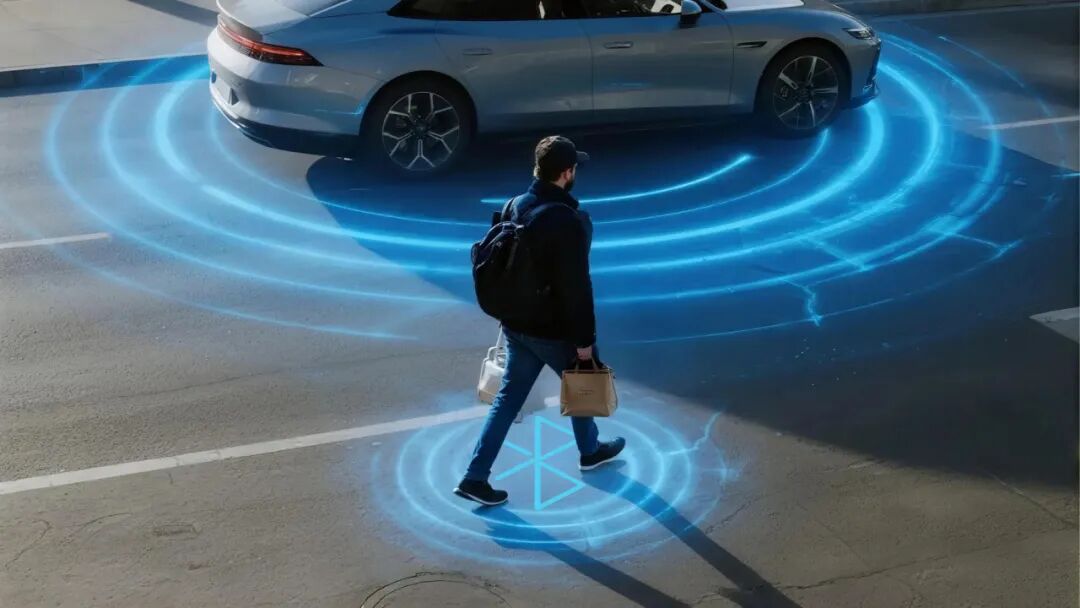
The core advantage of the proximity unlocking solution lies in its extreme convenience, allowing consumers to completely free their hands. When consumers are close enough to the target device, the automatic unlocking process is triggered, achieving a truly “seamless” unlocking experience.
As one of the most widely used communication technologies in short-range wireless interaction, BLE is becoming the ideal carrier for the new generation of proximity unlocking solutions due to its low power consumption and native mobile ecosystem support.
01
How does BLE technology achieve seamless unlocking?
For consumers, the proximity unlocking solution not only upgrades the unlocking experience but also redefines the rhythm of life and security boundaries.
When the unlocking process is upgraded from manual operation to proximity unlocking, the cold device gains a delicate sense of “companionship,” freeing people from the cumbersome unlocking process and allowing them to focus on more creative tasks, significantly enhancing comfort and happiness in life.
For example, in the automotive field, the proximity unlocking solution is also known as the Digital Car Key, which integrates the car key function into smart devices (such as smartphones, smartwatches, and wristbands) through software or digital credentials.
Currently, the digital car key based on BLE technology is one of the mainstream solutions in the market, primarily achieving identity authentication through encrypted digital certificates, supporting functions such as unlocking, starting, and authorizing others to use, completely eliminating the dependence on physical keys.
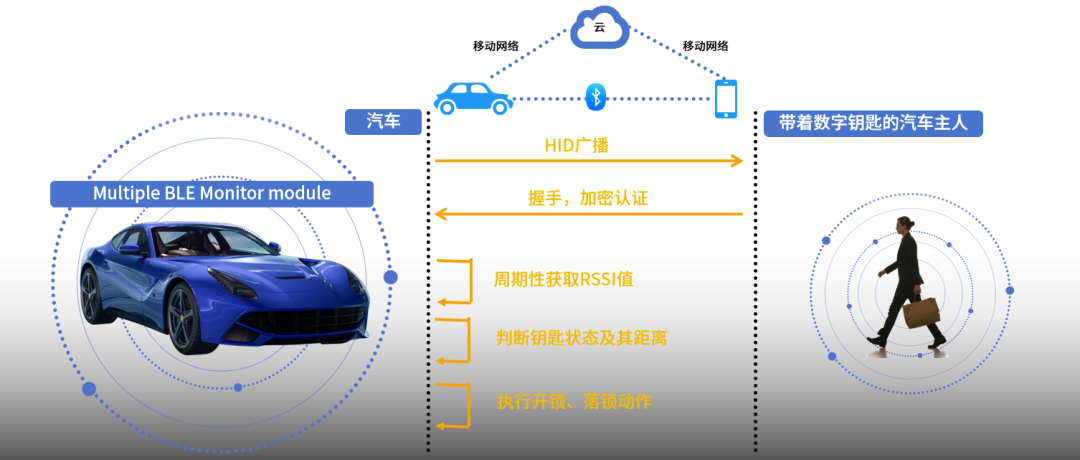
A schematic diagram of a BLE-based digital car key solution
As shown in the figure, the BLE digital car key is based on the RSSI (Received Signal Strength Indicator) principle. This solution consists of a BLE module (embedded in the lock circuit board), user terminal devices (smartphones/watches), and a cloud management platform.
When the car owner approaches the car with their phone, the integrated BLE module in the car lock continuously scans for terminal broadcast signals, automatically establishing a Bluetooth connection, and calculates the approximate distance based on the changes in RSSI values. When the RSSI strength reaches a preset threshold (e.g., -70dBm), the car lock will automatically trigger the locking/unlocking action, requiring no user operation, achieving a truly seamless locking/unlocking experience.
It is worth mentioning that the most common threats in wireless communication include passive eavesdropping, active eavesdropping, and tracking. The Bluetooth communication protocol can build a secure communication link through multiple mechanisms such as pairing, binding, identity verification, encryption, and data signing. Additionally, users can implement independent data encryption at the application layer to further enhance system security.
02
HM-BT2204, a high-performance BLE module
From technical principles to practical applications, achieving large-scale application of BLE proximity unlocking solutions relies on the performance support of underlying hardware modules in terms of communication accuracy, low power consumption algorithm optimization, and security encryption mechanisms.
It can be said that the performance of hardware modules directly determines the response speed, distance measurement accuracy, and long-term operational stability of seamless interaction, which is a key support for promoting BLE proximity unlocking technology from sample solutions to commercial applications.
For example, the HM-BT2204, independently developed by Hoperf, is a low-power, high-performance BLE module that has been certified by BQB, FCC, CE, IC, and SRRC. It employs intelligent interference elimination technology to optimize Bluetooth device connection stability, achieving more reliable wireless connections in complex environments.
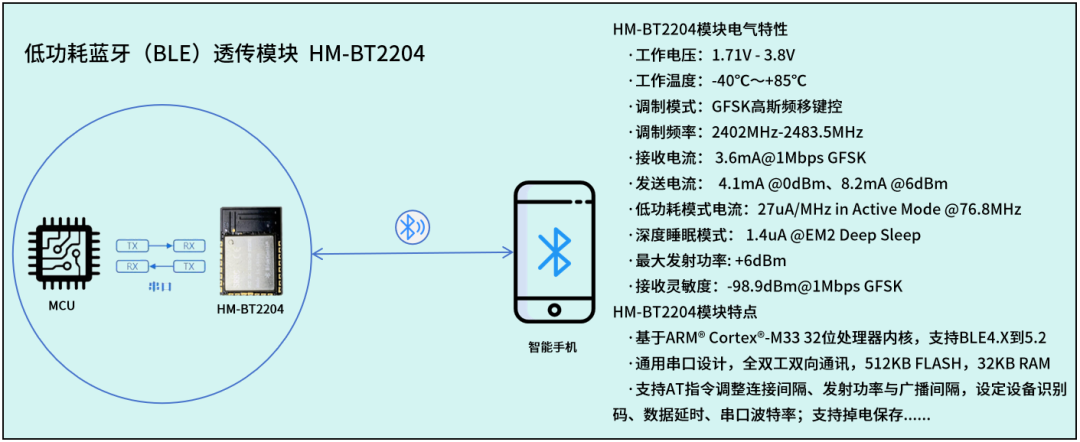
The HM-BT2204 is based on a high-performance, low-power Bluetooth BLE 5.2 SoC chip, featuring a 32-bit ARM® Cortex®-M33 processor core with a maximum frequency of 76.8MHz, on-chip 32KB RAM and 512KB FLASH, an integrated 2.4GHz RF transceiver, and an integrated antenna. It supports wireless data transmission and can quickly establish wireless connections and data communication between BLE slave devices and BLE master devices such as smartphones and tablets, with low resource occupation of external MCUs for quick integration.
Moreover, the user data format is defined by the upper-layer application program. Mobile devices can perform write operations on the module through an APP, and the written data will be sent to the user’s MCU via the module’s external interface.
When the module interface receives data packets from the external MCU, it will automatically forward them to the connected mobile device. Users need to complete the code design for the main MCU and the APP code design for the smart mobile device.
Looking ahead, as Bluetooth technology continues to iterate and module performance continues to break through, BLE proximity unlocking solutions will gradually break through scene boundaries, penetrating into diversified scenarios such as shared mobility, industrial IoT, and medical device management, promoting the seamless interaction experience to upgrade to “millisecond-level response” and “centimeter-level positioning,” allowing devices not only to “sense proximity” but also to “understand intent.”
1
END
1

About Hoperf
Shenzhen Hoperf Microelectronics Co., Ltd. (hereinafter referred to as Hoperf) was established in 2004 and is a national high-tech enterprise focusing on independent innovation and product development of core components for the Internet of Things.
Over the past 20 years, Hoperf has expanded its development from Sub-GHz wireless communication RF chips and module products to high-precision MEMS sensors and digital isolator products, forming a product layout that integrates key links of information perception and information interaction.After years of accumulation, Hoperf has developed into a system-level service provider for wireless communication in the Internet of Things, integrating RF chip design, firmware and protocol design, application development, and testing.
As one of the well-established IoT wireless RF chip brands in China, the company has accumulated a large number of high-quality customer resources and brand recognition both domestically and internationally, thanks to its solid R&D capabilities, reliable product quality, cost-effectiveness, and system-level service capabilities.
If you have any needs, please contact us immediately!
Phone: 400-1189-180
Email: [email protected]
Website: https://hoperf.cn/
For more information, please follow 【Hoperf】
↓↓↓↓
Please like

Please share

Please like