According to a report from Electronic Enthusiasts (by Mo Tingting), the international semiconductor IP company Arm recently announced its financial report for the first quarter of fiscal year 2026 (ending June 30, 2025), with both revenue and net profit falling short of market expectations.In addition to the financial data itself, another dynamic that has drawn significant attention from the industry is that Arm’s CEO, Rene Haas, publicly stated that the company is actively laying out plans for self-developed chips, marking a significant strategic transformation for this semiconductor company, which has primarily focused on IP licensing, and may lead to competition with its existing customers.
Moving away from reliance on smartphones, Arm may bet on data centers.
From an operational perspective, Arm reported revenue of $1.05 billion in the first quarter, slightly below analysts’ estimates of $1.06 billion; net profit was approximately $130 million, down from $223 million in the same period last year. Adjusted earnings per share were $0.35, in line with expectations. Arm provided guidance for the second quarter, expecting revenue to be between $1.01 billion and $1.11 billion, with adjusted earnings per share projected to be between $0.29 and $0.37.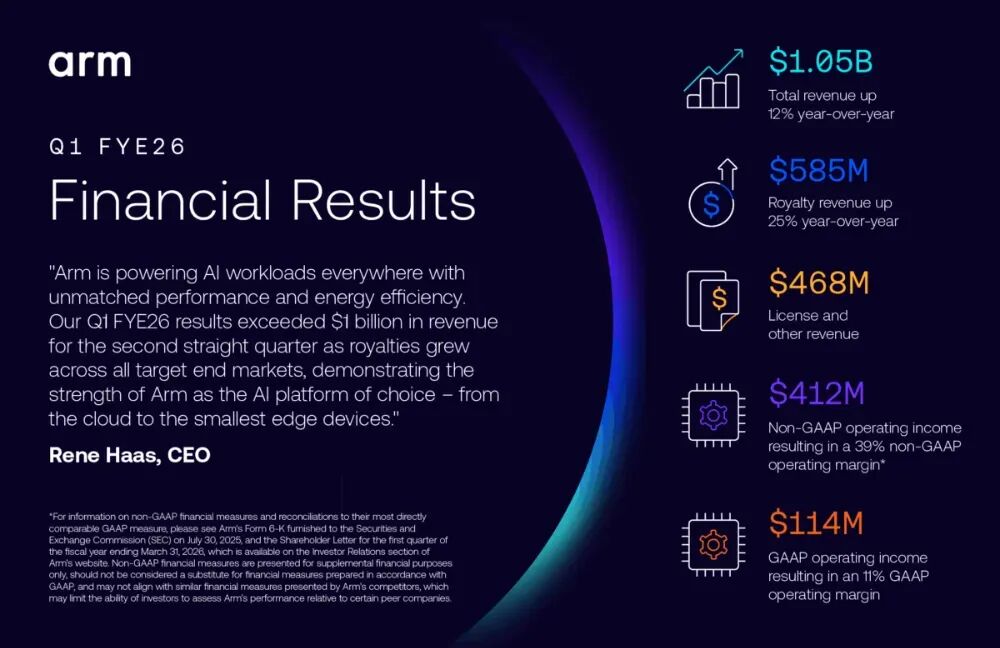 Arm’s revenue primarily comes from licensing fees and royalties from customers using the company’s technology to produce chips. Royalty revenue reached $585 million, achieving a 25% year-on-year growth; licensing and other revenues totaled $468 million, a 1% decline year-on-year. The financial report noted that over 70,000 customers are using Arm-based chips in data centers. Since 1990, 325 billion Arm-based chips have been shipped. It must be mentioned that the smartphone business is a major source of Arm’s royalty revenue, contributing 45% of total revenue in the first quarter. Arm’s technology is used in nearly 99% of smartphone processors, such as MediaTek’s Dimensity 9400 chip. However, it is precisely the weakness in this key market that caused Arm’s performance this quarter to fall short of expectations. IDC data shows that from April to June this year, global smartphone shipments grew by only 1%.
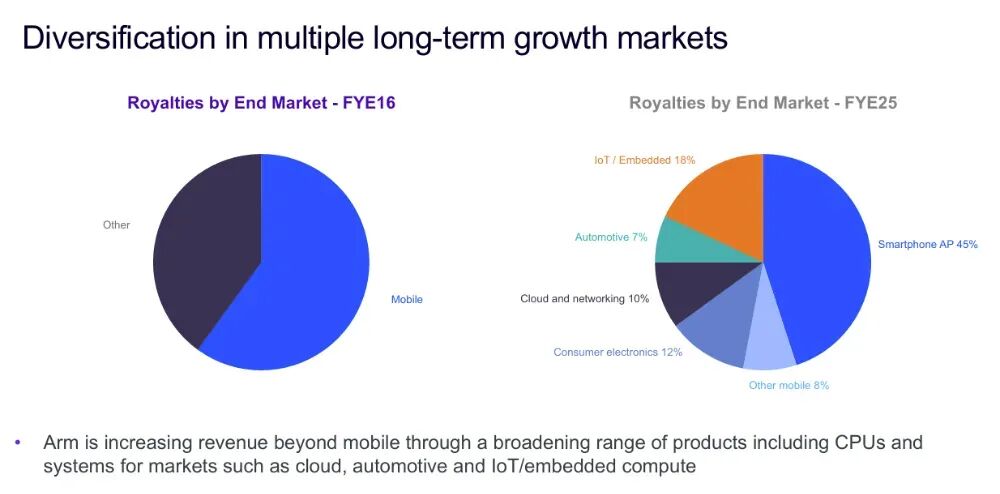 With the smartphone market showing sluggish growth, Arm needs to find new growth curves. From its financial report, revenue achieved a 12% year-on-year growth, thanks to the continued adoption of the Armv9 architecture, the gradual rollout of Arm CSS chips, and the use of Arm-based chips in data centers. Arm is showing increasingly strong development in the data center sector. Arm predicts that by 2025, nearly 50% of the computing power shipped to top hyperscale service providers will be based on Arm architecture. Data centers and servers have become important markets for Arm’s layout. Arm stated that over 70,000 enterprises are using Arm Neoverse data center chips for AI workload processing, a 40% year-on-year increase, which is 14 times that of 2021. Notably, Arm Neoverse CPUs are also customized for cloud AI infrastructure (such as NVIDIA Grace, AWS Graviton, etc.). According to Bernstein Research, in 2023, Arm server CPUs hold nearly 10% of the global server market; notably, Amazon Web Services (AWS) is a key driver, deploying half of the servers based on Arm architecture, and has widely deployed over 2 million self-developed Graviton chips in its cloud infrastructure.
Self-developed chips have long been in the making: CSS accelerates ecosystem maturity, Chiplet collaboration comes to fruition.
Foreign media reports indicate that Arm’s self-developed chips will involve the development of “physical chips, motherboards, and even systems,” positioned as CPUs for user data centers, adopting the Arm v9 architecture, and will be the “physical embodiment” of Arm’s Compute Sub Systems (CSS) products, to be produced by foundries such as TSMC. However, Arm has not specified a concrete timeline or product details for the launch. Rene Haas emphasized in an interview: “We are consciously increasing our investment, no longer limited to design itself, but moving towards actual manufacturing, such as creating chiplets or even more complete solutions.” Chiplets adopt a modular design concept, allowing each chiplet to be independently designed, manufactured, and tested. AI chips using Chiplet architecture offer higher computing power, better power control, and improved energy efficiency. MEMS consulting predicts that driven by high-performance computing demands in data centers and AI, the global Chiplet market is expected to reach $411 billion by 2035. According to media reports, Arm is actively taking action to build a specialized team responsible for Chiplets and finished chip production, on one hand recruiting talent widely, and on the other hand needing to secure business orders from competitors. It must be pointed out that Arm has long been planning in the Chiplet field and has accumulated rich customer cooperation experience, which has laid a solid technical foundation for its self-developed chips. Arm collaborates with chip design companies, chip manufacturers, and other industry chain enterprises. For example, it has partnered with Samsung Foundry, ADTechnology, and Rebellions to develop AI CPU Chiplet platforms based on Neoverse CSS V3. This platform utilizes the Neoverse CSS V3 architecture provided by Arm.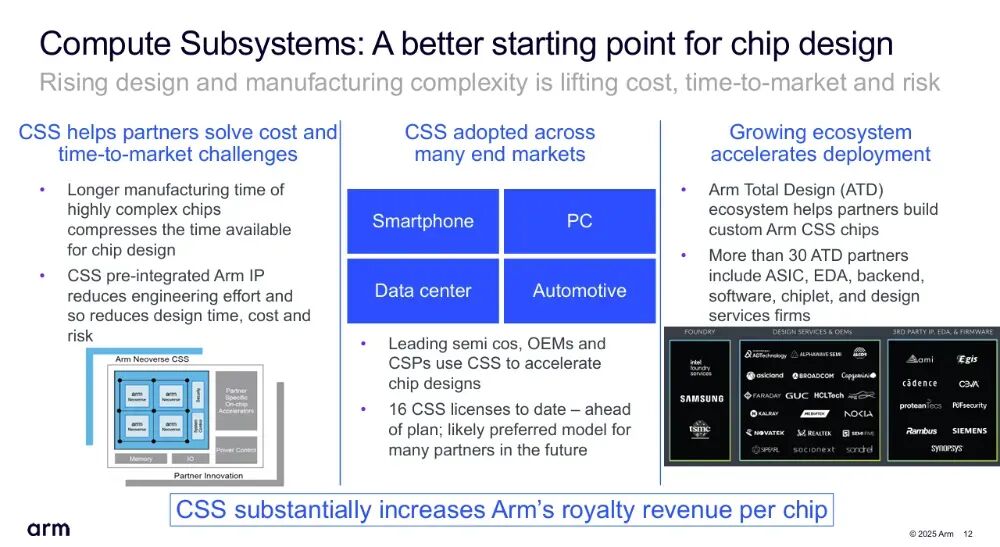 CSS has brought significant revenue to Arm and has become an important growth engine. Arm noted that this business is expected to drive total royalty revenue to achieve mid-single-digit growth in fiscal year 2025, and further increase to double-digit growth in fiscal year 2026. CSS royalties come from two main areas: infrastructure and client devices, specifically including smartphones, automotive, data centers, PCs, etc. Arm pointed out that in this quarter, the company issued three CSS licenses, all related to existing CSS customers who wish to use the next generation of CSS in future chips. So far, 16 companies have obtained CSS licenses. Partners include ASIC, EDA, backend, software, chip, and design service companies, reflecting strong market demand for CSS technology. CSS also directly increases Arm’s royalty revenue per chip. It is understood that products such as Xiaomi’s new XRING O1 chip and Exynos 2500 chip are all based on the latest mobile Arm CSS platform. Arm has also launched Arm Zena CSS for the automotive market. Additionally, adopting the Armv9 architecture brings higher royalty rates than any previous architecture. Previously, Arm could help partners build customized Arm CSS chips. Now, Arm is starting to adopt CSS self-developed chips, a shift that not only marks its business model extending from “enabler” to “participant” but will also impact the semiconductor industry landscape. For Arm, self-developed chips will strengthen its technological leadership in high-end and high-growth areas, especially in key markets such as data centers, AI acceleration, and high-end mobile computing; at the same time, self-developed chips will enhance Arm’s bargaining power and profitability, driving an overall increase in IP licensing prices. For the industry chain, Arm’s direct involvement in chip development may also reshape its relationships with existing chip manufacturers.
Summary
Arm’s performance in the first quarter of fiscal year 2026 is under pressure, primarily due to stagnation in the smartphone market. In the face of this bottleneck, Arm is accelerating its strategic transformation, shifting its focus to the high-growth data center and AI markets. Crucially, Arm has announced its entry into self-developed chips, aiming to upgrade from an IP enabler to a solution provider, strengthen its technological leadership, and open up new growth curves. This move may reshape its business model and relationships with industry chain partners.

Statement:This article is original from Electronic Enthusiasts and must be cited as above. For group discussions, please add WeChat elecfans999, for submission of reports or interview requests, please email [email protected].
More hot articles to read
-
Details of Huawei Mate80 and Apple iPhone 17 Pro exposed? Huawei smartphones once again dominate the Chinese market in Q2.
-
Lei Jun: Xiaomi is now at the forefront of global self-developed SoCs.
-
Self-developed chips, aggressively targeting enterprise-level, domestic storage sees a “quantum leap”.
-
TI/ADI/ST consecutively warn: The automotive chip market remains pessimistic.
-
Intel plans to lay off 21,000 employees, possibly skipping the 18A process.
Click to follow and star us
Set us as a star to not miss any updates!