Author: Ma Zhi
Published by the IoT Think Tank
Please cite the source and origin when reprinting
—— [Introduction] ——
The IoT Think Tank will publish a series of articles written by Mr. Ma Zhi every Friday afternoon in the second article slot – “Exploring IoT Platforms: Domestic and International”.
The IoT Think Tank will publish a series of articles written by Mr. Ma Zhi every Friday afternoon in the second article slot – “Exploring IoT Platforms: Domestic and International”
—— Domestic ——
(1) Baidu IoT Hub Access
(2) Alibaba Cloud IoT Suite
(3) QQ IoT · Smart Hardware Open Platform
(4) JD Micro Link
(5) Smart Cloud IoT Cloud Service Platform and Smart Hardware Self-Development Platform
(6) Qingke Cloud FogCloud
(7) Ablecloud IoT Self-Development and Big Data Cloud Platform
(8) China Mobile IoT Open Platform OneNet
—— International ——
(1) Amazon AWS IoT
(2) Microsoft Azure IoT
(3) IBM Watson IoT
(4) Ayla Networks
Platform Positioning
Connect devices, other M2M assets, and personnel to better utilize data in business and operations.
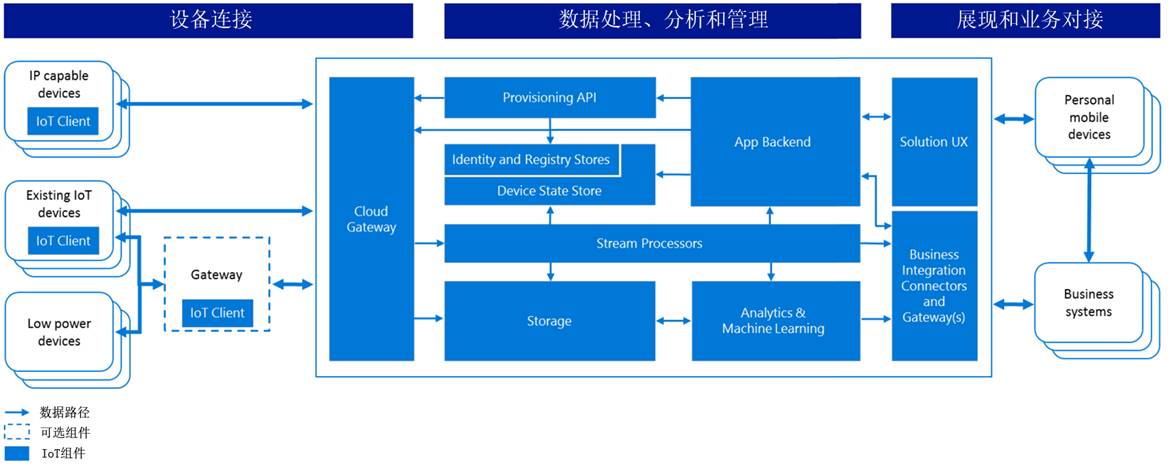
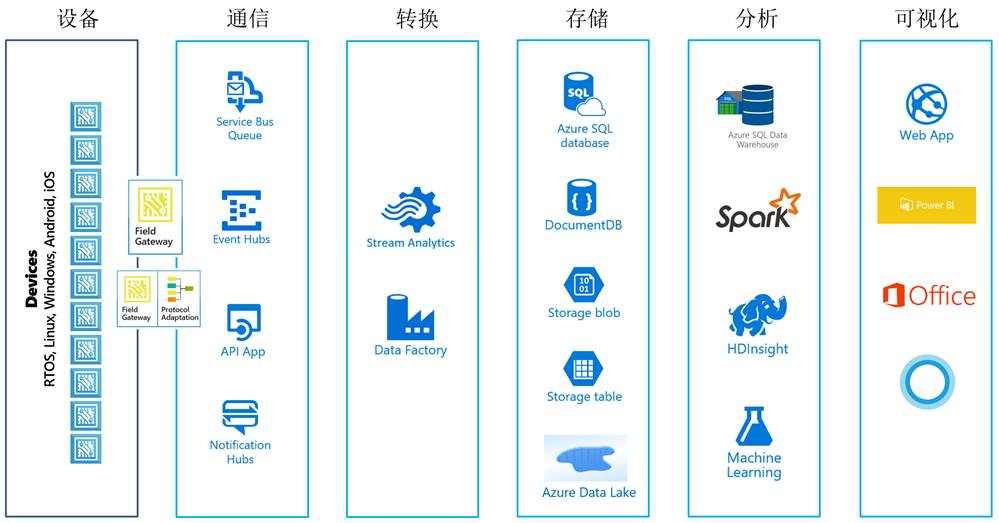
Azure IoT Architecture
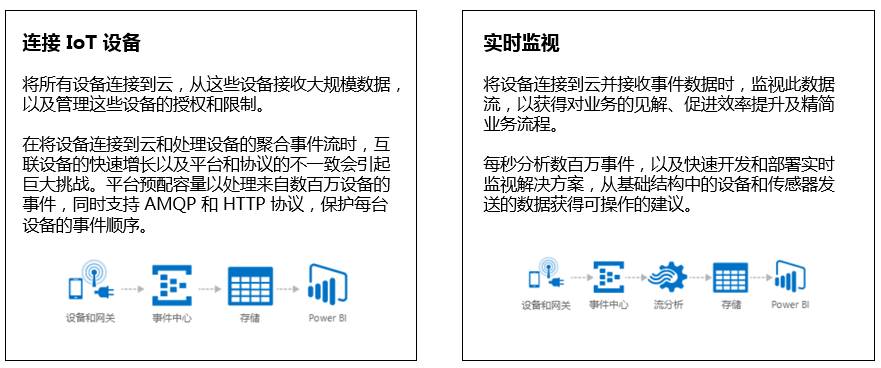
Azure IoT Services
Azure IoT Hub
Azure IoT Hub is a fully managed service that enables secure and reliable bi-directional communication between millions of IoT devices and a solution backend.
• Provides reliable device-to-cloud and cloud-to-device messaging at scale.
• Implements secure communication using security credentials and access control for each device.
• Broadly monitors device connectivity and device identity management events. Includes device libraries for the most popular languages and platforms.
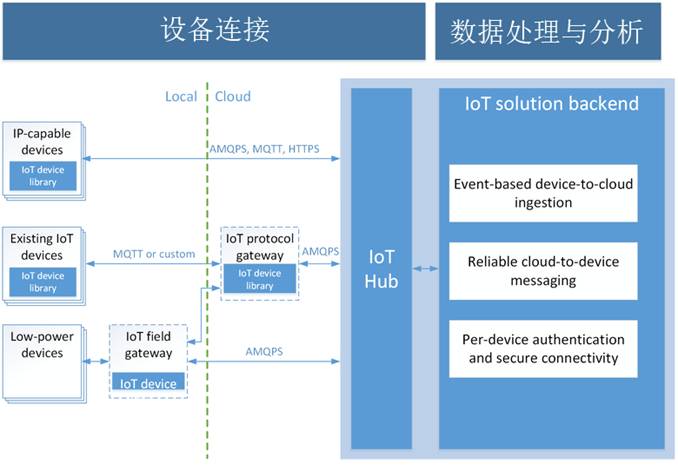
Device-Level Authentication: Each device is assigned a unique security key, and the IoT Hub identity registry stores device identities and keys, allowing the backend to whitelist or blacklist individual devices for complete control over device access.
Device Connection Operation Monitoring: Detailed operation logs exist for device identity management operations and device connection events, facilitating the identification of connection issues, such as devices attempting to connect with incorrect credentials, sending messages too frequently, or rejecting all cloud-to-device messages.
Rich Device Library: The Azure IoT device SDK supports managed languages such as C, C#, Java, and JavaScript, and supports many Linux distributions, Windows, and real-time operating systems.
Scalable IoT Protocols: The IoT Hub has a common protocol that allows devices to use MQTT v3.1.1, HTTP 1.1, or AMQP 1.0 natively. The IoT Hub can also be extended to support custom protocols:
• On-Premises Gateway: Create an on-premises gateway using the Azure IoT Gateway SDK, which can convert custom protocols into one of the three protocols understood by the IoT Hub.
• Cloud Gateway: Custom Azure IoT protocol gateway (an open-source component running in the cloud).
Scalable High-Concurrency Event Processing: The Azure IoT Hub can scale to millions of simultaneously connected devices and millions of events per second.
Event-Based Device Data Processing: The event processing engine can handle device events on the hot path and can also store them on the cold path for analysis. The IoT Hub can retain event data for up to 7 days to ensure reliable processing and mitigate load peaks.
Reliable Cloud-to-Device Messaging: The backend uses the IoT Hub to send messages to individual devices (with at least once delivery guarantee). Each message has its own time-to-live setting, and the backend can request delivery and expiration receipts. This ensures complete visibility into the lifecycle of cloud-to-device messages.
Storage and Analysis of Sensor Data Files and Caches: Devices upload files hosted by the IoT Hub to Azure storage using SAS URI. When files arrive in the cloud, the IoT Hub can generate notifications to enable backend processing of these files.
Event Hubs
• Event Hubs is an event processing service that provides a large-scale event and telemetry data ingress to the cloud, with low latency and high reliability. Event Hubs acts as the “front door” for event streams, serving as a component or service between event producers and event consumers, allowing the generation of event streams to be decoupled from their consumption.
• Event Hubs can ingest millions of events per second, enabling the processing and analysis of massive data generated by connected devices and applications.
• Once data is collected by Event Hubs, it can be transformed and stored using any real-time analytics provider or batch/storage adapter.
• Event Hubs decouples the generation of event streams from their consumption, allowing consumers to access events on their own schedule.
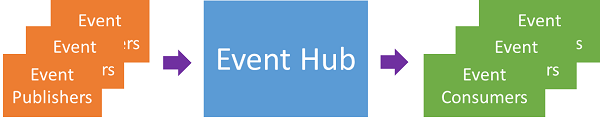
Stream Millions of Events per Second to Multiple Applications
• Event Hubs is a highly scalable publish-subscribe collector that can ingest millions of events per second, capable of processing and analyzing massive data generated by interconnected devices and applications. After data is collected into Event Hubs, it can be transformed and stored using any real-time analytics provider or batch/storage adapter.
Allow Applications to Handle Variable Load Distribution of Events
• Big data is a direct reflection of today’s interconnected world. Big data has many sources, such as telemetry data generated by interconnected cars and thermostats every few minutes, event performance counters generating events every second, or mobile applications capturing telemetry data every time a user performs an action. A resilient hosted collector service can handle changing load distributions and load peaks caused by intermittent connectivity.
Cross-Platform Connection of Millions of Devices
• The rapid emergence of interconnected devices poses greater challenges for the IT industry, as it must deal with various platforms and protocols. Handling large-scale aggregated streams while connecting these different data sources has become a significant challenge. Event Hubs allows users to easily provision capacity to collect events from millions of devices while maintaining event order based on each device. Supporting AMQP and HTTP allows many platforms to work with Event Hubs, and native client libraries are available for various popular platforms.
Stream Analytics
Real-time stream processing engine in the cloud for rapid development and deep insights into existing data attributes.
• Perform real-time analytics for IoT solutions
• Stream millions of events per second
• Achieve reliability and performance predictions for critical tasks
• Create real-time dashboards and alerts using data from devices and applications
• Use common SQL-based languages across multiple data streams for rapid development
Real-Time Analytics Results
• Achieve rapid development and deployment of low-cost analytics solutions, obtaining deep analytical results in real-time from devices, sensors, infrastructure, and applications.
Achieve Rapid Development
• Reduce the difficulty and complexity of developing analytics capabilities for scalable distributed systems. Simply describe the required transformations using SQL-based syntax, and the system will automatically allocate resources to achieve scalability, performance, and resilience without the need to manage complex infrastructure and software.
Execute Real-Time Analytics
• With out-of-the-box integration with Event Hubs, receive millions of events per second. Compare multiple real-time streams or compare real-time streams with historical values and models. This enables anomaly detection and incoming data transformation, and can trigger alerts when specific errors or conditions occur in the stream, as well as support real-time dashboards.
Achieve Task Reliability and Scalability
• Scale to meet any data volume requirement while still achieving high throughput, low latency, and guaranteed resilience, without any hardware or other upfront costs, and without spending time on installation or setup. Start and run in minutes. Stream Analytics can process data under high throughput conditions, with predictable results and no data loss.
Notification Hubs
A scalable mobile push notification engine that can quickly push millions of messages to multiple platforms (iOS, Android, WP, etc.)
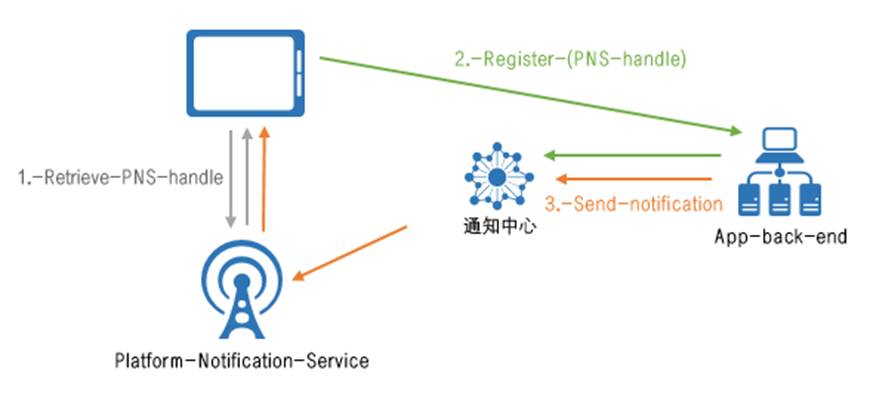
Broadcast to Millions of Devices in Minutes
• Quickly push millions of messages to iOS, Android (BaiduPush), Windows, or Kindle devices.
Support Any Backend System
• Can be integrated with any backend system running in an internal environment or Azure cloud: .NET, PHP, Java, Node.
Push to Different User Groups via Dynamic Tags
• Utilize tagging features to segment user groups based on activity, interests, location, or preferences, pushing the right information to the right people at the right time.
Easily Achieve Localization with Templates
• Use template features to push localized notification information, allowing users to receive messages consistent with their language. The template feature does not require storing localization settings for each customer.
Designed for Large-Scale Environments
• Quickly scale to millions of devices and send billions of push notifications without restructuring or sharding. Notification Hubs automatically adjusts the infrastructure as needed, pushing information to each active device with very low latency.
Machine Learning
Provides a simple, powerful, flexible, cloud-based predictive analytics solution
Now part of the Cortana Intelligence Suite
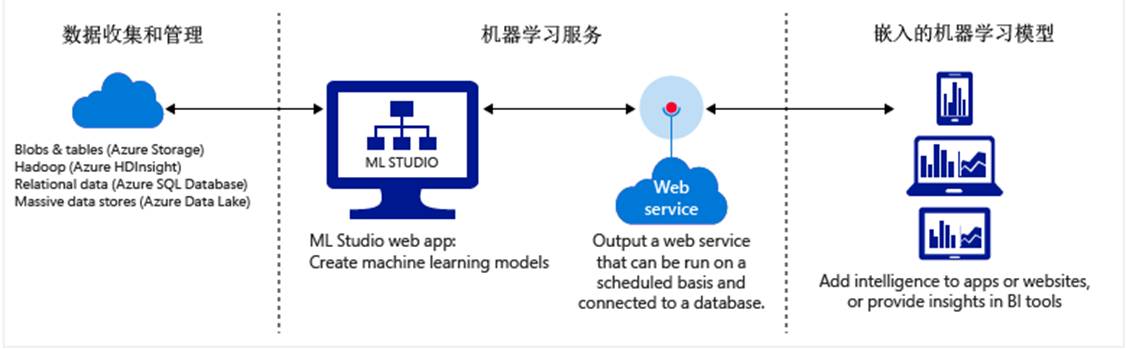
Main Features
• Data exploration, descriptive analytics, predictive analytics
• Supervised learning, unsupervised learning
• Model training and evaluation
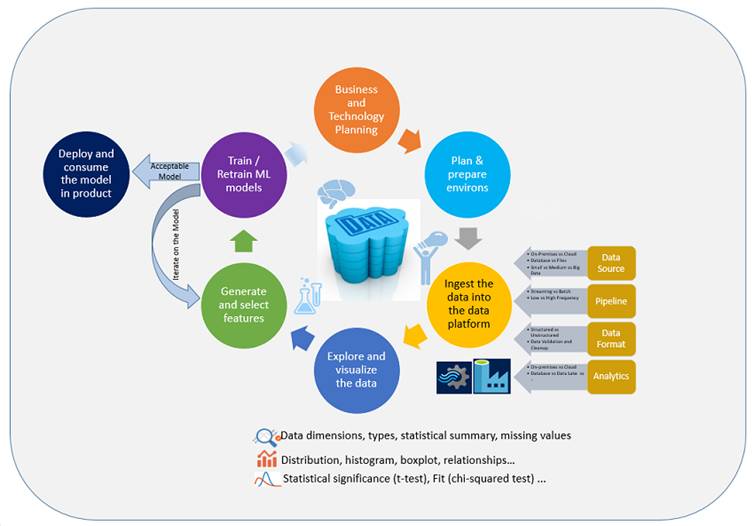
Machine Learning Steps
1. Import data to the platform
2. Explore and visualize data
3. Generate and select features
4. Create and train machine learning models
5. Deploy and use models
Development Tool Interface – Create IoT Hub
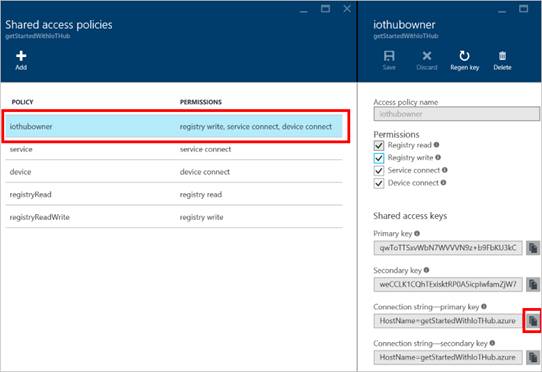
IoT Hub Creation Result
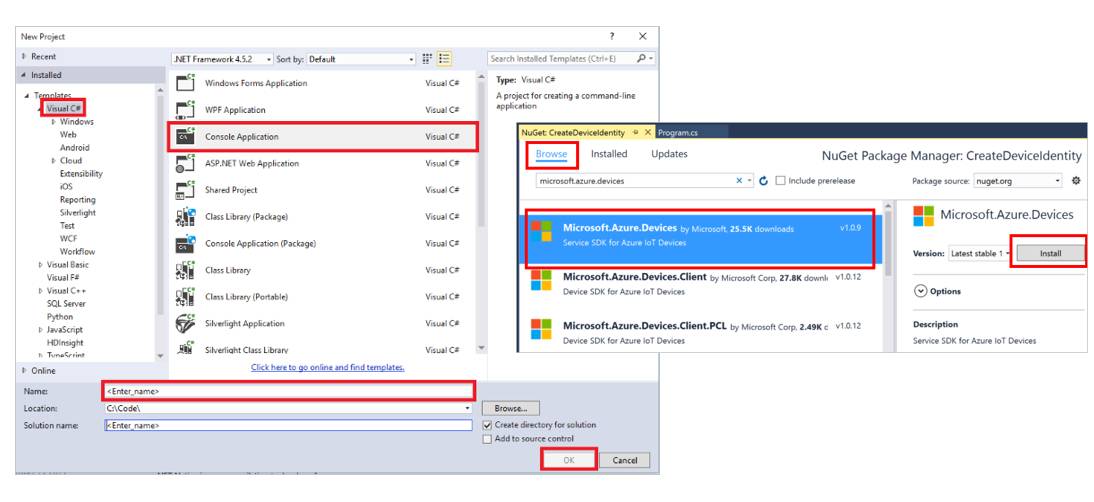
Development Tool Interface – Create Device Identity
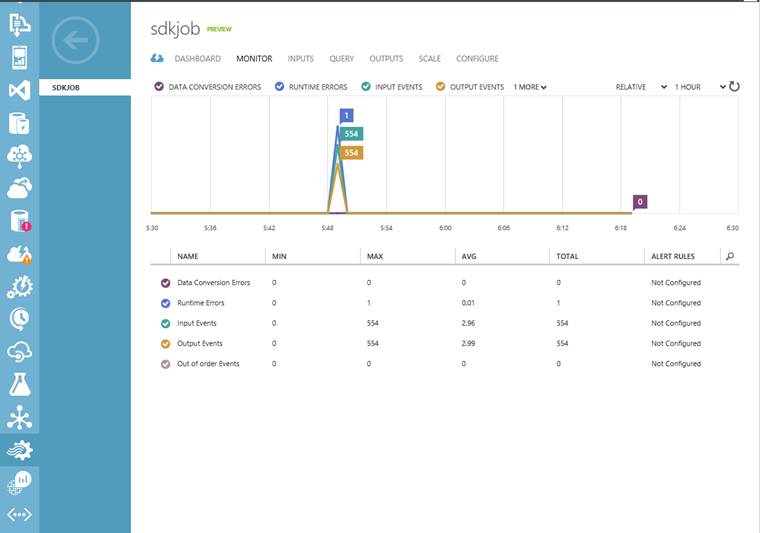
Development Tool Interface – Create Stream Analytics Job Monitor
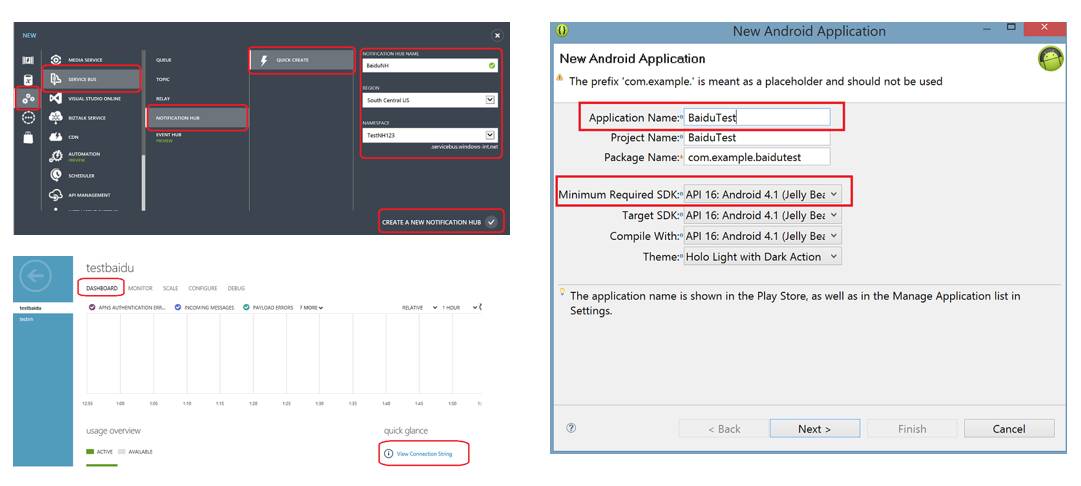
Development Tool Interface – Notification Hub
Development Tool Interface – Machine Learning Model
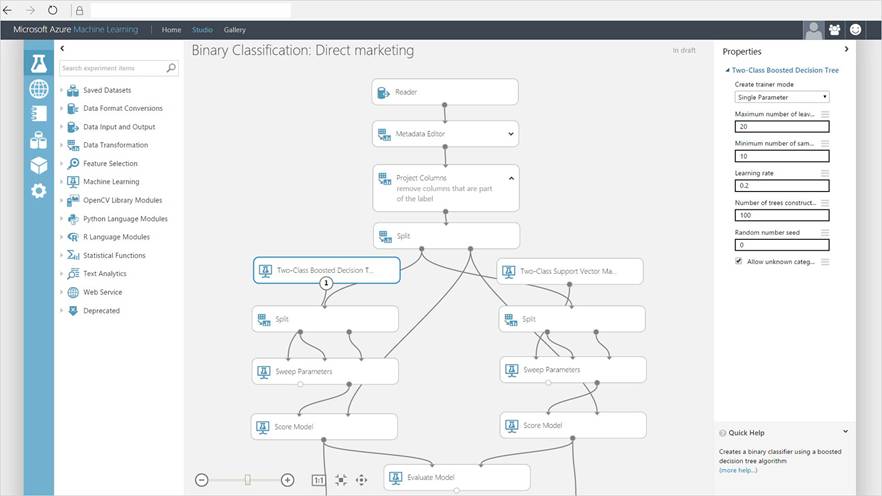
Machine Learning Studio: Create Predictive Models
Development Tool Interface – Cortana Intelligence Suite
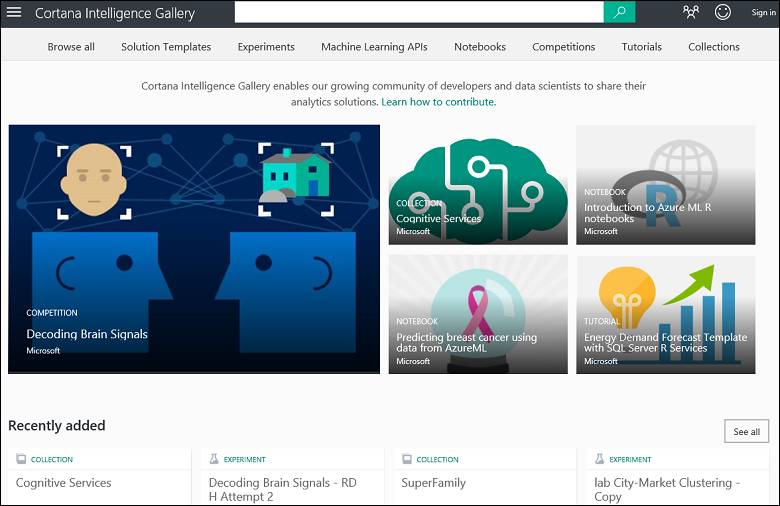
Select Analysis Solution
Previous Popular Articles (Click on the title to read directly):
-
“[Heavyweight] IoT Industry Panorama Report, the First Domestic IoT Industry Two-Dimensional Perspective Panorama”
-
“Exclusive Interview with Academician Wu Hequan: Four Good News Indicate that IoT Development is on Track”
-
“China’s First Low-Power Wide-Area Network LPWAN Market Report Released: Where is the Next IoT Opportunity? [Text Version]”
-
“A Cartoon Explains: What is LoRa Behind NB-IoT, which Everyone is Talking About?”
-
“A Cartoon Explains: Besides WiFi and Bluetooth, What Can the Recently Popular NB-IoT Do?”“
-
“McKinsey’s Heavyweight Report: How Can Enterprises Tap into the Value of ‘Industry 4.0’? (Collection Edition)”