Divergent mechanisms of rhizosphere and non-rhizosphere soil organic carbon sequestration under precipitation variability: Evidence from microbial life-history strategies
Abstract
Background: Climate change-induced precipitation variability has profound impacts on soil carbon dynamics in agricultural ecosystems in arid regions.
Methods: To elucidate the carbon retention mechanisms of rhizosphere and non-rhizosphere soils under precipitation variability, we conducted an eight-year precipitation manipulation experiment (50% reduction, 25% reduction, control, 25% increase, 50% increase) in farmland on the Loess Plateau in China. This study comprehensively assessed the dynamics of carbon components and the driving factors behind these mechanisms.
Results: Our results indicate that increased precipitation significantly enhanced organic carbon (SOC) in both rhizosphere (20.5% increase) and non-rhizosphere (22.5% increase) soils, although carbon accumulation patterns exhibited spatial differences. Rhizosphere carbon accumulation primarily originated from mineral-associated organic carbon (MAOC) (MAOC/SOC ratio increased from 80.3% to 88.8%), while non-rhizosphere soils relied on contributions from particulate organic carbon (POC) (POC/SOC ratio increased from 12.5% to 17.5%). Additionally, microbial communities displayed functional group decoupling. Increased precipitation shifted bacteria towards r-strategies in both habitats (evidenced by a decrease in the ratio of oligotrophic/mesotrophic bacteria and an increase in rrn copy numbers), while fungal life strategies remained unchanged. Bacterial α-diversity increased in both regions, but the response of fungal α-diversity diverged, increasing in rhizosphere soils while decreasing in non-rhizosphere soils. Partial least squares path modeling (PLS-PM) revealed habitat-specific carbon sequestration mechanisms. In rhizosphere soils, precipitation stimulated root carbon secretion (70.7%) and increased the carbon-to-nitrogen ratio of exudates (119.8%), promoting the proliferation of r-strategists, enhancing MAOC formation and SOC accumulation. In contrast, non-rhizosphere soils depended on precipitation-mediated microbial diversity regulation and aggregate protection to promote POC formation and SOC accumulation.
Conclusion: This study proposes carbon sequestration models for rhizosphere and non-rhizosphere soils under variable precipitation conditions, providing key insights for predicting carbon trajectories in climate-sensitive agricultural ecosystems.
Main Determinants and Analytical Methods
1. Determination of soil physicochemical properties
2. Determination of soil enzyme activity
3. Microbial nutrient limitation
4. DNA extraction and high-throughput sequencing
5. Evaluation of microbial life strategies
6. Higher rrn copy numbers represent a preference for the r-strategy, and lower rrn copy numbers represent a preference for the K-strategy. The average rrn copy number of each OTU was estimated from the rrnDB database
7. Two-way ANOVA and Duncan’s multiple comparisons
8. Regression analyses
9. Random forest and Pearson correlation analyses
10. Partial least squares models (PLS-PM)
Main Results
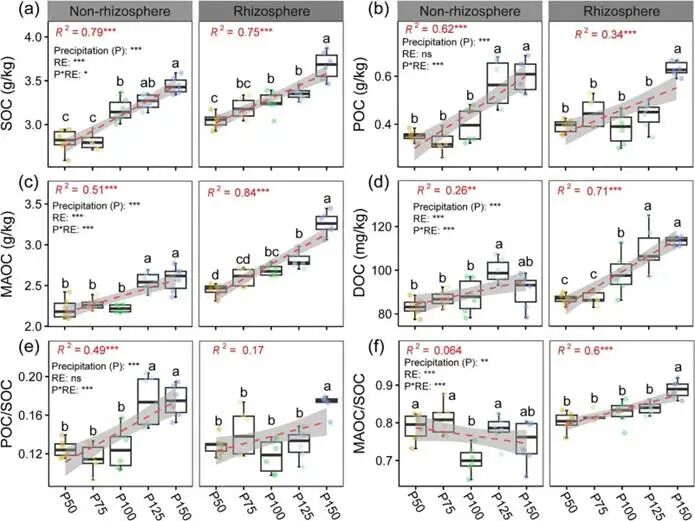
1. Characteristics of the response of rhizosphere and non-rhizosphere soil organic carbon pools to changes in precipitation.
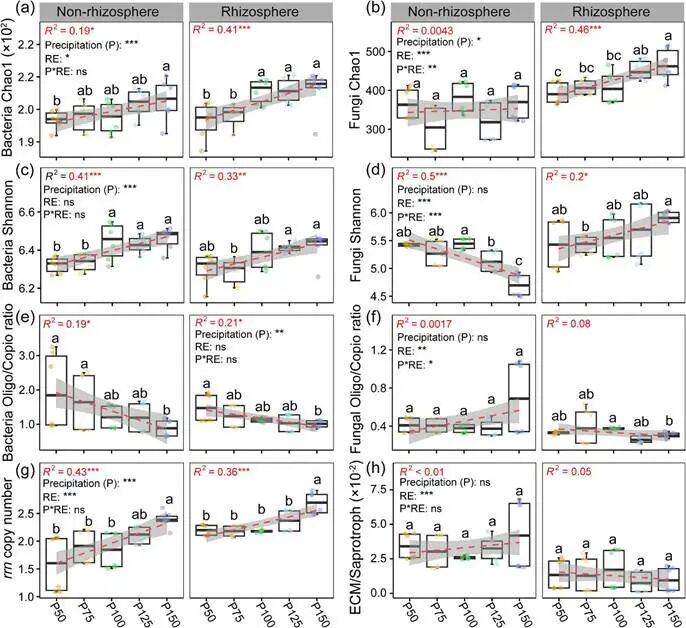
2. Characterization of the response of soil rhizosphere and non-rhizosphere microbial diversity and life strategies to changes in precipitation.
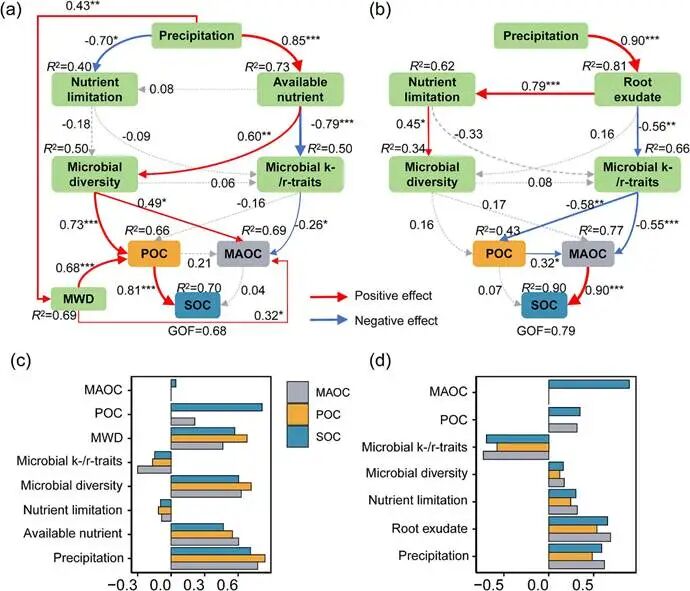
3. PLS-PM modelling showing potential direct and indirect relationships between soil properties (or root secretion), nutrient limitation, microbial diversity and life strategies on SOC under changes in precipitation.
For detailed information, please refer to:


Click the “Read Original” button below to view the original text