Overview of the G2D Module
Author: @chhjnavy
Original Article: https://bbs.aw-ol.com/topic/3291/
Main Functions of G2D: 1) Rotation: Supports 90, 180, 270 degrees; 2) Scale: Scaling;
3) Mirroring: Horizontal / Vertical;
4) Transparent Overlay: Achieves overlay of two RGB images;
5) Format Conversion: Various format conversions such as YUV to RGB;
6) Rectangle Filling, and many other functions;

G2D Configuration
Source Code Directory
-
tina-v853-docker/kernel/linux-4.9/drivers/char/sunxi_g2d
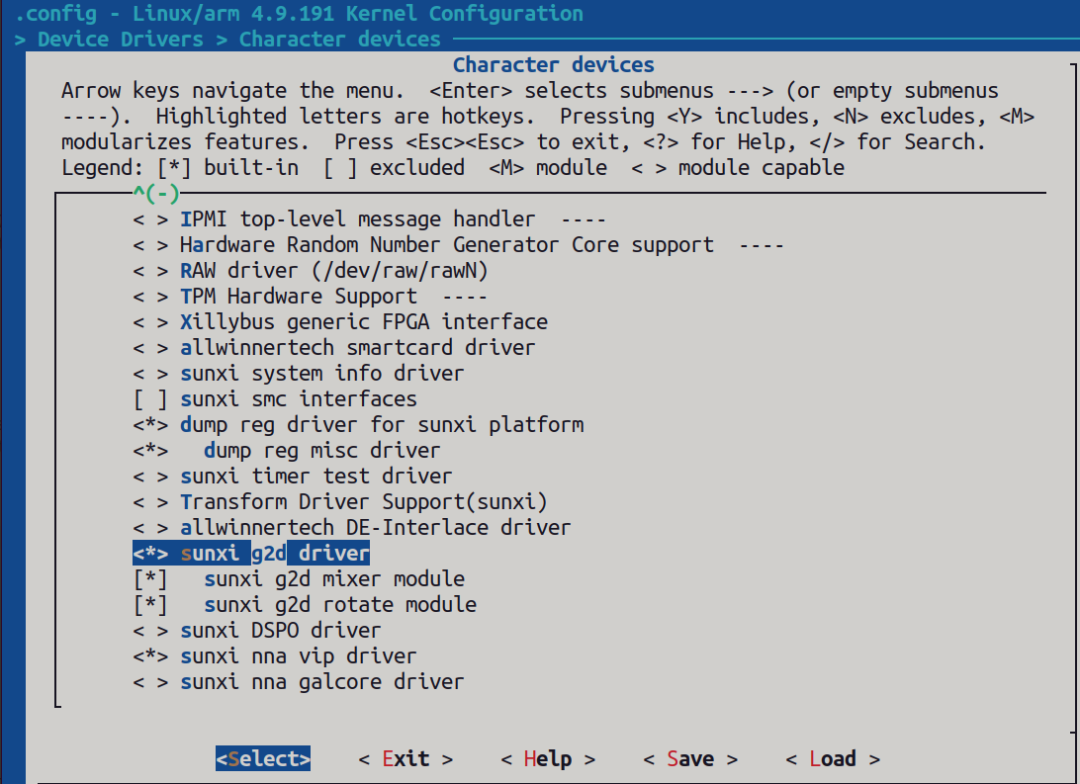
Configure with make kernel_menuconfig
-
Device Drivers > Character devices > sunxi g2d driver
Device Tree Configuration
-
Path of sun8iw21p1.dtsi:
tina-v853-docker/kernel/linux-4.9/arch/arm/boot/dts/sun8iw21p1.dtsi
g2d: g2d@05410000 { compatible = "allwinner,sunxi-g2d"; reg = <0x0 0x05410000 0x0 0xbffff>; interrupts = <GIC_SPI 89 IRQ_TYPE_LEVEL_HIGH>; clocks = <&clk_g2d>; iommus = <&mmu_aw 3 1>; status = "okay"; };Note: The status must be set to “okay”.
Recompile the Kernel
Use the flashing tool PhoenixSuit to flash the compiled img image onto the development board.
Open the control terminal with adb shell to check the device node G2D:

Operations via G2D Device Node
static int SampleG2d_G2dOpen(SAMPLE_G2D_CTX *p_g2d_ctx){ int ret = 0; p_g2d_ctx->mG2dFd = open("/dev/g2d", O_RDWR, 0); if (p_g2d_ctx->mG2dFd < 0) { aloge("fatal error! open /dev/g2d failed"); ret = -1; } return ret;}
Specific Applications of G2D Sample
G2D Sample Directory

Performing Rotation, Scaling, and Format Conversion
Specific Implementation: Convert a 1920×1080 NV21 format image to RGB888 format and scale it down to 640×360 size. This involves two functions: format conversion and scaling.
First, allocate virtual address space based on the 1920×1080 NV21 format and the 640×360 RGB888 format, and convert to physical addresses (note: G2D conversion is performed in physical addresses).
Size of 1920×1080 NV21 Format Space (Input File):
-
Y occupies 1920*1080 = 2073600 bytes
-
UV occupies 1920*1080 / 2 = 1036800 bytes

Size of 640×360 RGB888 Format Space (Output File):
-
RGB occupies 640*360*3 = 691200 bytes
Additionally: Use the following function to convert virtual addresses to physical addresses:
g2d_getPhyAddrByVirAddr();The complete function to allocate virtual space and convert to physical space is as follows:
static int PrepareFrmBuff(SAMPLE_G2D_CTX *p_g2d_ctx){ SampleG2dConfig *pConfig = NULL; unsigned int size = 0; pConfig = &p_g2d_ctx->mConfigPara; p_g2d_ctx->src_frm_info.frm_width = pConfig->mSrcWidth; p_g2d_ctx->src_frm_info.frm_height = pConfig->mSrcHeight; p_g2d_ctx->dst_frm_info.frm_width = pConfig->mDstWidth; p_g2d_ctx->dst_frm_info.frm_height = pConfig->mDstHeight; size = ALIGN(p_g2d_ctx->src_frm_info.frm_width, 16)*ALIGN(p_g2d_ctx->src_frm_info.frm_height, 16); if(pConfig->mPicFormat == MM_PIXEL_FORMAT_YVU_SEMIPLANAR_420 || pConfig->mPicFormat == MM_PIXEL_FORMAT_YUV_SEMIPLANAR_420) { p_g2d_ctx->src_frm_info.p_vir_addr[0] = (void *)g2d_allocMem(size); if(NULL == p_g2d_ctx->src_frm_info.p_vir_addr[0]) { aloge("malloc_src_frm_y_mem_failed"); return -1; } p_g2d_ctx->src_frm_info.p_vir_addr[1] = (void *)g2d_allocMem(size/2); if(NULL == p_g2d_ctx->src_frm_info.p_vir_addr[1]) { g2d_freeMem(p_g2d_ctx->src_frm_info.p_vir_addr[0]); aloge("malloc_src_frm_c_mem_failed"); return -1; } p_g2d_ctx->src_frm_info.p_phy_addr[0] = (void *)g2d_getPhyAddrByVirAddr(p_g2d_ctx->src_frm_info.p_vir_addr[0]); p_g2d_ctx->src_frm_info.p_phy_addr[1] = (void *)g2d_getPhyAddrByVirAddr(p_g2d_ctx->src_frm_info.p_vir_addr[1]); } if(pConfig->mDstPicFormat == MM_PIXEL_FORMAT_RGB_888) { size = p_g2d_ctx->dst_frm_info.frm_width * p_g2d_ctx->dst_frm_info.frm_height * 3; p_g2d_ctx->dst_frm_info.p_vir_addr[0] = (void *)g2d_allocMem(size); if(NULL == p_g2d_ctx->dst_frm_info.p_vir_addr[0]) { if(p_g2d_ctx->src_frm_info.p_vir_addr[0] != NULL) { g2d_freeMem(p_g2d_ctx->src_frm_info.p_vir_addr[0]); } if(p_g2d_ctx->src_frm_info.p_vir_addr[1] != NULL) { g2d_freeMem(p_g2d_ctx->src_frm_info.p_vir_addr[1]); } aloge("malloc_dst_frm_y_mem_failed"); return -1; } p_g2d_ctx->dst_frm_info.p_phy_addr[0] = (void *)g2d_getPhyAddrByVirAddr(p_g2d_ctx->dst_frm_info.p_vir_addr[0]); } return 0; }Use fopen to pass two file handles, fd_in and fd_out, to operate on the input and output file resources.
p_g2d_ctx->fd_in = fopen(p_g2d_ctx->mConfigPara.SrcFile,"r"); if(NULL == p_g2d_ctx->fd_in) { aloge("open src file failed"); ret = -1; goto _err2; } fseek(p_g2d_ctx->fd_in, 0, SEEK_SET); p_g2d_ctx->fd_out = fopen(p_g2d_ctx->mConfigPara.DstFile, "wb"); if (NULL == p_g2d_ctx->fd_out) { aloge("open out file failed"); ret = -1; goto _err2; } fseek(p_g2d_ctx->fd_out, 0, SEEK_SET);Read the 1920×1080 NV21 image data into virtual space
read_len = p_g2d_ctx->src_frm_info.frm_width * p_g2d_ctx->src_frm_info.frm_height; if(pConfig->mPicFormat == MM_PIXEL_FORMAT_YVU_SEMIPLANAR_420|| pConfig->mPicFormat == MM_PIXEL_FORMAT_YUV_SEMIPLANAR_420) { size1 = fread(p_g2d_ctx->src_frm_info.p_vir_addr[0] , 1, read_len, p_g2d_ctx->fd_in); if(size1 != read_len) { aloge("read_y_data_frm_src_file_invalid"); } size2 = fread(p_g2d_ctx->src_frm_info.p_vir_addr[1], 1, read_len /2, p_g2d_ctx->fd_in); if(size2 != read_len/2) { aloge("read_c_data_frm_src_file_invalid"); } fclose(p_g2d_ctx->fd_in); g2d_flushCache((void *)p_g2d_ctx->src_frm_info.p_vir_addr[0], read_len); g2d_flushCache((void *)p_g2d_ctx->src_frm_info.p_vir_addr[1], read_len/2); }Open G2D, initialize, and start conversion
ret = SampleG2d_G2dOpen(p_g2d_ctx); if (ret < 0) { aloge("fatal error! open /dev/g2d fail!"); goto _err2; } ret = SampleG2d_G2dConvert(p_g2d_ctx); if (ret < 0) { aloge("fatal error! g2d convert fail!"); goto _close_g2d; }// Specific conversion function: static int SampleG2d_G2dConvert_scale(SAMPLE_G2D_CTX *p_g2d_ctx){ int ret = 0; g2d_blt_h blit; g2d_fmt_enh eSrcFormat, eDstFormat; SampleG2dConfig *pConfig = NULL; pConfig = &p_g2d_ctx->mConfigPara; ret = convert_PIXEL_FORMAT_E_to_g2d_fmt_enh(pConfig->mPicFormat, &eSrcFormat); if(ret!=SUCCESS) { aloge("fatal error! src pixel format[0x%x] is invalid!", pConfig->mPicFormat); return -1; } ret = convert_PIXEL_FORMAT_E_to_g2d_fmt_enh(pConfig->mDstPicFormat, &eDstFormat); if(ret!=SUCCESS) { aloge("fatal error! dst pixel format[0x%x] is invalid!", pConfig->mPicFormat); return -1; } //config blit memset(&blit, 0, sizeof(g2d_blt_h)); if(0 != pConfig->mDstRotate) { aloge("fatal_err: rotation can't be performed when do scaling"); } blit.flag_h = G2D_BLT_NONE_H; // angle rotation used // switch(pConfig->mDstRotate) // { // case 0: // blit.flag_h = G2D_BLT_NONE_H; //G2D_ROT_0, G2D_BLT_NONE_H // break; // case 90: // blit.flag_h = G2D_ROT_90; // break; // case 180: // blit.flag_h = G2D_ROT_180; // break; // case 270: // blit.flag_h = G2D_ROT_270; // break; // default: // aloge("fatal error! rotation[%d] is invalid!", pConfig->mDstRotate); // blit.flag_h = G2D_BLT_NONE_H; // break; // } //blit.src_image_h.bbuff = 1; //blit.src_image_h.color = 0xff; blit.src_image_h.format = eSrcFormat; blit.src_image_h.laddr[0] = (unsigned int)p_g2d_ctx->src_frm_info.p_phy_addr[0]; blit.src_image_h.laddr[1] = (unsigned int)p_g2d_ctx->src_frm_info.p_phy_addr[1]; blit.src_image_h.laddr[2] = (unsigned int)p_g2d_ctx->src_frm_info.p_phy_addr[2]; //blit.src_image_h.haddr[] = blit.src_image_h.width = p_g2d_ctx->src_frm_info.frm_width; blit.src_image_h.height = p_g2d_ctx->src_frm_info.frm_height; blit.src_image_h.align[0] = 0; blit.src_image_h.align[1] = 0; blit.src_image_h.align[2] = 0; blit.src_image_h.clip_rect.x = pConfig->mSrcRectX; blit.src_image_h.clip_rect.y = pConfig->mSrcRectY; blit.src_image_h.clip_rect.w = pConfig->mSrcRectW; blit.src_image_h.clip_rect.h = pConfig->mSrcRectH; blit.src_image_h.gamut = G2D_BT601; blit.src_image_h.bpremul = 0; //blit.src_image_h.alpha = 0xff; blit.src_image_h.mode = G2D_PIXEL_ALPHA; //G2D_PIXEL_ALPHA, G2D_GLOBAL_ALPHA blit.src_image_h.fd = -1; blit.src_image_h.use_phy_addr = 1; //blit.dst_image_h.bbuff = 1; //blit.dst_image_h.color = 0xff; blit.dst_image_h.format = eDstFormat; blit.dst_image_h.laddr[0] = (unsigned int)p_g2d_ctx->dst_frm_info.p_phy_addr[0]; blit.dst_image_h.laddr[1] = (unsigned int)p_g2d_ctx->dst_frm_info.p_phy_addr[1]; blit.dst_image_h.laddr[2] = (unsigned int)p_g2d_ctx->dst_frm_info.p_phy_addr[2]; //blit.dst_image_h.haddr[] = blit.dst_image_h.width = p_g2d_ctx->dst_frm_info.frm_width; blit.dst_image_h.height = p_g2d_ctx->dst_frm_info.frm_height; blit.dst_image_h.align[0] = 0; blit.dst_image_h.align[1] = 0; blit.dst_image_h.align[2] = 0; blit.dst_image_h.clip_rect.x = pConfig->mDstRectX; blit.dst_image_h.clip_rect.y = pConfig->mDstRectY; blit.dst_image_h.clip_rect.w = pConfig->mDstRectW; blit.dst_image_h.clip_rect.h = pConfig->mDstRectH; blit.dst_image_h.gamut = G2D_BT601; blit.dst_image_h.bpremul = 0; //blit.dst_image_h.alpha = 0xff; blit.dst_image_h.mode = G2D_PIXEL_ALPHA; //G2D_PIXEL_ALPHA, G2D_GLOBAL_ALPHA blit.dst_image_h.fd = -1; blit.dst_image_h.use_phy_addr = 1; ret = ioctl(p_g2d_ctx->mG2dFd, G2D_CMD_BITBLT_H, (unsigned long)&blit); if(ret < 0) { aloge("fatal error! bit-block(image) transfer failed[%d]", ret); system("cd /sys/class/sunxi_dump;echo 0x14A8000,0x14A8100 > dump;cat dump"); } return ret;}After conversion, store the 640×360 RGB888 image data using the fd_out handle
if(pConfig->mDstPicFormat == MM_PIXEL_FORMAT_RGB_888) { out_len = p_g2d_ctx->dst_frm_info.frm_width * p_g2d_ctx->dst_frm_info.frm_height *3; g2d_flushCache((void *)p_g2d_ctx->dst_frm_info.p_vir_addr[0], out_len); fwrite(p_g2d_ctx->dst_frm_info.p_vir_addr[0], 1, out_len, p_g2d_ctx->fd_out); }
Summary of Conversion Steps
Through the modular analysis in Step 3, it can be seen that G2D conversion is roughly divided into the following steps:
-
Initialize to open I/O memory;
-
Allocate virtual address space for src and dst image data and convert to physical address space;
-
Place src image data into virtual address space, then automatically map to physical address space;
-
Open the G2D device node for conversion (the most important step, specific conversion can be analyzed through the manual);
-
Save the converted dst image data;
-End-
This article is reproduced from: https://bbs.aw-ol.com/topic/3291/