The author has been learning, using, and researching computer monitoring systems since 1993, and for over 30 years has continuously focused on the implementation of computer monitoring systems in various engineering projects.
The projects personally implemented by the author involve chemical, steel, non-ferrous metals, cement, tobacco, thermal and hydropower, water conservancy gate stations, and pump stations. Today, let’s discuss the computer monitoring systems in process industries.
In the modern process industry, computer monitoring systems have become a key technical support to ensure efficient, stable, and safe production operations. From the fine processing of tobacco to the complex reaction processes in chemical engineering, from stable power supply to high-temperature metallurgy, and to the strict hygiene control in food processing, computer monitoring systems are ubiquitous, playing an irreplaceable role.
1. Definition and Composition of Computer Monitoring Systems
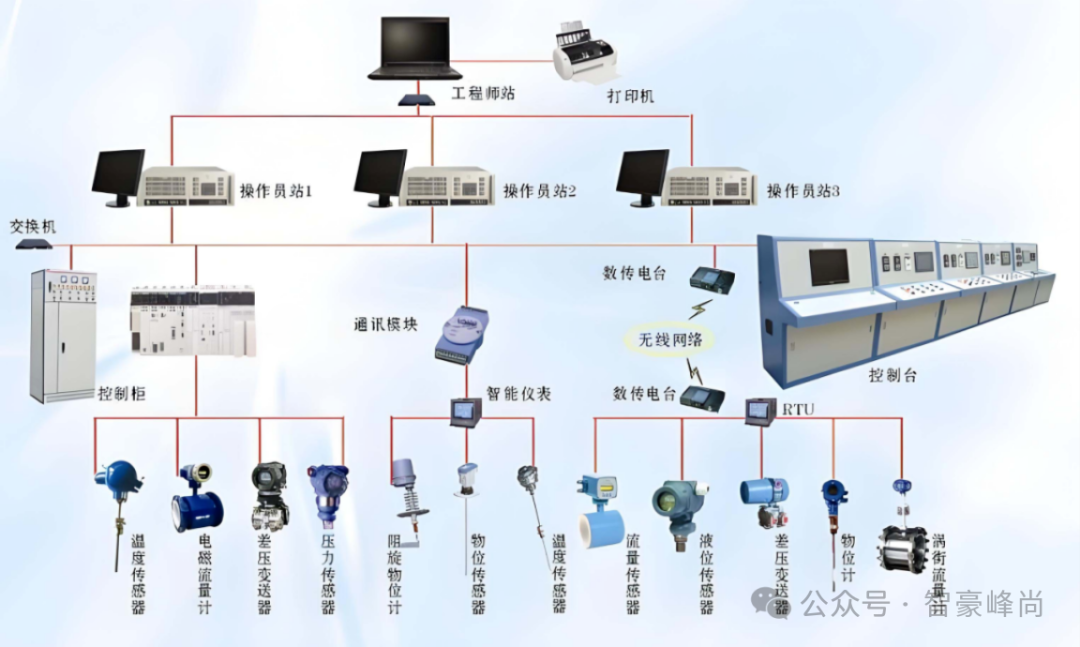
A computer monitoring system is a complex system that comprehensively utilizes computer technology, automation technology, and communication technology to achieve all-round monitoring and management of industrial production processes. Its core lies in the centralized monitoring and management of the entire site through the computer in the central control room, while combining on-site instruments, programmable logic controllers (PLCs), and distributed control system (DCS) substations located in different workshops and process segments to complete local adjustments, control, and data collection, thereby constructing an organic whole.
(1) Hardware Composition
1. Central Control Computer: As the “brain” of the entire monitoring system, it possesses powerful data processing and computing capabilities, able to quickly receive and analyze data from various sites and issue control commands. It typically uses high-performance server-grade computers equipped with multi-core processors, large-capacity memory, and high-speed storage devices to ensure smooth and stable system operation.
2. On-site Instruments: A wide variety, including temperature sensors, pressure sensors, flow sensors, liquid level sensors, and other types of detection instruments, they act as the “tentacles” of the system, sensing various physical parameters in the production process in real-time and converting them into electrical or digital signals to upload to the upper control system. For example, in chemical production, temperature sensors can accurately measure the temperature inside the reaction kettle, providing critical data for controlling the reaction process.
3. Programmable Logic Controller (PLC): A digital computer specifically designed for industrial applications. It uses programmable memory to store user-oriented instructions for executing logical operations, sequential control, timing, counting, and arithmetic operations, and controls various types of machinery or production processes through digital or analog input/output interfaces. PLCs are widely used in industrial control due to their high reliability, strong anti-interference capability, simple programming, and flexibility. For instance, in a tobacco production line, PLCs can precisely control the start and stop of various devices, their operating speeds, and action sequences, ensuring a smooth production process.
4. Distributed Control System (DCS): DCS is a distributed control system composed of multiple substations. Each substation is responsible for controlling and collecting data from specific areas or process segments, and then transmitting the data to the central control room via a communication network. Substations typically include controllers, input/output modules, etc., enabling decentralized control of on-site equipment while maintaining real-time communication with the central control computer for centralized management. In power systems, DCS substations can monitor and adjust equipment such as generator sets and substations in real-time, ensuring the safety and stability of power production.
5. Communication Network: This is the “nervous system” connecting the central control computer and on-site equipment, responsible for data transmission and exchange. Common communication networks include industrial Ethernet and field buses (such as Profibus, Modbus, etc.). Industrial Ethernet has advantages such as high speed, reliability, and good openness, suitable for large data volume transmission; field buses, on the other hand, have low cost, strong real-time performance, and strong anti-interference capabilities, making them more suitable for use in industrial environments. Through the communication network, data from on-site devices can be transmitted to the central control computer in a timely manner, and control commands from the central control computer can also be quickly issued to on-site devices, achieving real-time monitoring and control of the production process.
(2) Software Composition
1. Operating System: Provides the basic operating environment and resource management functions for the computer monitoring system, commonly including Windows Server, Linux, etc. These operating systems are characterized by high stability, strong reliability, and good compatibility, capable of supporting the operation of various industrial software and ensuring long-term stable operation of the system.
2. Monitoring Software: The core software of the computer monitoring system, responsible for data collection, processing, display, alarm, control, and other functions. It typically features a user-friendly human-machine interface, allowing operators to intuitively understand the operational status of the production process through a graphical interface, monitor various parameters in real-time, and perform remote operations and controls. Monitoring software also possesses powerful data processing capabilities, enabling analysis, statistics, and storage of collected data, providing a basis for production management and decision-making. For example, by analyzing historical data, potential issues and optimization opportunities in the production process can be identified, allowing for corresponding measures to improve production efficiency and product quality.
3. Database Management System: Used to store and manage the large amounts of data generated by the monitoring system, including real-time data, historical data, alarm data, etc. Common database management systems include Oracle, SQL Server, MySQL, etc. Database management systems ensure data security, integrity, and consistency, and provide efficient data query and retrieval functions, facilitating user analysis and utilization of data.
4. Control Algorithm Software: Based on the characteristics and control requirements of the production process, corresponding control algorithm software is developed to achieve precise control of the production process. Control algorithm software typically employs advanced control theories and technologies, such as PID control, fuzzy control, predictive control, etc., automatically adjusting control parameters based on actual operating conditions to keep the production process in an optimal state. For example, in chemical production, control algorithm software can precisely control parameters such as temperature, pressure, and flow in the reaction kettle, ensuring the smooth progress of chemical reactions and improving product quality and production efficiency.
2. Characteristics of Computer Monitoring Systems
(1) Hardware Characteristics
1. High Reliability: The complex industrial production environment requires extremely high reliability of equipment. The hardware of computer monitoring systems employs a series of reliability design measures, such as redundancy technology, anti-interference design, and heat dissipation design. For example, the central control computer typically uses dual-machine hot backup or clustering technology, so that when one computer fails, the other can immediately take over, ensuring uninterrupted system operation; on-site instruments and equipment use materials and designs with strong anti-interference capabilities, allowing stable operation in harsh environments with strong electromagnetic interference, high temperatures, and high humidity.
2. Strong Real-time Performance: The real-time monitoring and control of the production process require the system to respond quickly to changes in on-site equipment. The hardware of computer monitoring systems possesses high-speed data collection and processing capabilities, able to complete data collection, transmission, and processing in a very short time, and promptly issue control commands. For instance, the scanning cycle of a PLC is typically in the millisecond range, allowing for quick responses to changes in on-site input signals, achieving real-time control of equipment.
3. Good Expandability: With the development of industrial production and improvements in processes, computer monitoring systems need to have good expandability to easily add new devices and functions. The hardware architecture of the system typically adopts a modular design, with various modules connected through standard interfaces, allowing users to flexibly configure the system according to actual needs, adding or replacing hardware devices, such as adding new sensors, controllers, or expanding input/output modules.
4. Strong Compatibility: In industrial production, there are often various brands and models of equipment. The hardware of computer monitoring systems needs to have good compatibility, enabling seamless connection and communication with various on-site devices. For example, the communication network supports multiple communication protocols, allowing compatibility with devices produced by different manufacturers, achieving data sharing and collaborative work between devices.
(2) Software Characteristics
1. Rich Functionality: The software of computer monitoring systems covers multiple aspects such as data collection, processing, display, alarm, control, and data analysis, capable of meeting different levels of needs in the industrial production process. Operators can monitor various parameters of the production process in real-time through the software interface, promptly identify abnormal situations and take corresponding measures; management personnel can use data analysis functions to understand the operational status of the production process, providing a basis for production decision-making.
2. Good Usability: The software typically features a user-friendly human-machine interface, employing graphical and visual designs, making it simple and intuitive to operate, easy for operators to get started. Even non-professionals can become proficient in using the monitoring system after simple training. For example, monitoring software displays the status of the production process through intuitive flowcharts, dashboards, and trend graphs, allowing operators to easily understand the production situation.
3. Strong Customizability: Different industrial production processes have different characteristics and needs, so the software of computer monitoring systems needs to have customizability, allowing for personalized development based on users’ actual needs. Software developers typically provide rich development tools and interfaces, enabling users to perform secondary development of the software according to their process requirements and control strategies to achieve specific functions.
4. High Stability: The software design and development process fully considers the complexity and stability requirements of the industrial production environment, employing a series of stability assurance measures, such as data verification, error handling, and memory management. The software undergoes rigorous testing and validation, maintaining stable and reliable operation over long periods, avoiding production accidents caused by software failures.
3. Wide Application of Computer Monitoring Systems in Process Industries
(1) Tobacco Industry
In the tobacco production process, computer monitoring systems precisely monitor and control each link. From the storage, fermentation, cutting, rolling, to packaging of tobacco leaves, the system monitors parameters such as temperature, humidity, and weight in real-time, ensuring product quality consistency. For example, during the fermentation of tobacco leaves, the monitoring system precisely controls the temperature and humidity of the fermentation chamber, achieving optimal fermentation results and enhancing the flavor and quality of the tobacco. At the same time, the monitoring system can also monitor the status of production equipment, promptly identify potential equipment failures, and conduct maintenance in advance, ensuring production continuity, improving production efficiency, and reducing production costs.
(2) Chemical Industry
Chemical production is characterized by high temperatures, high pressures, flammability, explosiveness, and complex processes, requiring extremely high safety and process control. Computer monitoring systems play a crucial role in the chemical industry. They monitor parameters such as temperature, pressure, flow, and liquid level of equipment like reaction kettles, pipelines, and storage tanks in real-time, immediately issuing alarm signals upon detecting anomalies and automatically taking corresponding control measures, such as adjusting valve openings or stopping material feeding, to prevent accidents. By optimizing control of the production process, monitoring systems can improve product conversion rates and quality, reduce energy consumption and raw material waste, and achieve safe, efficient, and green development in chemical production.
(3) Power Industry
The stable operation of power systems is crucial to the national economy and people’s livelihoods, and computer monitoring systems are key technologies to ensure the safety and reliability of power production, transmission, and distribution. In power plants, monitoring systems monitor and adjust equipment such as generator sets, boilers, and steam turbines in real-time, ensuring efficient operation of the units; in substations, monitoring systems monitor and control equipment such as transformers, circuit breakers, and relay protection devices, achieving safe transmission and distribution of electricity. At the same time, monitoring systems can also analyze and predict the load conditions of the power grid in real-time, rationally dispatching power resources to ensure stable operation of the power grid and improve the reliability of power supply and power quality.
(4) Metallurgical Industry
The metallurgical production process involves high-temperature smelting, rolling, forging, and other links, with strict requirements for equipment operating status and production processes. Computer monitoring systems achieve comprehensive monitoring and automated control of the production process in the metallurgical industry. By monitoring parameters such as temperature, pressure, and composition of equipment like blast furnaces, converters, and electric furnaces, production processes are optimized to improve metal recovery rates and product quality. In steel rolling production lines, monitoring systems precisely control parameters such as rolling speed, pressure, and roll gap, achieving high-precision rolling of steel to meet different user requirements for steel dimensions and performance. Additionally, monitoring systems can also perform fault diagnosis and predictive maintenance on equipment, reducing equipment failure rates, improving production efficiency, and extending equipment lifespan.
(5) Food Processing Industry
The food processing industry has extremely high requirements for hygiene safety and product quality. Computer monitoring systems monitor the entire process of raw material procurement, storage, processing, and packaging in food processing. By monitoring indicators such as temperature, humidity, and microbial content in the production environment, the monitoring system ensures that the food processing process meets hygiene standards. On production lines, monitoring systems conduct real-time detection of equipment operating status, product weight, and packaging integrity, promptly removing non-conforming products to ensure the stability and consistency of product quality. At the same time, monitoring systems can also implement traceability management of production data, allowing for quick identification of causes and corresponding measures in case of quality issues, ensuring consumer food safety.
As one of the core technologies for the modernization of process industries, computer monitoring systems, with their comprehensive architecture and excellent characteristics, play an irreplaceable role in various fields such as tobacco, chemicals, power, metallurgy, and food processing. They not only improve production efficiency and ensure product quality but also make significant contributions to safe production and energy conservation. With continuous technological advancements, computer monitoring systems will continue to innovate and develop, providing stronger technical support for the intelligent and green transformation of process industries, driving the industrial sector towards a higher level of development.