
The initial concept of the Internet of Things (IoT) is generally believed to have been proposed by Professor Ashton from MIT’s Auto-ID Center in 1999 during his research on RFID. At that time, it was referred to as a sensor network, defined as: a network concept where any object is connected to the Internet for information exchange and communication through information sensing devices such as RFID, infrared sensing, global positioning systems, and laser scanners, according to agreed protocols, to achieve intelligent identification, positioning, tracking, monitoring, and management.
In 2005, the definition of IoT changed in a report released by the International Telecommunication Union (ITU), significantly expanding its scope. It no longer referred solely to IoT based on RFID technology but proposed a vision of interconnection between any objects at any time and place, the development of ubiquitous networks and computing. Beyond RFID technology, sensor technology, nanotechnology, and intelligent terminals have also seen broader applications today.
In China, the concept of IoT has gained deep recognition through strong support from the government and enterprises. The current IoT has been labeled as “Chinese-style”, meaning that IoT connects ubiquitous terminal devices and facilities, including sensors with “intrinsic intelligence”, mobile terminals, industrial systems, building control systems, home intelligent facilities, video surveillance systems, and “intelligent objects or animals” or “intelligent dust” with “external enabling” such as various assets tagged with RFID, individuals and vehicles carrying wireless terminals. This is achieved through various wireless and wired long-distance and short-distance communication networks for interconnection (M2M), large-scale application integration, and computer-based SaaS operations, under the environments of intranets, private networks, and the Internet, adopting appropriate information security mechanisms to provide secure, controllable, and even personalized real-time online monitoring, positioning tracking, alarm linkage, dispatch command, contingency management, remote control, security prevention, remote maintenance, online upgrades, statistical reports, and decision support management and service functions, achieving efficient, energy-saving, safe, and environmentally friendly management, control, and operation of “everything”.
IoT System
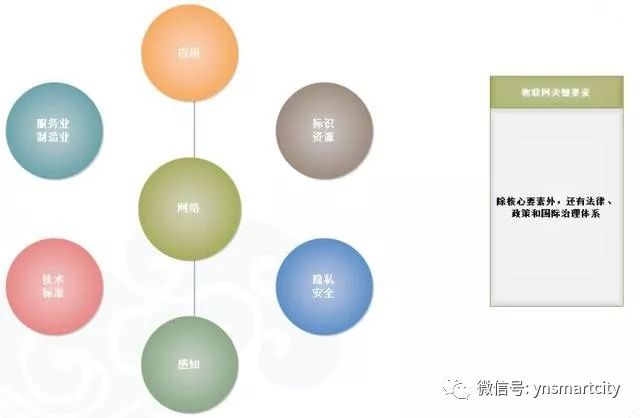
[Basic Elements of IoT]
The key elements for the development of IoT include a network architecture composed of perception, network, and application layers, IoT technologies and standards, IoT-related industries including services and manufacturing, resource systems, privacy and security, and legal, policy, and international governance systems that promote and regulate IoT development.
IoT Network Architecture
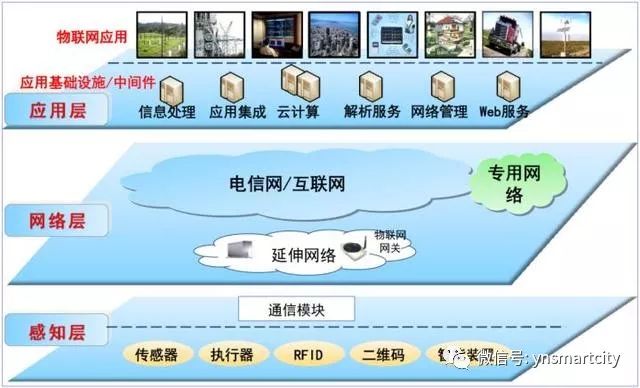
The IoT network architecture consists of the perception layer, network layer, and application layer.
The perception layer realizes intelligent perception and recognition of the physical world, information collection processing, and automatic control, connecting physical entities to the network layer and application layer through communication modules.
The network layer mainly facilitates the transmission and routing of information, including extended networks, access networks, and core networks. The network layer can rely on public telecommunication networks and the Internet, or it can utilize industry-specific communication resources.
The application layer includes application infrastructure/middleware and various IoT applications. Application infrastructure/middleware provides general foundational services, capabilities, and resource invocation interfaces for IoT applications, enabling various applications of IoT across many fields.
IoT Technology System
IoT involves various technical fields such as perception, control, network communication, microelectronics, software, embedded systems, and MEMS, making the key technologies involved in IoT very diverse. To systematically analyze the IoT technology system, it can be divided into key technologies for perception, network communication, application, common technologies, and supporting technologies.
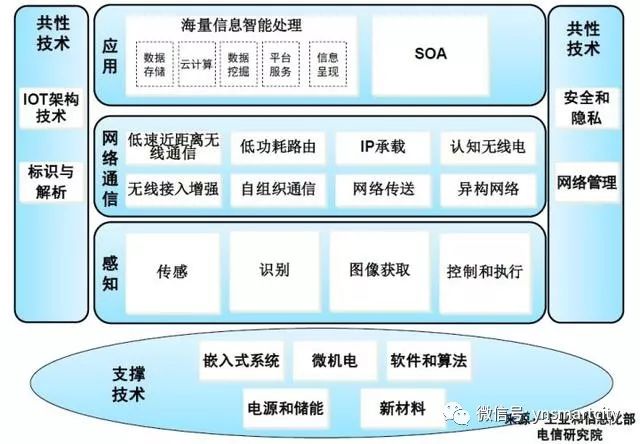
[Key Technologies for Perception, Network Communication, and Application]
Sensing and recognition technologies are the primary stages in obtaining information and controlling objects in the IoT. Sensors convert physical quantities, chemical quantities, and biological quantities from the physical world into digital signals available for processing, while recognition technologies acquire object identification and location information within the IoT.
[Key Technologies for Network Communication]
Network communication technology primarily enables the bidirectional transmission, routing, and control of IoT information and control information, focusing on low-speed short-range wireless communication technologies, low-power routing, self-organizing communication, enhanced M2M communication, IP carrying technology, network transmission technology, heterogeneous network integration technology, and cognitive radio technology.
[Key Technologies for Applications]
Massive intelligent information processing integrates high-performance computing, artificial intelligence, databases, and fuzzy computing technologies to process collected sensing data, focusing on data storage, parallel computing, data mining, platform services, and information presentation. Service-oriented architecture (SOA) is a loosely coupled software component technology that modularizes different functional modules of applications and connects them through standardized interfaces and invocation methods, enabling rapid reusable system development and deployment.
[Supporting Technologies]
Supporting technologies for IoT include embedded systems, MEMS, software and algorithms, power and energy storage, and new materials technology.
[Common Technologies]
Common technologies for IoT design across different network layers mainly include architecture technology, identification and resolution, security and privacy, and network management technology.
IoT Standardization System
IoT standards are the high ground in the international competition of IoT technologies. Since IoT involves different professional technical fields and applications across various industries, its standards must cover foundational public technologies for different applications and technical standards that meet industry-specific needs: including national standards as well as industry standards.
The IoT standard system is relatively complex. It can be initially constructed from five levels: overall IoT standards, perception layer standards, network layer standards, application layer standards, and common key technology standards.
[Overall IoT Standards]
Including IoT guidelines, overall IoT architecture, and IoT business requirements.
[Perception Layer Standards]
Mainly involve electrical and data interfaces for various information acquisition devices such as sensors, common technical standards for perception data models, description languages, and data structures, RFID tag and reader interfaces and protocol standards, and specific industry and application-related perception layer technical standards.
[Network Layer Standards]
Mainly involve IoT gateways, short-range wireless communication, self-organizing networks, simplified IPv6 protocols, low-power routing, enhanced machine-to-machine wireless access and core network standards, M2M modules and platforms, network resource virtualization standards, and heterogeneous integrated network standards.
[Application Layer Standards]
Including application layer architecture, intelligent information processing technologies, and industry and public application standards. The application layer architecture focuses on object-oriented service architecture, including SOA architecture, business process management for upper-layer applications, communication protocols between business processes, metadata standards, and SOA security architecture standards. Standards for intelligent information processing technologies include cloud computing, data storage, data mining, and massive intelligent information processing and presentation. Cloud computing technology standards focus on open cloud computing interfaces, open virtualization architecture for cloud computing (resource management and control), cloud computing interoperability, and cloud computing security architecture.
[Common Key Technology Standards]
Including identification and resolution, quality of service, security, and network management technology standards.
Identification and resolution standards include coding, resolution, authentication, encryption, privacy protection, management, and multi-identifier interoperability standards.
Security standards focus on security architecture, security protocols, authentication and encryption technologies supporting various network integrations, user and application privacy protection, virtualization and anonymization, and service-oriented adaptive security technology standards.
IoT Industry
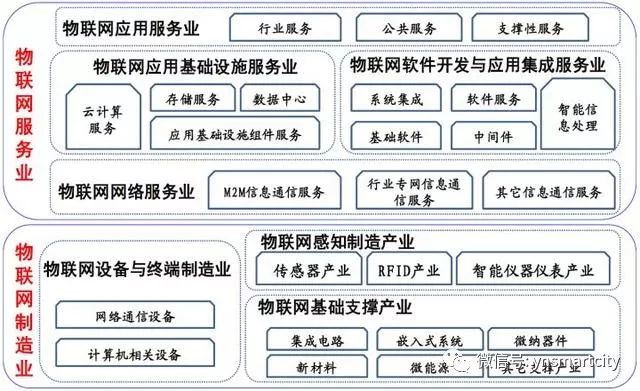
[Industry System]
The IoT-related industry refers to the collection of related industries necessary to realize IoT functions, primarily consisting of the service and manufacturing sectors.
The IoT manufacturing sector mainly focuses on the manufacturing of sensing end devices, where the high intelligence of sensing end devices is closely related to embedded systems. The high precision of devices relies on foundational industries such as integrated circuits, embedded systems, micro-nano devices, new materials, and micro-energy. Some computer equipment and network communication devices are also part of the IoT manufacturing sector.
The IoT service sector mainly includes four categories: IoT network services, IoT application infrastructure services, IoT software development and application integration services, and IoT application services. IoT application infrastructure services primarily include cloud computing services, storage services, etc. IoT software development and integration services can be further divided into basic software services, middleware services, application software services, intelligent information processing services, and system integration services. IoT application services can be divided into industry services, public services, and support services.
Most of the IoT industry belongs to the information industry, but it also involves other industries, such as smart meters. The development of the IoT industry is not a reorganization of existing information industries but creates new markets and forms through applications. Overall, it can be divided into three scenarios:
1. The enhancement of existing industries due to IoT applications, mainly reflected in product upgrades, such as sensors and RFID, which have developed for decades. As IoT applications upgrade to intelligent networks, they achieve significant expansions in product functionality, application range, and market scale, with the sensor and RFID industries becoming the core of IoT perception terminal manufacturing.
2. The horizontal market expansion of existing industries due to IoT applications, mainly reflected in field extension and quantitative expansion. For example, servers, software, embedded systems, and cloud computing have expanded new market demands due to IoT applications, forming new growth points.
3. Unique markets and services created and derived from IoT applications, such as sensor network devices, M2M communication devices and services, and IoT application services, are new business forms that emerged after the development of IoT.
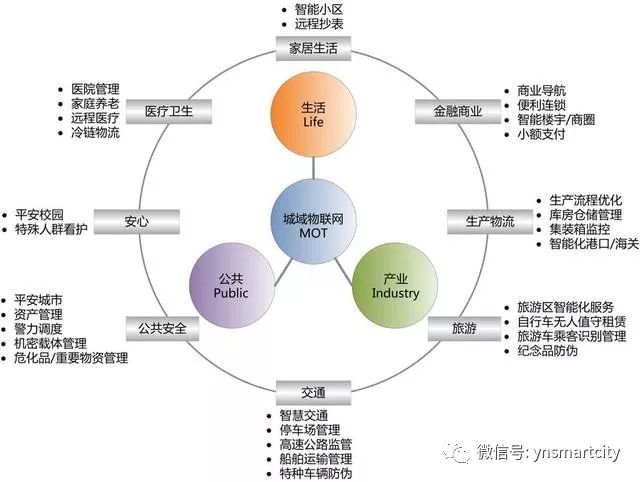
We hope that through this article, everyone can form their understanding of IoT fundamentals. For those who want to learn more specific cases, I have a lot of materials; feel free to leave a message.
We focus on the latest trends in the IoT industry, dedicated to being your pocket knowledge base for IoT, aiming to build a collaborative learning knowledge platform, making it convenient for you to learn and communicate freely; DINGKU IOT Tribe (dkiot888) is committed to being your “good servant”. DINGYI HONGJI always adheres to the artisan spirit, responsible for every piece of Chinese manufacturing.

Disclaimer: This article is an excerpt or reprint from the internet, and the copyright belongs to the original author. The content represents the personal views of the original author and does not represent the views of this public account or its responsibility for its authenticity. If there are copyright issues, please contact us, and we will delete the content as soon as possible!