

July 3
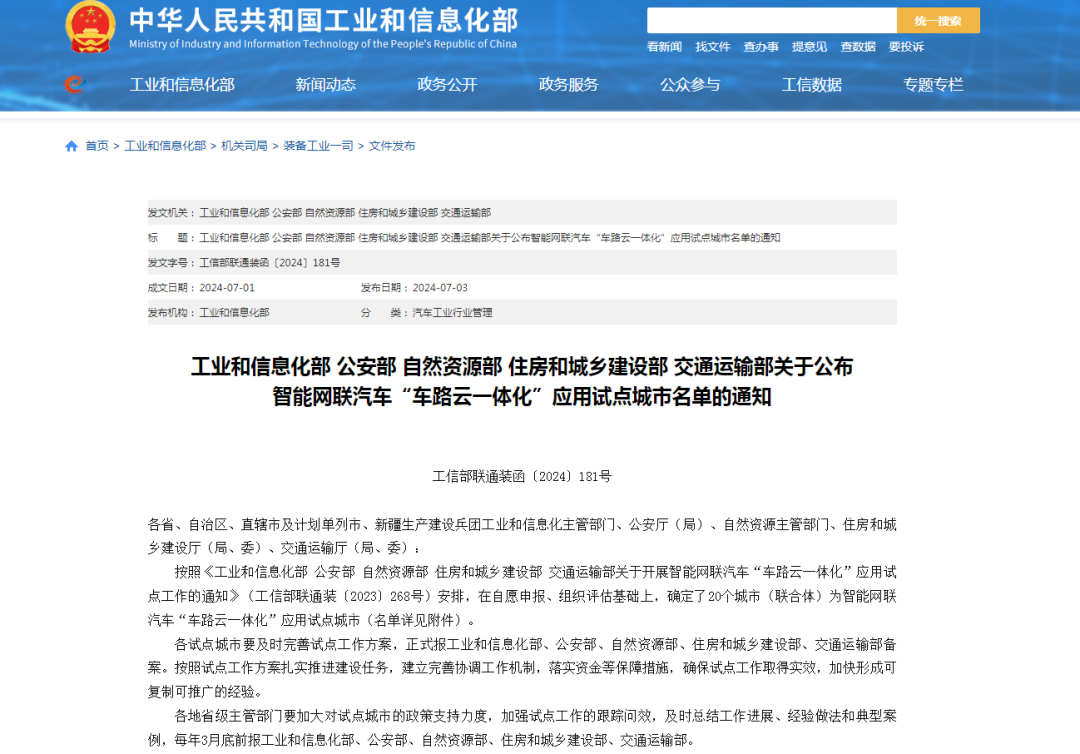
Ministry of Industry and Information Technology, Ministry of Public Security
Ministry of Natural Resources, Ministry of Housing and Urban-Rural Development
Ministry of Transport jointly announced
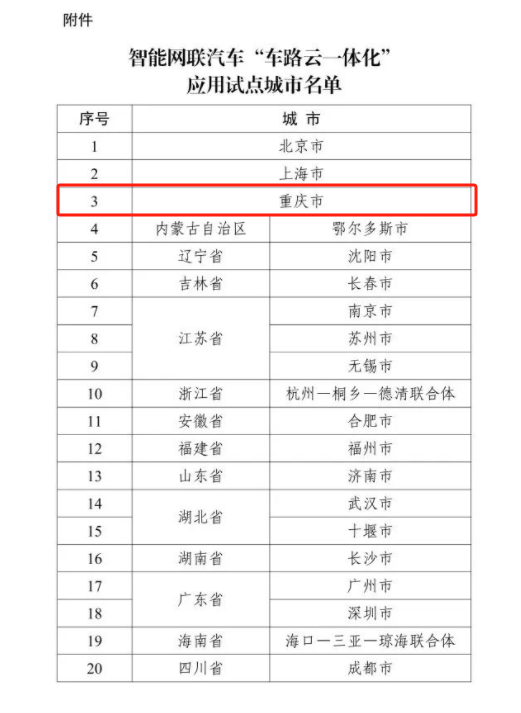
the list of pilot cities for smart connected vehicles “Integrated Vehicle-Road-Cloud”
Chongqing has been selected
↓↓↓
What advantages does Chongqing have?
Currently, three districts in the city are conducting demonstration applications for smart connected vehicles:
● Within the jurisdiction of the Western Science City in Chongqing High-tech Zone, a demonstration area project for “Integrated Vehicle-Road-Cloud” is under construction, along with a completed autonomous driving demonstration line project;
● Within the jurisdiction of Liangjiang New Area, a vehicle-road collaboration project, a national-level vehicle networking pilot area project, and a high-level autonomous driving demonstration line project have been completed;
● Within the jurisdiction of Yongchuan District, a Western autonomous driving open testing base project, an autonomous driving bus demonstration operation project, and an autonomous driving innovation demonstration center project have been completed.The next step is to create a sustainable development benchmark city for “Integrated Vehicle-Road-Cloud” covering an area of over 5,000 square kilometers, with road mileage exceeding 5,000 kilometers, a population of over 11 million, and supporting over 1 million service vehicles, achieving unified system architecture and standards, forming complete service capabilities, and supporting the exploration of segmented business models.About smart connected vehicles“Integrated Vehicle-Road-Cloud” pilot application workYou may also want to know these↓↓↓
What is the application and selection process for the pilot?
Application process. The pilot application work is voluntarily applied for by cities, and cities wishing to participate in the pilot must prepare an application according to the requirements of the “Notice on Conducting Pilot Applications for Smart Connected Vehicles ‘Integrated Vehicle-Road-Cloud'”. The provincial-level industrial and information authorities, in conjunction with public security, natural resources, housing and urban-rural development, and transportation authorities, will review the application and jointly issue written recommendations, sending relevant materials to the Ministry of Industry and Information Technology, Ministry of Public Security, Ministry of Natural Resources, Ministry of Housing and Urban-Rural Development, and Ministry of Transport (hereinafter referred to as the five departments).
Selection process. The five departments jointly formed a working group to organize the preparation of the “Management Measures for the Review of Pilot Applications for Smart Connected Vehicles ‘Integrated Vehicle-Road-Cloud'” and conducted the review work based on this, which mainly includes material form review, expert meeting review, and on-site defense review. The material form review mainly examines the qualifications of the applicant, the completeness and authenticity of the application materials, and whether the procedures are complete. The expert meeting review mainly scores the relevant content in the application materials and forms review opinions, and the working group confirms the cities participating in the on-site defense review based on the comprehensive expert opinions. The on-site defense review invites each city to modify and improve the application plan according to expert opinions and participate in the on-site defense, where review experts score and form review opinions, and the working group determines the list of pilot cities after comprehensive evaluation and following the appropriate procedures.
How does this pilot ensure the overall requirements of “same architecture, unified standards, interoperable business, and safe and reliable”?
Firstly, regarding the same architecture, pilot cities should further optimize and improve the construction plan for “Integrated Vehicle-Road-Cloud” under the guidance of the five departments, clarifying the interrelationships among the components of “vehicle, road, cloud, network, map, and safety”, and develop a platform construction plan based on a three-tier cloud platform architecture of central cloud, regional cloud, and edge cloud, creating a unified platform foundation, while building a cloud service platform that supports diverse applications based on their respective development characteristics.
Secondly, regarding unified standards, the five departments organize relevant standardization organizations and industry institutions to jointly develop the standard system for vehicle-road-cloud integration and recommended standards for pilot applications, sorting out relevant national standards, industry standards, and group standards that support pilot applications, using technical standards to support pilot applications. In the early stages of the pilot, plans are formulated and implemented based on mature standards, accumulating practical experience and relevant data during the process to support the improvement of the standard system and the formulation of related standards, aiming to establish a unified and shared standard system for smart connected vehicles’ “Integrated Vehicle-Road-Cloud” by 2026.
Thirdly, regarding interoperable business, pilot cities should achieve interoperability between the cloud control basic platform, urban traffic safety comprehensive service management platform, traffic information management public service platform, urban information model platform, and other platforms based on unified architecture and technical standards, breaking down data “silos” between different fields and regions, achieving the sharing of common basic data, and the cross-domain sharing of infrastructure, services, and platforms, supporting the exploration of business models for intelligent assisted driving, autonomous driving, intelligent transportation, and smart cities across various scenarios at the city and intercity levels.
Fourthly, regarding safety and reliability, each pilot city should adhere to a safety bottom line, coordinate the relationship between development and safety, further strengthen the research and improvement of relevant policies and regulations, timely issue local regulations and management requirements as appropriate, and enhance the full-process safety assurance capabilities such as risk prevention, hidden danger investigation, and emergency response, meeting national regulatory requirements for road traffic safety, network security, data security, and geographic information security during the industry development process.
What are the expected outcomes of this pilot application?
Firstly, to establish low-latency, highly reliable connected cloud control infrastructure. Aiming to cover the entire pilot city, continuously improving the coverage of intelligent roadside infrastructure and cloud control basic platforms; by deploying standardized connected cloud control infrastructure at scale, meeting the consistency and continuity needs of smart connected vehicles’ cross-regional services, comprehensively enhancing the installation rate and effectiveness of onboard connected terminals, laying the foundation for nationwide large-scale application promotion.
Secondly, to promote large-scale applications of autonomous driving in multiple scenarios. In conjunction with the needs of smart cities, intelligent transportation, and industrial development, pilot applications for smart buses, smart passenger vehicles, autonomous parking, urban logistics, and automated delivery in multiple scenarios will be carried out according to local conditions, continuously meeting the growing public demand for mobile travel and the operational needs of vehicles in different commercial scenarios, comprehensively enhancing urban traffic safety levels and travel efficiency.
Thirdly, to explore and form new business models for “Integrated Vehicle-Road-Cloud” investment and operation. Clarifying the commercial operation entities for the pilot of smart connected vehicles’ “Integrated Vehicle-Road-Cloud”, encouraging the exploration of investment and joint operation development models involving state-owned platforms, vehicle manufacturers, operators, technology companies, etc., and exploring the formation of new business models characterized by mutual integration, division of labor, and shared benefits.
Fourthly, to establish a unified standard and testing evaluation system. By jointly conducting standard research work, constructing a unified and shared standard system for smart connected vehicles’ “Integrated Vehicle-Road-Cloud” as well as intelligent transportation, vehicle intelligent management, basic mapping, etc., and establishing a comprehensive testing evaluation system for “Integrated Vehicle-Road-Cloud”, fully supporting the testing and verification capabilities of smart connected vehicles in simulation, closed courses, and actual roads.
How will this pilot application continue with previously supported testing areas, vehicle networking pilot areas, and dual-intelligence pilot projects?
Currently, there are 17 national-level intelligent connected vehicle testing areas, 7 vehicle networking pilot areas, and 16 dual-intelligence pilot cities established nationwide, with over 32,000 kilometers of open testing roads, more than 7,700 testing licenses issued, and over 120 million kilometers of testing mileage, with over 8,700 intelligent roadside units (RSUs) deployed in various locations, and many places have begun building cloud control basic platforms. However, the construction of “Integrated Vehicle-Road-Cloud” in various regions is still in its early stages, and a complete system architecture has not yet been established, with infrastructure construction exhibiting a “fragmented” phenomenon, making it difficult to support the large-scale application of autonomous driving technology and networking functions.
The pilot application for smart connected vehicles’ “Integrated Vehicle-Road-Cloud” will fully leverage the foundational work of previous testing areas, vehicle networking pilot areas, and dual-intelligence pilot projects to promote the implementation and large-scale application of smart connected vehicles’ “Integrated Vehicle-Road-Cloud” technology. Firstly, further expanding the pilot scope through unified architectural design, promoting urban-level construction and contiguous infrastructure construction in urban clusters, breaking down the “fragmented, siloed” single-point deployment, achieving larger-scale and broader application practices. Secondly, emphasizing the coordinated development of all aspects such as vehicle, road, cloud, network, map, and safety, highlighting the empowering role of networking, covering collaborative warning, collaborative driving assistance, and collaborative autonomous driving applications of different levels from a scenario perspective. Thirdly, further clarifying the organizational mechanism, establishing a collaborative working mechanism for pilot applications led by local leaders with participation from relevant departments, clarifying the construction and operation entities for the “Integrated Vehicle-Road-Cloud” pilot, and exploring business models for infrastructure investment, construction, and operation.
How can pilot application cities fully leverage their main role to implement organizational work?
Pilot application cities should further optimize and improve the construction plan for “Integrated Vehicle-Road-Cloud” under the guidance of the five departments, doing a good job in top-level design planning, and solidly advancing construction tasks according to the pilot work plan.
Firstly, fully leveraging the role of the city-level collaborative working mechanism to form a joint force in supporting policies, funding input, construction planning, and safety supervision, pragmatically promoting implementation.
Secondly, determining the city-level “Integrated Vehicle-Road-Cloud” construction and operation entity, exploring a full lifecycle model of intelligent connected infrastructure “construction, management, operation, service, and research” according to the government-led, market-driven operational approach.
In addition, the provincial-level authorities of the pilot cities should increase policy support for pilot cities, coordinate the interconnectivity of roadside infrastructure and urban-level cloud control basic platforms within the province, promote the “outward radiation” of pilot cities and contiguous construction between cities, while strengthening the tracking and evaluation of pilot application work, timely summarizing work progress, experiences, advanced models, and typical cases.
What is the comprehensive evaluation mechanism for pilot application cities?
The five departments will form an expert committee to jointly strengthen the overall guidance and comprehensive evaluation of pilot application work.
Firstly, requiring each city to promptly summarize and report construction progress, existing problems, advanced models, and typical cases, completing the report by the end of March each year.
Secondly, regularly organizing relevant experts to conduct surveys and research on pilot application cities, carrying out annual construction progress and application effect evaluations of pilot application cities, and promptly forming expert guidance opinions on identified problems, summarizing and promoting advanced experiences and typical practices from the pilot.
Thirdly, carefully studying the matters that pilot application cities need support from the central level, promoting the resolution of major issues during the pilot process.
Fourthly, suspending the pilot qualification of entities found to have safety hazards or failing to implement pilot work as required, urging pilot application cities to promptly rectify and eliminate safety hazards, and terminating the pilot qualification of entities with serious safety hazards or those that do not rectify safety hazards in a timely manner.
(Source: Chongqing Release)

Editor-in-Chief: Du Shulin | Deputy Editor-in-Chief: Zhang Ke
Chief Editor: Fu Siying, Cao Mei | Editor: Zhang Tingting
Liangjiang New Area Media Center Produced
Reproduction without permission is prohibited
Statement: Except for original content and special instructions, the text and images of the manuscript are sourced from the internet and major mainstream media. Copyright belongs to the original author. If you believe the content infringes copyright, please contact us for deletion.