During the learning process of C++, we are often taught that each object containing virtual functions has a virtual function pointer (vptr) that points to a virtual function table (vtable). This simplified understanding is completely correct in the context of single inheritance, but it obscures an important truth in the C++ object model: in multiple inheritance, an object may have multiple virtual function pointers..
Today, let us delve into this important detail that is often overlooked by most tutorials.
The Simple World of Single Inheritance
In single inheritance, the situation is indeed straightforward:
class Animal {
public:
virtual void speak() = 0;
virtual void eat() = 0;
};
class Dog : public Animal {
public:
void speak() override { cout << “Woof!” << endl; }
void eat() override { cout << “Eating dog food” << endl; }
virtual void fetch() { cout << “Fetching ball” << endl; }
};
Memory Layout:
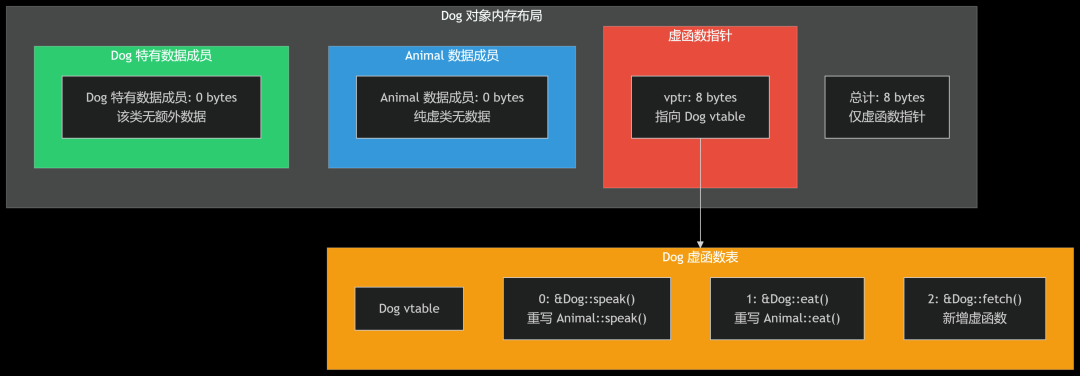
In single inheritance, each object indeed has only one vptr, pointing to a consolidated virtual function table.
The Complex Reality of Multiple Inheritance
When we enter the world of multiple inheritance, the situation fundamentally changes:
class Flyable {
public:
virtual void fly() = 0;
virtual void land() = 0;
};
class Swimmable {
public:
virtual void swim() = 0;
virtual void dive() = 0;
};
class Duck : public Animal, public Flyable, public Swimmable {
public:
void speak() override { cout << “Quack!” << endl; }
void eat() override { cout << “Eating grains” << endl; }
void fly() override { cout << “Flying” << endl; }
void land() override { cout << “Landing” << endl; }
void swim() override { cout << “Swimming” << endl; }
void dive() override { cout << “Diving” << endl; }
};
The Truth About Multiple vptrs
A Duck object actually contains three virtual function pointers:

Why Multiple vptrs Are Needed?
1. Independent Interface Contracts – Each base class represents an independent interface – Needs to maintain the integrity of their respective virtual function tables
2. this Pointer Adjustment Requirements
Duck duck;
Flyable* flyable = &duck; // Pointer position needs adjustment!
flyable->fly(); // The this pointer must be correct during the call
3. Avoiding Interface Pollution – Each base class’s virtual function table only contains methods relevant to that interface – Maintaining clear interface boundaries
Thunk Functions: Hidden Pointer Adjusters
In multiple inheritance, the compiler generates special thunk functions to handle this pointer adjustments:
// Compiler-generated thunk function (conceptual code)
void Flyable_fly_thunk(Flyable* this) {
// Calculate the actual address of the Duck object
Duck* duck_this = reinterpret_cast(
reinterpret_cast(this) – offsetof(Duck, flyable_part)
);
duck_this->fly(); // Call the actual implementation
}
Actual Verification: Checking Object Size
We can verify this phenomenon using sizeof:
cout << “Animal size: ” << sizeof(Animal) << endl; // Typically 8 bytes (vptr)
cout << “Flyable size: ” << sizeof(Flyable) << endl; // Typically 8 bytes (vptr)
cout << “Swimmable size: ” << sizeof(Swimmable) << endl;// Typically 8 bytes (vptr)
cout << “Duck size: ” << sizeof(Duck) << endl; // Typically 24+ bytes (3*vptr + data)
Performance Impact and Optimization Considerations
Memory Overhead
– Each additional base class incurs the overhead of one vptr (typically 8 bytes)
– Multiple virtual function tables occupy additional static storage space
Call Performance
// The performance of these calls differs!
duck.speak(); // Direct call, fastest
animalPtr->speak(); // Single vptr lookup, relatively fast
flyablePtr->fly(); // Requires thunk adjustment, slower
Optimization Suggestions
1. Prefer single inheritance
2. Use interface inheritance instead of implementation inheritance
3. Consider using composition instead of multiple inheritance
4. Be aware of the additional overhead of virtual base classes
Real-World Application Scenarios
1. COM Interface Implementation
class MyCOMObject : public IUnknown, public IDispatch, public IMyInterface {
// Each COM interface requires an independent vptr
// This is a requirement of the COM specification
};
2. Component Systems in Game Development
class GameObject : public Transform, public Renderable, public Collidable, public Updatable {
// Each functional component has an independent interface
// Multiple vptrs ensure clear interface separation
};
3. Cross-Platform Abstraction Layers
class PlatformWindow : public WindowInterface, public EventHandler, public GraphicsContext {
// Different platform implementations share the same interface
// Multiple vptrs maintain interface consistency
};
Debugging Tips: Observing Multiple vptrs
In the debugger, you can observe the existence of multiple vptrs:
Duck duck;
Animal* animal = &duck;
Flyable* flyable = &duck;
// Check in the debugger:
// animal and flyable have different values!
// They point to different offset positions of the Duck object
Conclusion: Embrace Complexity and Make Informed Choices
The multiple vptr mechanism in C++ demonstrates the wisdom of language designers in addressing complexity issues:
1. Maintain Compatibility: Each base class retains an independent virtual function table structure
2. Ensure Correctness: Thunk functions guarantee the correctness of the this pointer
3. Provide Flexibility: Support complex design patterns and multiple interface implementations
Key Takeaways: – Multiple inheritance indeed leads to the existence of multiple vptrs – This design ensures the independence and correctness of interfaces – Understanding this mechanism helps in writing more efficient code – Weigh functionality against performance overhead in design decisions
Next time you design a complex class hierarchy, remember: each virtual base class may bring an additional virtual function pointer. This awareness will help you make more informed design decisions, writing C++ code that is both powerful and performant.
The C++ object model is both complex and elegant, and understanding its details is a necessary path to becoming an advanced C++ developer. The existence of multiple vptrs is not a flaw of the language, but a reasonable solution to the complexities of reality.