01Basic Understanding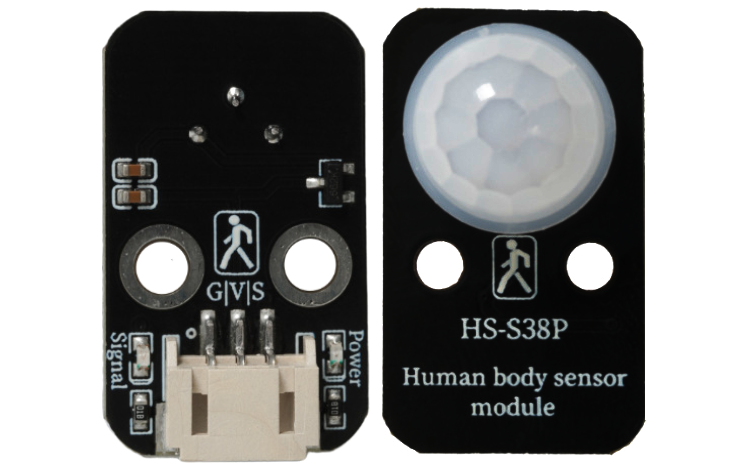 Model:HS-S38PName:Human SensorSeries:SensorDescription:This is a human presence detection module based on the principle of infrared pyroelectricity, equipped with a Fresnel lens and signal processing circuit. It can capture the changes in infrared thermal radiation emitted by the human body and output high/low level signals to achieve the intelligent sensing function of “triggered by human presence, delayed off after leaving.” It is a core component for security warning and energy-saving control.Usage Scenarios:Automatically control lighting in smart homes (e.g., corridor lights turn on when someone arrives and turn off when they leave); detect abnormal intrusions in security systems (e.g., triggering alarms during unmanned periods); automatic ventilation in bathrooms (fan starts when someone is present); energy-saving for office equipment (automatically turn off monitors after people leave); assistive technology for the disabled (triggering doors or calling devices for those with mobility issues); build an “interactive sensing system” in AI education for primary and secondary schools to understand infrared detection and human perception principles, in line with the “General Education Guidelines for Artificial Intelligence in Primary and Secondary Schools (2025 Edition)” practical requirements.Disciplinary Integration:Physics, Biology, Labor, Information TechnologyEthical Education:The detection range of the human sensor may involve privacy areas (e.g., bedrooms), requiring clarity on the reasonableness of installation locations; false triggers (e.g., pets causing lights to turn on) may lead to energy waste, discussing the adaptation of “sensitivity grading” for different scenarios; data recording (e.g., activity periods) may leak life patterns, necessitating regulation of data usage; over-reliance on automatic sensing may reduce energy-saving awareness, requiring a balance between technological convenience and proactive savings; different environments (e.g., high-temperature areas) may affect detection accuracy, prompting consideration of the significance of “multi-sensor fusion” to enhance reliability.
02Technical Parameters
Working Principle::
The core of the module is a pyroelectric infrared sensor that can sense the 8-14μm infrared radiation emitted by the human body (around 36°C). The Fresnel lens focuses the infrared signal onto the sensor. When a person moves, the intensity of infrared radiation changes, and the sensor outputs a weak electrical signal, which is processed through amplification, filtering, and comparison circuits to output a high level (indicating detection of a person); after the person leaves, a delay circuit controls the signal to return to a low level (default delay of 2-300 seconds adjustable).
Parameter Analysis:
G(GND): Power input negative/ground
V(VCC):Power input positive/positive
S(Signal):Signal output interface
Detection Range: 3-7 meters (unobstructed, affected by installation height)Detection Angle: ±60° (horizontal direction, determined by lens angle)Delay Time: 5-200 seconds (adjustable via potentiometer, time to maintain high level after person leaves)Trigger Method: Motion-triggered (static persons may not be detected)03Code Example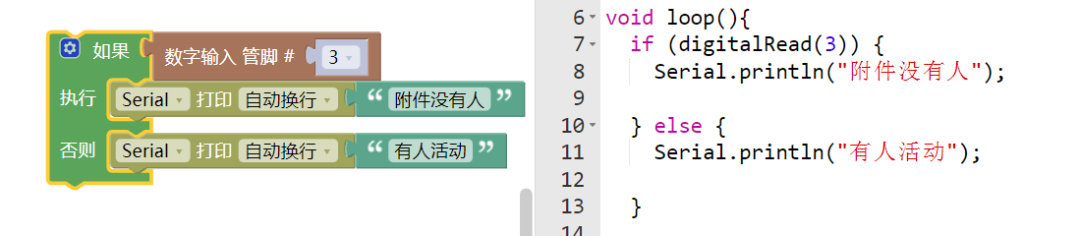
The connection pin is D3.
04Safety Measures
1.Power off before wiring, confirm the positive and negative terminals of VCC and GND; reverse connection may burn the signal processing circuit;
2. Avoid direct exposure to strong heat sources (e.g., heaters, incandescent lamps) to prevent infrared radiation interference leading to false triggers;
3. During installation, keep away from fans and air conditioning outlets, as airflow may cause sensor misoperation;
4. Do not touch or wipe the Fresnel lens to prevent scratches that affect infrared focusing;
5. Do not use in humid environments (humidity > 85% RH), as moisture may cause circuit short circuits;
6. Avoid moving quickly in front of the sensor during debugging to prevent frequent triggers affecting judgment;
7. When not in use for a long time, power off and store to avoid component aging.
05Extensions
Students can try the following methods:
1. Create an “intelligent sensing light”: link with an LED module to automatically turn on the light when a person is detected, and turn off after a delay;2. Build a “security alarm system”: combine with HS-F07P active buzzer to trigger an alarm during unmanned periods;3. Design an “energy-saving office assistant”: connect to a computer USB relay to automatically turn off the monitor after a person leaves;4. Develop an “accessibility controller”: install in elderly rooms to automatically light up night lights when someone gets up and trigger call buttons. Arduino Sensor: HS-S01A Infrared SensorArduino Sensor: HS-S02P Infrared Sensor (Obstacle Avoidance)Arduino Sensor: HS-S03P Ultraviolet SensorArduino Sensor: HS-S05P Sound SensorArduino Sensor: HS-F07P Active BuzzerArduino Sensor: HS-S08P Flame SensorArduino Sensor: HS-S09LB Raindrop SensorArduino Sensor: HS-S09PC Soil Moisture Sensor
Arduino Sensor: HS-S10P Fog Sensor
Arduino Sensor: HS-S11-L Gas Sensor
Arduino Sensor: HS-S20P Ambient Light Sensor
Arduino Sensor: HS-S21P Tilt SensorArduino Sensor: HS-S22P Grayscale SensorArduino Sensor: HS-S23P Infrared Receiver ModuleArduino Sensor: HS-S24P Digital Temperature SensorArduino Sensor: HS-S26A Temperature and Humidity SensorArduino Sensor: HS-S28P Potentiometer
Arduino Sensor: HS-S29P Infrared Transmitter Module
Arduino Sensor: HS-S30P Clock Module
Arduino Sensor: HS-S31P Touch Sensor
Arduino Sensor: HS-S32L Rotary Encoder Module
Arduino Module: HS-S34P Dual-axis Joystick Module
Arduino Module: HS-S37PS Water Level Sensor

— Previous Recommendations —