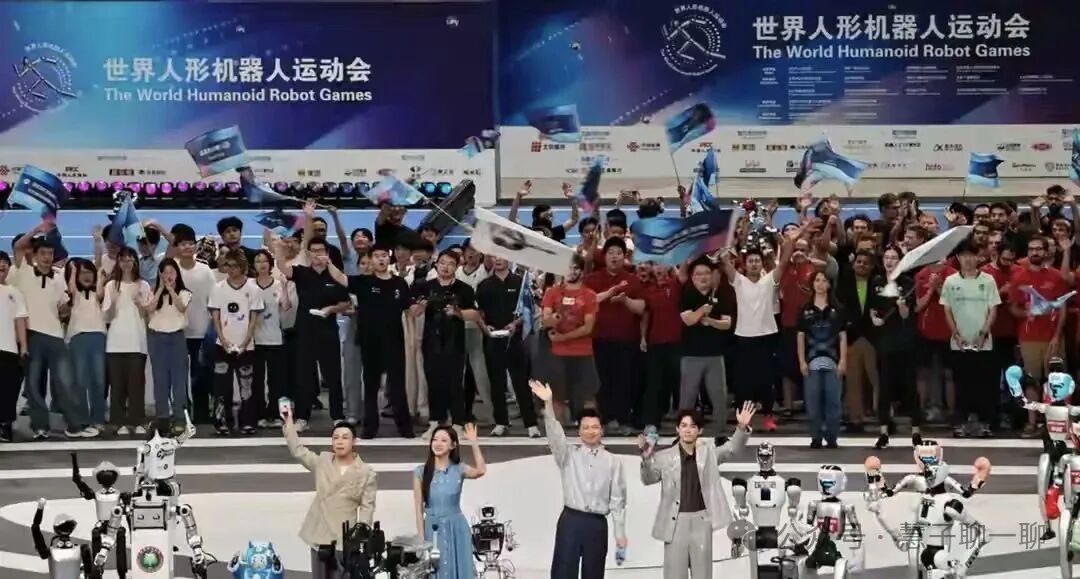
You may have never thought that one day, the precision of robots marching in formation would make human instructors feel ashamed. This is not a scene from a science fiction movie. On August 14, 2025, under the dome of the National Speed Skating Hall in Beijing, 25 accelerated evolution BoosterT1 robots appeared in a 5×5 formation at the opening ceremony of the World Humanoid Robot Games. They were not guided by remote controls, nor were there operators nearby for protection; they completed their movements with an error of no more than 0.5 degrees solely through autonomous decision-making, resembling a well-trained honor guard. This seemingly simple performance conceals technological secrets that could rewrite the history of robot development. From ‘wobbling’ to ‘iron legion’, a limit challenge about synchronization Three years ago, humanoid robots could only stagger in a straight line, but now they must perform coordinated movements, a challenge comparable to teaching kindergarten children to dance the ballet “Swan Lake.” Maintaining balance for a single robot is already difficult, and when 25 move simultaneously, any tiny error can be magnified.
For instance, if the robot on the left steps too quickly by 0.1 seconds, or if the sensor of the robot on the right is disturbed by strong light, it could cause the formation to collapse into a “drunken gathering.” The solution from BoosterT1 is remarkable; each robot’s foot pressure sensors and gyroscopes form a “digital brain”, adjusting joint torque 1000 times per second, like 25 acrobats sharing a single nervous system.
Even more astonishing is their “collective intelligence.” When the venue’s air conditioning suddenly blows strong winds, the edge robots can sense the disturbance through millimeter-wave radar and instantly share the data with the entire formation. In less than 20 milliseconds, all robots adjust their step frequency synchronously, like puppets pulled by invisible strings. This real-time anti-interference capability comes from the open-source 3v3 decision-making algorithm developed by Accelerated Evolution, originally used for cooperative defense in robot soccer matches, now providing military-grade stability for the formation performance. Dissecting the black technology: the technological revolution hidden in “marching in place” A closer look at the robots’ “iron feet” reveals that each foot has 128 pressure sensing points, more sensitive than human foot nerves. They do not stomp rigidly; instead, they mimic the biological “rolling gait”. When the heel touches the ground, it absorbs impact, and when the forefoot pushes off, it releases elastic potential energy, even accounting for shoe sole wear. This bionic design reduces energy consumption by 40%, providing enough endurance for continuous marching during a parade. The real “strongest brain” is hidden in the cloud. Each robot connects to a distributed computing power pool via a 5G private network, with quantum encryption channels ensuring communication security. When robot number 3 prepares to slow down due to battery overheating, it will notify its teammates to adjust their speed 300 milliseconds in advance, just like the lead bird in a flock. This predictive collaboration allows the movement error of the 25 robots to be controlled within 0.3 degrees, imperceptible to the human eye, which is stricter than the 0.8-degree standard of professional honor guards. From the laboratory to the battlefield, an ultimate test of trust The most shocking aspect of this performance is the word “unprotected“. Previous robot demonstrations always included safety ropes and emergency stop buttons, like the safety supports on a baby walker. This time, the organizers boldly removed all safety measures, allowing 25 robots worth over ten million to move freely. This confidence stems from extreme testing; the development team had the formation walk in heavy rain, subjected it to strong electromagnetic interference, and even deliberately knocked over the lead robot, yet the entire formation could self-heal its formation in 1.2 seconds. This reliability is opening up possibilities for military and disaster relief applications. The Tokyo Fire Department in Japan has tested similar robots to enter the ruins of the Fukushima nuclear power plant; their advantage lies not in individual capabilities but in collective cooperation. When 10 robots form a detection network, the efficiency of radiation data collection increases by 17 times. On the battlefield in Ukraine, bomb disposal teams have begun using robot formations to scan minefields synchronously, with images of them advancing “hand in hand” with metal detectors resembling the formation at the opening ceremony. Cold reflections behind the celebration: when robots learn to unite, what about humans? After the performance, Zhao Weichen, Vice President of Accelerated Evolution, revealed an intriguing detail: to enable high school teams to quickly get started, they packaged the core algorithms into a “robot collaboration development kit”, as simple to assemble as LEGO blocks. As a result, the youngest participant, 16-year-old Lin Jiayi from Singapore, taught 6 robots to dance street dance in just two weeks. This democratization of technology embodies a more important concept than mechanical synchronization: the future does not belong to the strongest individual, but to the most collaborative group. As we leave the venue, the setting sun gilds the robots’ metal frames. Their neatly lined silhouettes resemble soldiers awaiting inspection, or students preparing for a break exercise. Perhaps in the near future, when rescue robots form a human chain to traverse earthquake ruins, and construction robots build aerial corridors, humanity will remember the summer of 2025, when 25 robots demonstrated terrifying precision in synchronization on that icy blue field, proving for the first time that even steel bodies can perform a collective dance. What we must do is learn to dance with this new legion, neither blindly worshiping nor arrogantly underestimating, but maintaining reverence and clarity, just as we do with all technologies that change the world.