From Beginner to Abandonment in Rust Concurrency: Thread Pool Edition

Comparison Summary of Rust Thread Pool Libraries 2.1 Rayon Thread Pool •Core Features: Based on a data parallel model, automatically manages the thread pool, supports <span>join</span> for parallel task execution•Advantages: •Threads are reusable, avoiding the overhead of frequent creation/destruction•Automatically adjusts the number of threads based on CPU core count•Provides <span>scope</span> to create child threads, supporting … Read more


C++ Multithreading Magic Guide: Build Your Own Thread Factory

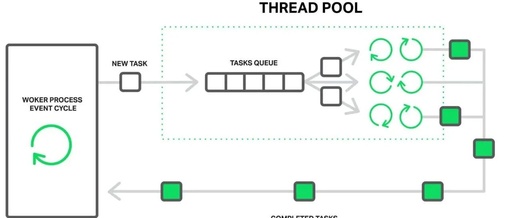
Stop hiring temporary workers on the street; build your own factory. A thread pool is essentially a factory. It employs a fixed number of workers (threads) and continuously receives tasks (work) that these workers will complete in turn. This is the core idea of a thread pool: Instead of hiring a worker for each task … Read more

Linux Kernel (11) – Work Queue Management

Linux Kernel (11) - Work Queue Management

Linux Kernel (11) – Work Queue Management Problem Traditional Work Queue In previous content, we mentioned the work queues that follow interrupts, including shared work queues and custom work queues, which indicate that time-consuming tasks will be assigned threads for processing. The above image illustrates the setup of a traditional work queue. CPU Queue: The … Read more

Thread Pool Design and Lock Optimization in C++ Multithreading and Concurrency

Thread Pool Design and Lock Optimization in C++ Multithreading and Concurrency

1. Thread Pool Design Concept: A thread pool is a mechanism for managing thread resources, where a certain number of threads are created in advance. When a task is submitted, a thread is obtained from the pool to execute the task, and after the task is completed, the thread is not destroyed but returned to … Read more

Why the C++ STL Does Not Include a Built-in Thread Pool? Exploring the Design Philosophy of the Standard Library and the Evolution of Concurrency

Why the C++ STL Does Not Include a Built-in Thread Pool? Exploring the Design Philosophy of the Standard Library and the Evolution of Concurrency

Click the blue text to follow the author 1. Introduction In the era of multi-core processors, to efficiently utilize computing resources, the thread pool has become an important concurrency model, suitable for server-side applications, high-performance computing, and various scenarios that need to handle a large number of concurrent tasks. By pre-creating and managing a set … Read more

Implementation of a Thread-Safe Signal and Slot Mechanism Based on C++17

Implementation of a Thread-Safe Signal and Slot Mechanism Based on C++17

Why do we need our own “Qt-style communication mechanism”? In GUI programming, asynchronous systems, and event-driven architectures, signals and slots are a classic design pattern. They enable loose coupling communication between objects, avoiding complex callback nesting and direct dependencies. The signal-slot mechanism in the Qt framework is well-known, but it relies on a large meta-object … Read more

Multithreaded Programming in Embedded Linux

Multithreaded Programming in Embedded Linux

Multithreaded Programming in Embedded Linux 1. What is a Thread? 1.1 Essence of Threads A thread is the smallest execution unit scheduled by the operating system, sharing the resources of a process (memory, files, etc.), but possessing independent: Stack space (for storing local variables) Register state (program counter, etc.) Thread ID and priority 1.2 Comparison … Read more

Quick Mastery of New C++ Features: High-Performance Thread Pool Design and Implementation in C++11

Quick Mastery of New C++ Features: High-Performance Thread Pool Design and Implementation in C++11

Overview This is a high-performance thread pool implemented based on the C++11 standard, featuring the following characteristics: Supports any function as a task: Can execute regular functions, member functions, lambda expressions, etc. Supports obtaining return values: Asynchronously obtain task execution results through the std::future mechanism Type-safe: Ensures type safety using C++11 template deduction Efficient synchronization: … Read more

Recommended Linux C++ Project: File Server + How to Quickly Get Started with Large C++ Projects

Recommended Linux C++ Project: File Server + How to Quickly Get Started with Large C++ Projects

1 The Significance of This Sharing Source code address: https://github.com/shangguanyongshi/WebFileServer.git Video explanation:https://www.bilibili.com/video/BV1bGkPYzExW/ After learning C++ and Linux programming, you can use the WebFileServer file server as a practical project. It is more meaningful than the WebServer project as it includes file upload functionality. This sharing not only explains how to run the WebFileServer project but … Read more

C# Thread Pool: Concurrency Control Explained

C# Thread Pool: Concurrency Control Explained

C# Thread Pool: Concurrency Control Explained Hello everyone! Today I want to talk about the ThreadPool in C# and concurrency control. In modern application development, effectively using the thread pool can significantly enhance program performance and avoid the overhead of frequently creating and destroying threads. Let’s dive into this powerful feature! What is a Thread … Read more