Why is the goto Statement Rarely Used in Embedded C Programming?
Why is the goto Statement Rarely Used in Embedded C Programming?

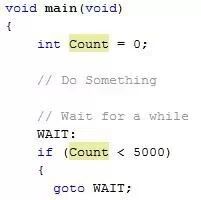
1 What is the goto Statement? The goto statement is known as a jump statement in C language. It is used for an unconditional jump to another label, transferring control to another part of the program. The goto statement is generally used infrequently because it worsens the readability and complexity of the program.Syntax: Example of … Read more

Terminal Beautification in Python: Generate Colorful JSON Trees with 4 Lines of Code

Terminal Beautification in Python: Generate Colorful JSON Trees with 4 Lines of Code

Hello everyone, I am Programmer Wan Feng. My learning website is: www.python-office.com, focusing on AI and Python automation for office tasks.[1] 1. Concepts and Principles During development, we often need to output JSON data in the terminal. However, the default JSON output is usually monochrome, making it difficult to quickly identify the data structure. Terminal … Read more

Why Embedded C Programming Prefers Typedef?

Why Embedded C Programming Prefers Typedef?

Click the above“Embedded and Linux Matters”, select“Pin/Star the Official Account” Welfare and valuable content delivered promptly Abstract: Different projects have different coding styles and “quirks”. After reading enough code, you will find that some code prefers macros while others prefer using typedef. So what are the benefits of using typedef? Why do many people like … Read more

Deconstructing High-Frequency C++ Interview Questions: What Problems Did C++11 Lambda Solve?

Deconstructing High-Frequency C++ Interview Questions: What Problems Did C++11 Lambda Solve?

Learning website for technical articles:https://www.chengxuchu.com Hello everyone, I am Chef, a programmer who loves cooking and has obtained a chef qualification certificate. When writing C++ code, especially when dealing with callbacks, algorithms, or asynchronous operations, you may often encounter situations where you need to write a large number of function objects or define additional functions. … Read more

Understanding the C Language typedef Keyword with Ease

Understanding the C Language typedef Keyword with Ease

In the C language, programmers often encounter complex type definitions, especially when writing embedded systems or microcontroller programs, where certain complex types are frequently used. To make the code more concise and readable, we can use a very useful tool—<span>typedef</span>. 1. Basic Usage of <span>typedef</span>: <span>typedef</span> serves to define a new name for an existing … Read more

A Detailed Explanation of Function Pointers in C++

A Detailed Explanation of Function Pointers in C++

Author:PhyJack https://www.cnblogs.com/phyjack/p/18445368 Overview This article provides a detailed introduction to pointers of ordinary functions and member functions of classes in C/C++. It explains practical techniques for using function pointers as inputs to other functions, return values, and how typedef can enhance code readability, illustrated with C++ code examples. For member function pointers of classes, the … Read more

Detailed Explanation of Labeling Techniques for Unit Length in Assembly Language

Detailed Explanation of Labeling Techniques for Unit Length in Assembly Language

1. Basic Concept of Labels In assembly language, a label is a symbolic name used to mark memory addresses. In 8086 assembly, there are two types of labels: Regular Labels: Represents only the address of a memory unit Labels with Unit Length: Represents not only the address but also implicitly includes the length information of … Read more

Practical Insights on C Language: The Ternary Operator – More Elegant than If, But Misuse Can Lead to Pitfalls!

Practical Insights on C Language: The Ternary Operator - More Elegant than If, But Misuse Can Lead to Pitfalls!

Scan the code to follow Chip Dynamics and say goodbye to “chip” bottlenecks! Search on WeChatChip Dynamics There is an unwritten rule in the programming world: if you can write one line, never write two. Thus, the ternary operator (?:) has become our excellent tool for “laziness”— It makes the code shorter, faster, and… harder … Read more

Code Style in C Language: The Importance of Uniformity

Code Style in C Language: The Importance of Uniformity

Code Style in C Language: The Importance of Uniformity In programming, the readability and maintainability of code are extremely important. Especially in a relatively low-level programming language like C, a good code style not only improves team collaboration efficiency but also reduces the likelihood of errors. This article will detail the code style in C … Read more

Enhancing C Language Code Readability: The Importance of Standards and Comments

Enhancing C Language Code Readability: The Importance of Standards and Comments

Enhancing C Language Code Readability: The Importance of Standards and Comments When writing C language programs, code readability is a crucial factor. Highly readable code not only facilitates understanding and maintenance by others but also helps developers quickly review their own thought processes. This article will discuss the importance of standards and comments in improving … Read more