

Wi-Fi as an Invisible Eye
Written by | Dongdian TechnologyAuthor | Li PenghuiLayout | Winnie
Estimated reading time: 3 minutes
Cover image source: Ann on Unsplash
Wi-Fi may not only be used for internet access; it can also “recognize” you.
A study from Sapienza University of Rome shows that every person’s body uniquely interferes with Wi-Fi signals, and this interference can be used as a “radio fingerprint” to identify and track individuals, even if they are not carrying a phone or other devices.
This technology, referred to by researchers as “WhoFi,” is a combination of “Who am I + Wi-Fi.” The core principle is that Wi-Fi signals are affected by objects in the environment, including the human body. By analyzing the “Channel State Information” (CSI) in the signals, researchers can capture subtle changes caused by bones, organs, and even body shape, thus extracting a “feature signature” that represents a person.
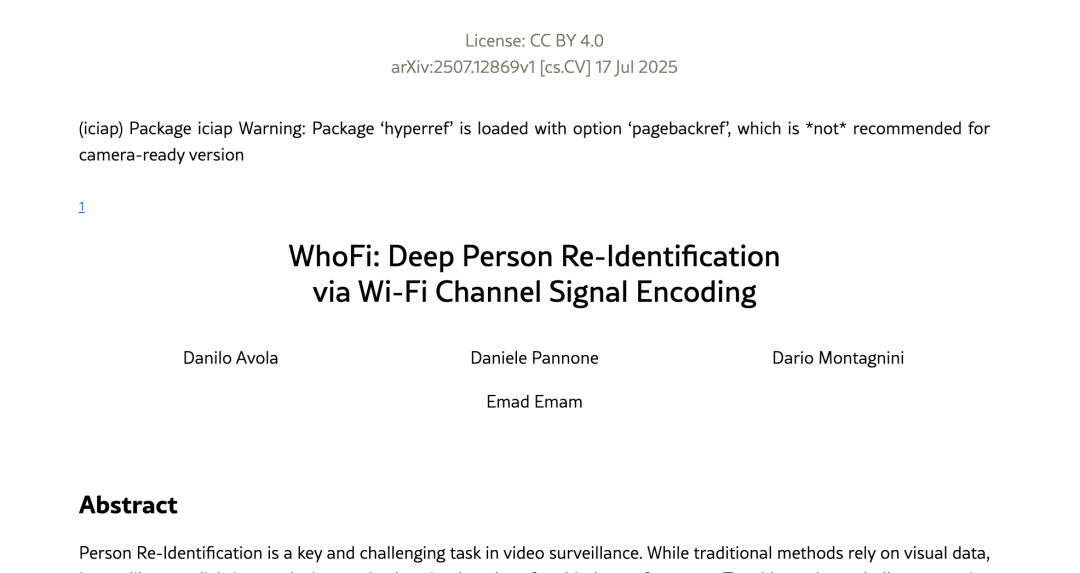
The paper has been published on the preprint platform arXiv.
Unlike traditional video surveillance, this technology does not identify a person’s real identity. Its goal is not to tell you “who this person is,” but to determine “whether this person has appeared before.” In other words, when the same person appears again in another Wi-Fi network coverage area, the system may recognize it as “the same person,” even without knowing their name or identity.
Compared to video systems that rely on lighting, angles, and clothing, Wi-Fi technology has certain advantages: it is not affected by light, can penetrate walls, and does not record images, making it easier to avoid privacy risks. Researchers emphasize that this method is not only robust but may also become a more privacy-friendly biometric identification method.
The deep learning model developed by the research team was tested on the public dataset NTU-Fi, with the version using the Transformer encoding architecture performing best, achieving a Rank-1 accuracy of 95.5%. Even when individuals are in different locations and wearing different clothing, the model can still determine if they are the same person by analyzing Wi-Fi signals.
It is worth mentioning that as early as 2020, another research team proposed a similar technology called EyeFi, which had an identification accuracy of about 75%. The performance of WhoFi indicates significant progress in this direction in recent years.
The authors of the paper state that the biological characteristic information contained in Wi-Fi signals is sufficient to support individual identification. With the development of perception technology, this research provides an important technical pathway for constructing signal-based re-identification systems (Re-ID) and further expands our understanding of “seeing.”
This article is an original piece by Dongdian Technology and may not be reproduced without authorization. For reprints or inquiries, please reply “reprint” in the background.
– – – – – – – – END – – – – – – – –
Discussion Topic
How do you view privacy protection issues when applying this technology?Come and leave your thoughts in the comments!*If you want to get industry news and share insights with like-minded technology enthusiasts, quickly scan the code to add “Dongdian Jun” to join the group chat! There are also occasional benefits distributed in the group!
Recommended Reading



Excellent articles are worth recommending!
One-click forwarding, tap to view!