In today’s world where embedded systems and IoT devices are prevalent, the 51 microcontroller, as the “mentor” for electronic engineers, still holds an important position in industrial control, smart home, and other fields.On this land of China, domestic 51 microcontroller manufacturers are also in fierce competition.
So, who is the “king” of domestic 51 microcontrollers? Today, let’s discuss this matter.
First, let’s take a look at the “status” of the 51 microcontroller.
The 51 microcontroller refers to microcontrollers based on the Intel 8051 architecture, a “veteran” that was born in the 1980s and is still active in various electronic devices today. It was originally designed by Intel and later improved and produced by many companies, forming a large product family. Although the ARM architecture is currently very popular, the 51 microcontroller remains the first choice for many engineers due to its ease of use, low cost, and well-established ecosystem, especially in education, industrial control, and consumer electronics.
What are the main players in the domestic 51 microcontroller market? The main manufacturers include:
1. STC Technology (宏晶科技) : Recognized as the leader in the domestic 51 microcontroller market, its STC series microcontrollers have a significant market share in China. STC Technology has now grown to become the world’s largest 8051 microcontroller design company, offering a full range of products from traditional 51 to the improved STC8 series.
2. Sinowealth (中颖电子) : Focused on the home appliance and industrial control sectors, it leads the MCU market for home appliances. Its product line covers 8-bit to 32-bit MCUs, with unique advantages in motor control and lithium battery management.
3. Chipsea (芯海科技) : Although its Q1 2021 financial report was not promising (net profit -2.93 million), this company, established in 2003, focuses on high-precision ADC and SOC chips, making strides in IoT solutions.
4. Nuvoton (新唐科技) : Provides microcontrollers based on the 8051 architecture, widely used in industrial control and consumer electronics.
The largest and most widespread domestic share belongs to STC. From the classic 89 series to the improved STC15 series and the latest STC8 series, STC offers various pin configurations and packages of 51 microcontrollers, covering almost all application scenarios.
Compared to traditional 51 microcontrollers, STC products have achieved breakthroughs in several areas:
-
Higher operating speeds (with a maximum frequency of over 35MHz)
-
Richer peripheral resources (PWM, ADC, hardware SPI/I2C, etc.)
-
Larger storage space (Flash up to 64KB, and even larger)
-
Lower power consumption design
-
Enhanced anti-interference capability
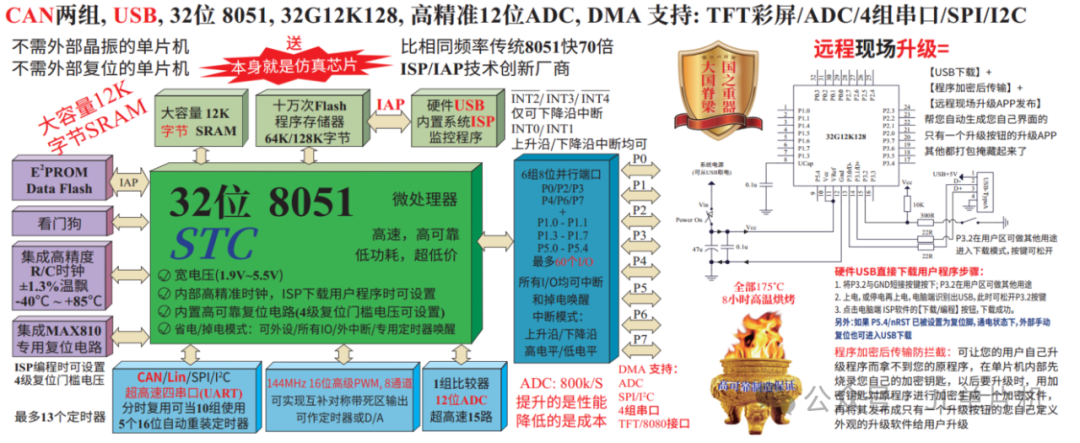
Many people have criticized the STC “alchemy furnace” promotional image.
While STC dominates the general 51 microcontroller market, other manufacturers have also found their niche in specific fields.
Sinowealth performs excellently in the home appliance MCU market, with its products “leading in the home appliance market while deeply cultivating motor control, lithium battery management, and other fields.” Sinowealth’s 51 microcontrollers “have certain advantages in home appliances, motors, and smart instruments.”
Chipsea has taken a different path, focusing on high-precision ADC and SOC chips, with products that “integrate 12-bit ADC, with OTP and Flash types,” suitable for applications requiring high-precision measurements.
Nuvoton‘s 8051 microcontrollers “are designed for industrial temperature specifications, providing a built-in RC oscillator at 22.1184 MHz (1% accuracy), built-in Data Flash, and rich I/O configuration functions,” having a certain market in industrial control.
However, with the development of new technologies such as IoT and artificial intelligence, the performance requirements for MCUs are becoming increasingly high. Although the 51 microcontroller is classic, its architecture was born 40 years ago, and it inevitably struggles in some high-performance application scenarios.
Domestic manufacturers aware of this have begun to plan their transformation:
-
STC Technology is expanding into the 32-bit MCU field while maintaining its advantages in 51 microcontrollers.
-
Sinowealth has already launched 32-bit MCUs based on the ARM Cortex-M series core.
-
Newcomers like GigaDevice have directly skipped the 51 architecture, focusing on 32-bit MCUs based on ARM and RISC-V architectures.