Friends, are you ready to welcome a “major earthquake” in the smartphone industry?
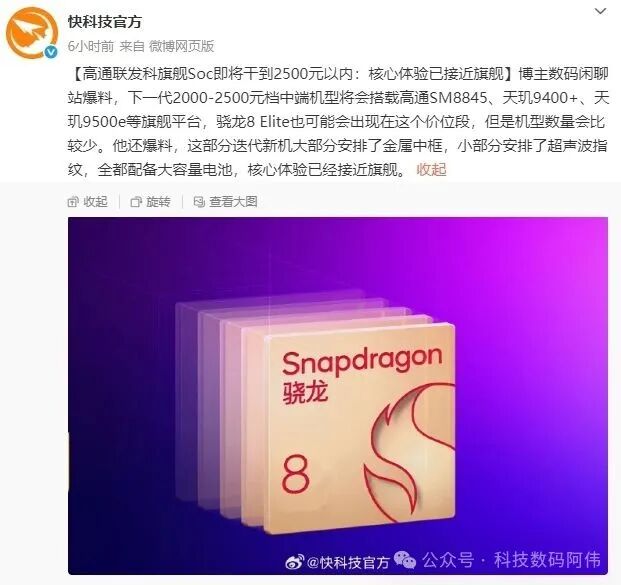
Just when we were accustomed to shelling out four to five thousand yuan or even more for a flagship chip, a bombshell announcement has arrived: Starting next year, the top-tier flagship and upper mid-range chips from Qualcomm and MediaTek will be directly “downgraded” to smartphones priced between 2000 and 2500 yuan! This is not just a simple price drop; it is set to completely reshuffle the pricing structure of the entire smartphone market!
This is not a “youth version”; this is a true “flagship heart”
In the past, when we mentioned mid-range devices, we often thought they were “good enough,” and their performance had to bow to their flagship counterparts. But this time, the situation is completely different.
According to insider reports, next year’s mid-range “super devices” priced at 2500 yuan will be powered by true “flagship hearts”:
Qualcomm’s “performance beast”: Snapdragon SM8845 (likely the successor to Snapdragon 8s Gen4), and even the top-tier Snapdragon 8 Elite is expected to appear in small quantities at this price point.
MediaTek’s “efficiency king”: Dimensity 9400+, Dimensity 9500e, all based on the most advanced 3nm process with full big core architecture, reportedly scoring over 3 million on AnTuTu!
What does this mean? It means that next year, you can spend just over 2000 yuan to get the core performance experience that flagship devices costing five to six thousand yuan can provide. Moreover, these new devices will generally feature metal frames, large capacity batteries, and some models may even come equipped with flagship-level ultrasonic fingerprint sensors. Aside from making some compromises in areas like photography and wireless charging, their core architecture is already incredibly close to that of a true flagship!
“Gods fighting,” why are we the biggest winners?
You might ask, how can such a big pie fall from the sky? Are chip manufacturers and smartphone makers not making money?
Behind this is actually an escalating “battle of the gods,” and we consumers happen to be the lucky ones “picking up equipment” in this war.
1. The “throne battle” between Qualcomm and MediaTek:
Once upon a time, Qualcomm Snapdragon was the undisputed king of the high-end market. However, in recent years, MediaTek has risen with its Dimensity 9000 series, not only boasting powerful performance but also impressive efficiency, snatching a significant share from Qualcomm. Faced with the aggressive MediaTek, Qualcomm must retaliate! Downgrading upper mid-range and flagship chips to the mid-range market is the most effective and direct way to regain market share.This tech race of chasing each other ultimately benefits us consumers.
2. The smartphone manufacturers’ “precise strategy”:
Of course, smartphone manufacturers are not doing charity. The reason they can lower prices is due to a set of “precise strategies.” They invest money in areas that we can perceive the most—performance, quality, and battery life. In less sensitive areas, such as replacing the main camera with a second-tier sensor, cutting out rarely used telephoto lenses, or removing wireless charging, they balance costs. This approach of “using good steel on the blade” perfectly meets the real needs of most users: “I don’t need everything to be top-tier, but I want the core experience to be excellent.”
💡 Learn something new: What’s so great about the “full big core” architecture?
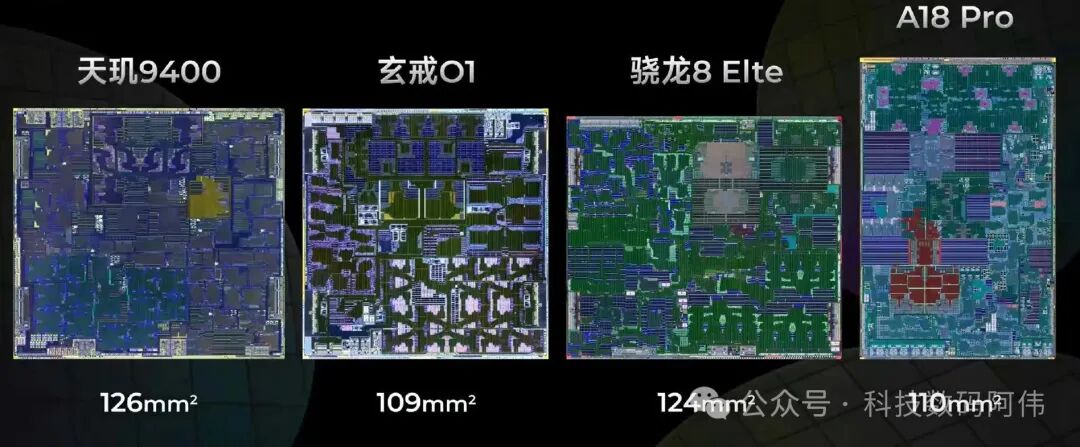
A term that has been repeatedly mentioned in this leak is “full big core architecture” (like the 2+6 self-developed Oryon architecture). How is this different from the “big core + small core” we used to hear?
To put it simply:
Traditional big-little core architecture is like a company that has both “project elites” (big cores) responsible for high-intensity sprint tasks and “staff” (small cores) handling daily trivial work, with clear division of labor and energy-saving during normal times.
In contrast, the “full big core” architecture is like a company full of “project elites” with no “slackers”. Its instantaneous explosive power is extremely strong, and when handling complex tasks (like playing large games or rendering videos), it can mobilize all cores to work together, achieving high efficiency. Of course, the downside is that power consumption may be higher, which tests the heat dissipation and power management capabilities of smartphone manufacturers.
Therefore, when “full big core” chips are introduced into mid-range devices, what we need to focus on is their actual heat dissipation performance, to see if they can allow these “elites” to maintain stable performance.
Conclusion: An era for rational consumers is coming
Without a doubt, 2025 will be the “year of performance accessibility” in the smartphone market.
The downgrading of flagship chips means that “performance” will no longer be the only standard for classifying smartphones. It breaks the inherent perception that “high price = high performance,” allowing us to obtain core experiences that we once dared not imagine with a more rational budget.
What does this mean for us ordinary consumers?
It means you no longer need to overspend to play games smoothly; it means you can invest the money saved in other aspects of life; and it means smartphone manufacturers must think beyond performance to offer us more appealing features, such as better design, more user-friendly systems, and improved after-sales service.
This is undoubtedly a positive transformation. So, if you are thinking about changing your phone but are not in a hurry, then congratulations, you might be the biggest winner of this “patient buyer” wave. Let’s look forward to the “true fragrant” era that belongs to us next year!
So, are you excited about the upcoming “2500 yuan flagship chip” smartphones? Will you choose to wait for it? Feel free to leave your thoughts in the comments!