

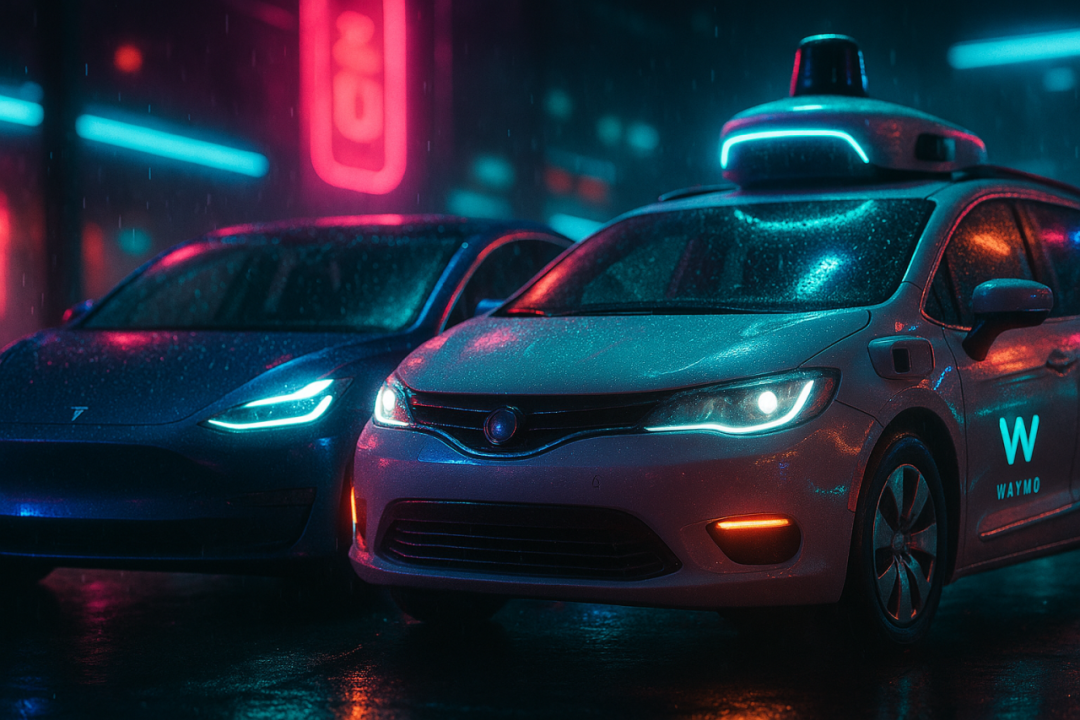
On July 14, Li Yanhong stated at a Baidu executive meeting that Robotaxi (autonomous driving taxis) must switch to a pure vision approach to have a chance, announcing that Baidu’s autonomous driving service platform, Luobo Kuaipao, will completely abandon the multi-sensor fusion route and fully transition to a pure vision technology solution. In the technical path to achieving Full Self-Driving (FSD), the competition between the “pure vision + neural networks” approach represented by Tesla and the “multi-sensor fusion” approach advocated by companies like Waymo (Google’s autonomous taxi) is becoming increasingly intense. The pure vision approach pursues minimalism and maximizes cost-effectiveness by reducing hardware thresholds through algorithmic innovation and data loops; while the multi-sensor fusion approach emphasizes redundancy design and safety first, relying on all-weather perception capabilities and high reliability. The competition between these two approaches not only concerns hardware configuration and algorithm selection but also represents a clash of two fundamentally different technological philosophies, marking a new stage in the battle for fully autonomous driving technology paths.
1. Autonomous Driving Classification Standards
According to the internationally recognized SAE classification standards, autonomous driving technology is divided into six levels from L0 to L5.
Table 1: Autonomous Driving Technology Classification
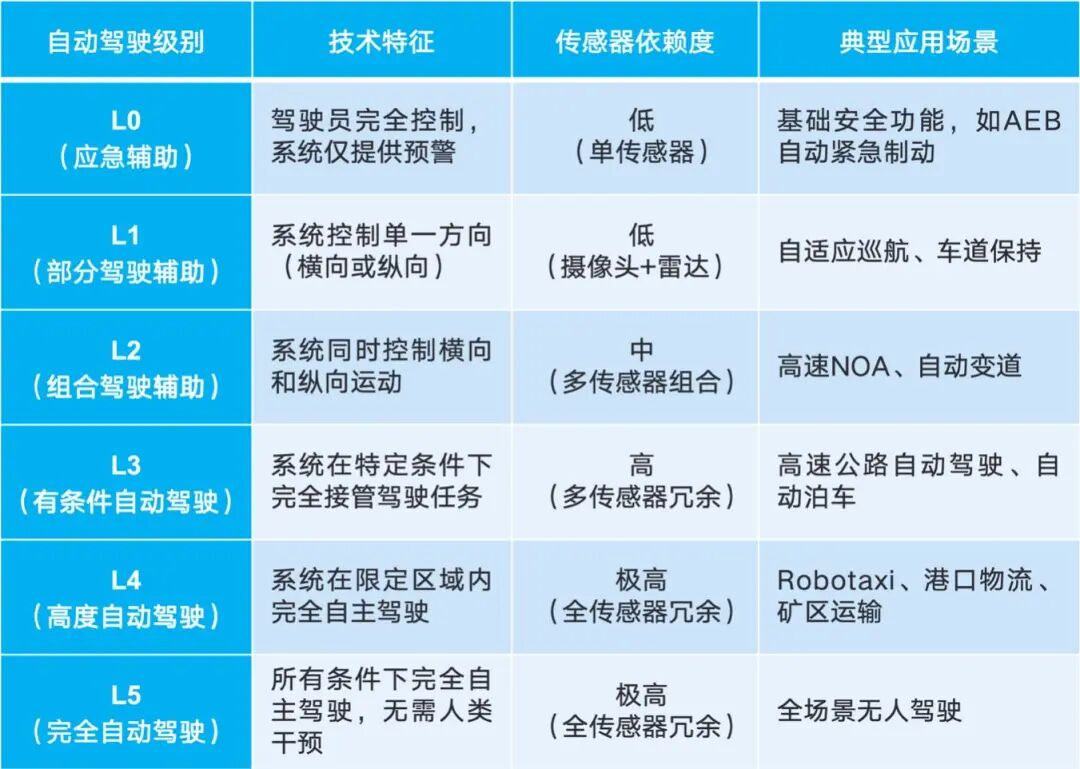
China implemented the “Automotive Driving Automation Classification” standard on March 1, 2022, which localizes and refines the SAE classification. Level 2 is defined as “the combined driving assistance system must have the ability to detect and respond to certain targets and events related to the vehicle’s lateral and longitudinal motion control,” clearly distinguishing it from Level 1’s single-direction control; Level 4 particularly emphasizes that “when the autonomous driving system can no longer perform dynamic driving tasks, the system must take measures to reduce the risk of vehicle accidents to an acceptable level.” This classification system provides important references for understanding the application scenarios of different technical routes.
From a technological evolution perspective, the global smart driving industry is currently at a critical transition from Level 2 to Level 3. Data shows that the penetration rate of Level 1 vehicles in China is about 11%, Level 2 is 51%, and Level 3 and Level 4 are 20% and 11%, respectively. It is expected that by 2025, the total penetration rate of all levels of autonomous driving will reach 80%. This indicates that autonomous driving technology is accelerating its transition from assisted driving to conditional autonomous driving, and this transition period is the most competitive phase for the two technical routes.
2. Analysis of Two Major Technical Paths
1
Pure Vision + Neural Networks: An Algorithm-Driven Cost Revolution
The pure vision + neural networks approach relies entirely on advanced computer vision technology, with the core idea of using high-definition cameras to capture real-world images and leveraging deep neural networks for environmental perception and scene understanding. Its technical principles are mainly reflected in three aspects.First, multi-camera layout and data stitching.Tesla uses eight cameras surrounding the vehicle, including front, side, and rear cameras, to create a 360° panoramic view through image stitching technology, with a monitoring distance of up to 250 meters. This layout mimics the visual perception of human drivers, capturing information from different angles around the vehicle.Second, HydraNets multi-task neural networks.Tesla’s HydraNets technology can simultaneously handle various driving tasks, such as lane line recognition, obstacle detection, and traffic sign understanding. Through deep learning models, the system can automatically extract key information from images and make end-to-end decisions and controls.Third, BEV + Occupancy Network technology.Tesla’s FSD V12 version adopts a BEV (Bird’s Eye View) network architecture, converting 3D environmental information into a 2D bird’s eye view for processing, combined with Occupancy Network technology to achieve precise modeling and understanding of road space.
The greatest advantage of the pure vision approach is its significant cost-effectiveness.By using only cameras, the manufacturing and maintenance costs of the entire vehicle can be significantly reduced. It is estimated that Tesla’s pure vision approach can reduce hardware costs by about 30% compared to multi-sensor solutions. Additionally, the system structure is simple, with fewer hardware components and potential failure points, leading to lower maintenance costs.
With the continuous iteration of AI technology, the algorithmic capabilities of the vision system are continuously improving.Tesla’s FSD V12 version has reduced the amount of code by 90% through an end-to-end neural network architecture, significantly enhancing the overall performance of the system. This algorithm-driven innovation allows the pure vision approach to continuously break through in complex environment understanding and dynamic decision-making, even outperforming multi-sensor fusion solutions in certain scenarios.
However, the primary challenge of pure vision is its strong sensitivity to climate..Cameras significantly lose recognition ability in low-visibility weather such as rain, fog, and snow. Data from the National Highway Traffic Safety Administration (NHTSA) shows that about 21% of related accidents occur in limited visibility scenarios, posing a severe test for the pure vision approach. Additionally, the heavy reliance on training data is also a major shortcoming. The performance of the pure vision approach heavily depends on the coverage and quality of training data; once faced with extreme driving situations not covered by the data, it may lead to recognition biases and misjudgment risks.
2
Multi-Sensor Fusion Approach: Redundant Design for Safety Assurance
The multi-sensor fusion approach advocates the comprehensive use of various sensors such as LiDAR, millimeter-wave radar, and cameras to build a perception system for the vehicle’s external environment. Companies like Waymo and Baidu Apollo adopt this method, using complementary data from different sensors to improve system accuracy.First, sensor data synchronization and calibration.The main challenge faced by multi-sensor fusion is how to effectively integrate data from different sensors (such as LiDAR, cameras, and millimeter-wave radar) in different time and spatial coordinate systems. For example, the point cloud data from LiDAR and the image data from cameras need to be aligned through spatial transformation matrices (R, T matrices), while time synchronization needs to be achieved through algorithms such as piecewise spline interpolation.Second, multi-source data fusion algorithms.Multi-sensor fusion requires advanced algorithms (such as global nearest neighbor algorithms, D-S evidence theory, etc.) to perform weighted fusion of data from different sensors, forming a unified understanding of the environment. For example, in identifying a vehicle target ahead, millimeter-wave radar can identify the distance and speed of obstacles, the front-facing camera can identify the type of obstacle, and LiDAR can provide high-precision 3D location information. The fusion of these three can achieve nearly 100% recognition accuracy.Third, redundancy design and fault tolerance.The multi-sensor fusion approach forms redundant perception capabilities by deploying various types of sensors. When one type of sensor fails due to environmental factors, other sensors can still provide critical information to ensure the system operates safely. For example, LiDAR operates efficiently in darkness and rain, complementing cameras to give the vehicle stronger adaptability to all scenarios.
Table 2: Characteristics of Autonomous Driving Sensor Solutions
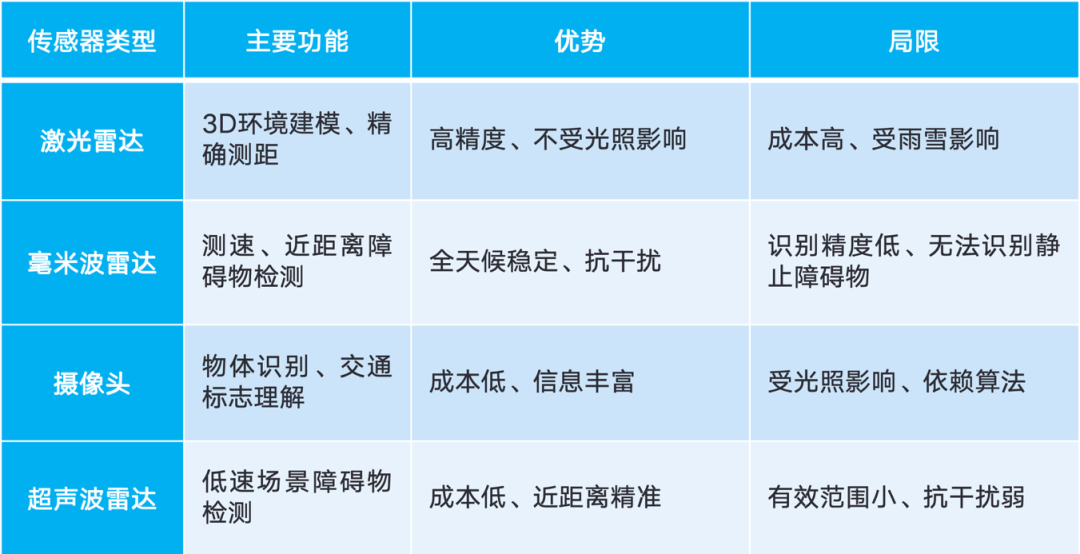
There are significant differences in cost and performance between multi-sensor fusion solutions.For example, Waymo’s Level 4 autonomous driving system uses high-end laser radar (300 meters detection range), multiple cameras, and millimeter-wave radar, with hardware costs exceeding $70,000. In contrast, Huawei’s ADS 3.0 optimizes sensor configuration (reducing the number of LiDAR from 3 to 1 and changing from multiple cameras to dual cameras) while improving algorithm efficiency, reducing computing power requirements from 400 TOPS to 200 TOPS, significantly lowering hardware costs.
In practical applications, multi-sensor fusion solutions have been commercialized in various scenarios.For example, Huawei’s ADS 3.0 can handle various emergencies in complex urban environments, such as “ghosting” scenarios; Baidu Apollo’s autonomous driving system in ports and mines achieves high-precision positioning and environmental perception through multi-sensor fusion, improving operational efficiency. Additionally, WeRide’s Level 4 Robotaxi has provided 150,000 trips in a year of trial operation in Guangzhou without a single active liability accident, proving the reliability of the multi-sensor fusion solution in specific scenarios.
3. Safety and Cost-Effectiveness: The Core Game of Two Technical Routes
The core point of contention in choosing an autonomous driving technology route lies in the trade-off between safety and cost-effectiveness. The pure vision approach and the multi-sensor fusion approach exhibit different performances on these two dimensions, forming a stark contrast.
1
In terms of safety, the multi-sensor fusion approach shows a clear advantage.
According to measured data, multi-sensor fusion systems have significantly higher reliability in complex roads and extreme weather compared to pure vision solutions. For example, in heavy rain, a certain new force brand’s pure vision urban NOA system has a takeover rate of 1.8 times per hundred kilometers, with a misjudgment rate of 32%, while the multi-sensor fusion solution can achieve recognition rates of over 98% in urban scenarios. Additionally, the multi-sensor fusion approach, through redundancy design, can reduce the probability of perception failures and improve the system’s response capability in emergencies.
The pure vision approach is also continuously improving safety with the support of algorithmic innovation and data loops. Tesla’s FSD system has trained on 4 billion kilometers of road test data, continuously iterating with a cloud-based large model, allowing the system to optimize driving strategies through “trial and error” like humans. Its FSD V12 version has achieved a 99.99% takeover interval mileage in complex road conditions in San Francisco, proving the reliability of the pure vision approach in specific scenarios. Furthermore, the pure vision approach reduces the number of sensors, lowering system complexity and potential failure points, thus enhancing system stability.
2
In terms of cost-effectiveness, the pure vision approach has a clear advantage.
Compared to LiDAR, camera technology is mature and inexpensive.Data shows that the cost of LiDAR has dropped from tens of thousands of dollars in 2018 to $200-500 by 2025, but it is still higher than that of cameras. The pure vision approach reduces hardware costs, enabling autonomous driving technology to reach the mass market more quickly. For example, Tesla has reduced the hardware costs of its autonomous driving system by about 30% through the pure vision approach, allowing the FSD system to be offered to consumers at a relatively low price.
3
From the perspective of industry development trends, the two technical routes are moving towards differentiated applications.
The pure vision approach is mainly applied to L2/L3 passenger vehicles, optimizing performance through data loops; the multi-sensor fusion approach has made faster commercial progress in L4 Robotaxi, port logistics, and mining transportation scenarios. For example, Baidu has deployed over a thousand “Luobo Kuaipao” autonomous ride-hailing vehicles in Wuhan using the multi-sensor fusion approach, achieving large-scale commercial operations; while Tesla is promoting the popularization of L2 autonomous driving through the pure vision approach, with its FSD system covering 99.99% of known extreme cases by April 2025.
4. Regulatory Environment and Social Acceptance: Key Factors Influencing Technical Route Selection
The choice of autonomous driving technology routes is not only influenced by the technology itself but also profoundly constrained by the regulatory environment and social acceptance. These two external factors are becoming key variables affecting the choice of technical routes.
In terms of the regulatory environment, governments around the world are accelerating the formulation of autonomous driving regulations, and the technical requirements and safety verification standards for autonomous driving systems in different regions will profoundly influence the industry’s technical selection tendencies.In November 2023, China released the “Notice on the Pilot Work for the Access and Road Testing of Intelligent Connected Vehicles,” which for the first time conducts pilot access for intelligent connected vehicles equipped with L3 and L4 autonomous driving systems. This notice requires that L3 autonomous driving systems must meet functional safety and fault degradation requirements, indirectly promoting multi-sensor redundancy design. In contrast, the regulatory framework for autonomous driving technology in various states in the U.S. is more diverse. States like California, Arizona, and Nevada have established relatively complete regulations for testing and application of autonomous driving vehicles, allowing road testing and commercial operations under specific conditions. These states’ regulations typically require that autonomous driving vehicles have a safety driver present during testing and operation to take control when necessary, providing a relatively relaxed testing environment for the pure vision approach.
In terms of social acceptance, consumer trust in autonomous driving technology directly relates to its market penetration rate.Data shows that nearly 70% of consumers still have reservations about autonomous driving vehicles, mainly due to safety not being fully verified. However, there are significant differences in the image of different technical routes in consumers’ minds. The multi-sensor fusion approach, due to its characteristics of “strong redundancy and high stability,” is more likely to gain consumer trust; while the pure vision approach, due to its “outstanding cost advantages and simple system structure,” is more likely to be accepted by the mass market.
Conclusion
The journey towards fully autonomous driving is not only a technological struggle but also a reflection of the evolution of the relationship between humans and machines. The divergence between “pure vision + neural networks” and “multi-sensor fusion” goes beyond hardware configuration, representing different cognitive logics and engineering paths. In the future, with the continuous advancement of AI algorithms, sensor performance, and computing power platforms, a perception system that integrates the advantages of both may become mainstream, truly promoting autonomous driving technology into thousands of households and reshaping the future of human mobility.
Author Profile
Yu Lei
Consulting Engineer (Investment), long-term service in government departments, deeply engaged in regional policy research, project consulting, project planning, funding applications, and other fields.
E N D
Editor | Mo Dawei
Review | Li Jing