On July 15, 2025, Antarctic Bear learned that the National Bureau of Statistics released the economic situation of China for the first half of 2025 in the report titled “National Economy Shows Resilience and Stability in the First Half of the Year.” Among the highlights of “rapid growth in industrial production, with good momentum in equipment manufacturing and high-tech manufacturing,” the growth of 3D printing equipment was specifically mentioned:
By product, the output of 3D printing equipment, new energy vehicles, and industrial robots increased by 43.1%, 36.2%, and 35.6% year-on-year, respectively. The National Bureau of Statistics specifically praised 3D printing, new energy vehicles, and industrial robots among so many industrial products, fully demonstrating the country’s recognition and support for these related industries!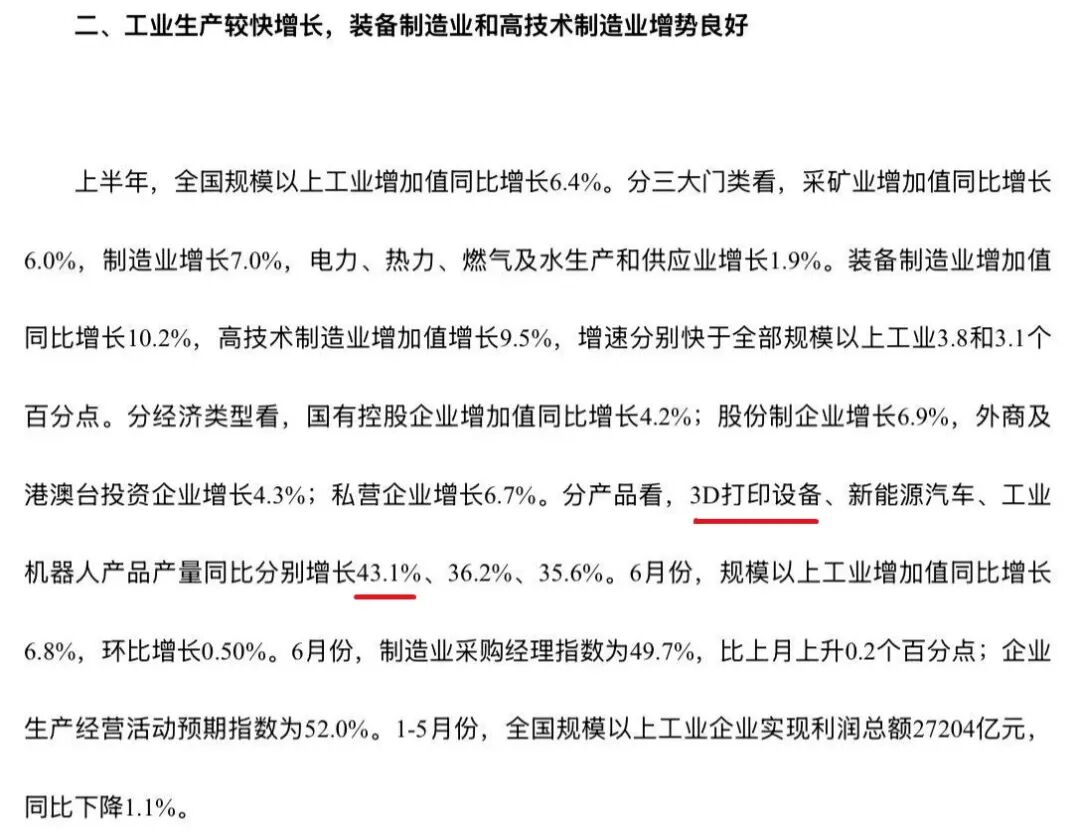
Since 2025, Antarctic Bear has observed a significant increase in the production of 3D printers in China. Last year’s output was 5 million units, and this year it may reach 7 million units. The vast majority of these are consumer-grade FDM 3D printers priced at a few thousand yuan each, with over 90% being exported, resulting in a growth of millions in quantity.
The top five manufacturers of consumer 3D printers globally are mostly based in Shenzhen. Antarctic Bear, as a media outlet in the 3D printing industry, has been observing the industry for over a decade. Previously, there were hundreds of desktop 3D printer manufacturers spread across other parts of the country, but in recent years, most have disappeared, leaving only manufacturers from Shenzhen to emerge.
Currently, the 3D printing industry in China, whether consumer-grade or industrial-grade, whether in equipment or materials, is highly competitive. For example, titanium alloy 3D printing powder material, which cost seven to eight hundred yuan per kilogram two to three years ago, has now dropped to over 200 yuan. Not only is there a price war, but also competition in technology and performance, forming a strong market competitiveness in FDM, LCD, SLA, SLM, and other technological products, especially for exports.
In 2024, China’s 3D printing farms are expected to explode, with hundreds or even thousands of 3D printing farms emerging in a short period, each with dozens, hundreds, or even thousands of 3D printers producing popular toy products like joint dragons, dragon eggs, and joint snakes, with printing and shipping volumes reaching hundreds of millions. These end products are sold to ordinary people both domestically and internationally through online stores, street stalls, and cross-border e-commerce platforms, providing a direct and intuitive experience of 3D printing to tens of millions or even hundreds of millions of people, significantly contributing to educational outreach in society. Coupled with the development of AI 3D large models, the threshold for 3D creation has been greatly lowered, resulting in a large number of fun and interesting models being added to the internet, stimulating interest in 3D printing.
Additionally, due to the significant increase in tariffs on international trade, especially the prevalence of de-globalization phenomena, which have disrupted the global supply chain, 3D printing has the advantage of rapid localized manufacturing. In extreme cases, production can be quickly organized.
In terms of quantity, the shipment of 3D printers in China is expected to reach around 5 million units in 2024, accounting for over 90% of the global market. In the next two to three years, shipments may reach 10 million units, achieving a new industry milestone.
Whether consumer-grade or industrial-grade, the application of 3D printing is experiencing a large-scale explosion. In addition to the number of 3D printed toys reaching the hundreds of millions; the application of metal 3D printing in the 3C field of mobile phones and watches is also expected to reach tens of millions of units annually. In the future, it is highly likely that our mobile phones will contain 3D printed components; in the aerospace field, 3D printing is gradually becoming a necessary process in parts manufacturing, with an increasing number of 3D printed parts in rockets, satellites, and other products; 3D printed shoes, with their fashionable designs and breathable comfort, are being embraced by more and more sports brands, resulting in the shipment of hundreds of thousands or even millions of pairs of 3D printed shoes.
Currently, there are already thousands of 3D printing companies in China. The enormous market potential has attracted more and more large manufacturing companies to enter the 3D printing industry. For example, BYD, Han’s Laser, Luxshare Precision, and Zhongshan Precision have all entered the market. The future landscape of the 3D printing industry may evolve from the current core market capacity of hundreds of billions based on equipment and materials to a market potential of over a trillion based on applications, with downstream applications having a broader horizon.
Source: Antarctic Bear 3D Printing