MicroPython is one of the most popular topics in open-source hardware in recent years, invented by Professor Damien George from the University of Cambridge, and is essentially a version of the Python language used for embedded programming.One of the challenges in embedded programming is that programmers need to focus not only on the software but also understand the underlying hardware. This includes knowledge of microprocessor registers, reading data sheets, and understanding library functions provided by manufacturers. Therefore, when we study microcontrollers, we always emphasize that it is both a software and hardware course, which can be somewhat challenging for students.Using MicroPython can effectively address these issues, as most peripherals and common functionalities have their own libraries, making development or porting easier and faster, allowing developers to focus on writing programs or hardware design. MicroPython can now be genuinely used for product development, which is why it quickly attracts smart hardware developers. The system architecture can be illustrated as shown in the figure below, where the user program is written in MicroPython.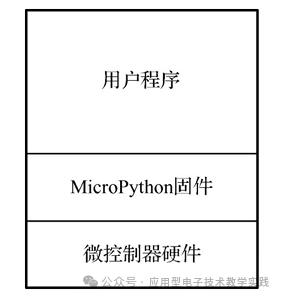 In summary, it has several advantages: comprehensive libraries, open-source, concise language, and high development efficiency. However, its runtime efficiency is certainly not as high as that of C language, and currently, not all embedded microprocessors support it (such as STM32F7, STM32L4, etc.).