Click↑Follow the blue text aboveFollow us! Get the latest updates in the display industry instantly!
The 2024 Touch Taiwan Smart Display Exhibition will take place on April 24, featuring display technology applications from the two panel giants, AUO and Innolux. AUO will once again bring automotive displays to the exhibition, showcasing MicroLED technology in dashboards and windows; Innolux will present smart LCD windows and naked-eye 3D displays, targeting automotive, gaming, and infotainment applications.
AUO is currently the largest supplier of automotive displays globally. CEO and General Manager, Paul Chang, stated that AUO entered the aftermarket 20 years ago and took 7 years to enter the OEM market, initially as a Tier 2 component supplier. As the integration of display components increased, AUO transitioned to a Tier 1 supplier, providing delivery services while maintaining strategic partnerships with Tier 1 manufacturers. He pointed out that the trend towards smart cockpits and entertainment requires more intelligent solutions, making the shift towards smart mobility one of AUO’s main strategies.
AUO Promises to Halve Prices Every Two Years
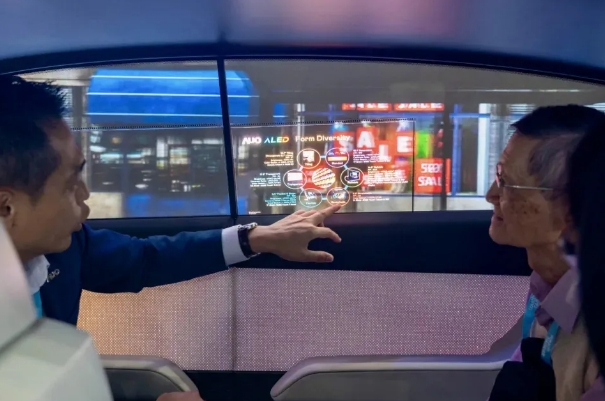
At this exhibition, AUO showcased various MicroLED applications, including multifunctional automotive dashboards and MicroLED integrated into car windows, combining augmented reality with transparent windows. When a driver approaches a scenic spot, information about the location or services offered by nearby businesses can be displayed on the window. The rear seats also feature foldable MicroLEDs hidden within the seats for entertainment applications.
AUO Chairman, Pang Shuang-Liang, stated that compared to LCDs, MicroLEDs have the advantage of visibility in sunlight, although they are currently more expensive. However, AUO promises to halve the module prices every two years. He noted that major automotive brands are already clients, and AUO has accumulated over 1,000 patents in the MicroLED field, making it a leading manufacturer in the industry. MicroLEDs have already been shipped for wearable devices, and automotive and large-size TVs will soon enter mass production.
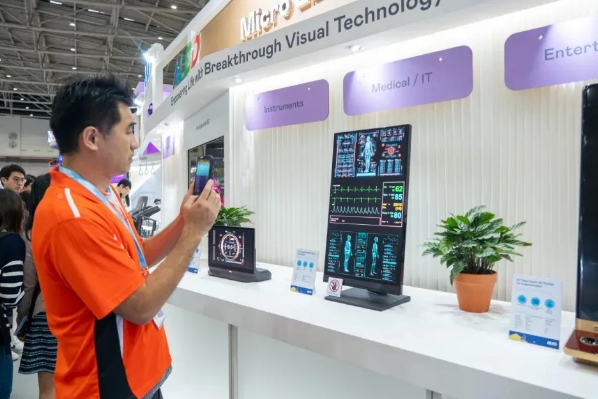
Pang Shuang-Liang mentioned that display technology products add value through vertical integration. The value of a panel sold alone is significantly lower than that of a complete solution, which can increase the panel’s value by tenfold. He hopes that the public will recognize AUO not just as a panel manufacturer but as a solution provider focused on display technology.
AUO’s CEO and General Manager, Paul Chang, stated that the group will focus on Micro LED as a core technology, gradually advancing towards smart mobility applications. He mentioned that AUO has invested 20 years in automotive display panels, primarily in the aftermarket, and it took 7-8 years to gradually enter the OEM market. Now, AUO has leapfrogged to become a Tier 1 automotive panel supplier and the largest supplier of central displays.
“The smart cockpit experience has become a new selling point for cars, attracting buyers with numerous display designs,” Chang said happily. As a result, even though the cost of displays in vehicles is low, they are increasingly valued by automakers. Automakers are not satisfied with the existing Tier-1 understanding of displays and are directly approaching AUO to discuss future panel planning.
Pang Shuang-Liang added that the transition from fuel vehicles to electric vehicles involves significant changes. In the past, fuel vehicles focused on how quickly the engine could accelerate from 0 to 100 horsepower, containing over 30,000 components. In contrast, electric vehicles have a higher degree of integration, with only about 7,000 components remaining after integration, focusing on four key elements: motor, battery, display, and chassis, which is completely different from traditional fuel vehicles.
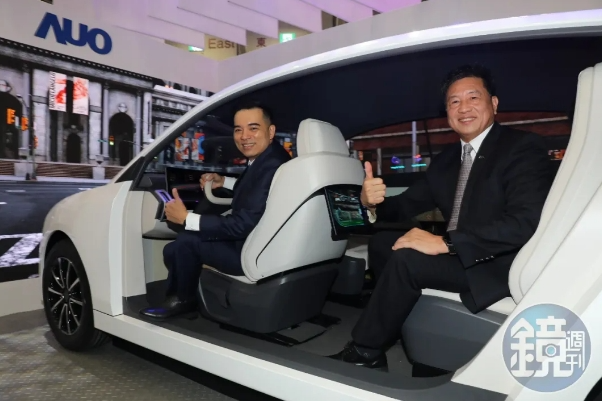
“In the future, electric vehicles will look quite similar, which is why automakers have high expectations for displays. This is where electric vehicles can differentiate themselves from others,” Pang Shuang-Liang pointed out.
AUO originally supplied to automakers through Tier-1 clients but was strongly urged by automakers to become a Tier-1 supplier. Chang mentioned that many automakers pressured AUO to become a Tier 1 supplier, which caused significant concern about the impact on existing client relationships. In fact, in 2019, there were discussions with the chairman about not becoming a Tier-1 supplier and remaining a Tier-0.5 supplier.
As the ecosystem for automotive display panels evolves, “there are increasingly more integrations on the panels, and many solutions are becoming more reasonable when led by panel manufacturers. Thus, AUO is gradually developing a model where they take on projects while Tier-1 handles backend integration,” Chang explained.
Pang Shuang-Liang emphasized that the characteristics of collaborating with automakers include high quality and reliability, as well as forward-looking technology. “When AUO discusses designs with automakers, they are always asked, ‘What’s the Next?’ meaning what will be done in the next ten years,” he stressed.
“In 2018, AUO faced difficulties due to the lack of OLED products, but after that, the gradual introduction of Micro LED has given us confidence. Micro LED will be a key technology for future automotive displays,” Pang Shuang-Liang shared about the turning point in collaboration with automakers.
Pang Shuang-Liang continued, stating that Micro LED is a technology AUO discusses with automakers for the next ten years. Currently, most automotive displays use LCD, Mini LED, and OLED, while Micro LED is entering the Design In phase. Actual automotive products are expected to debut in three years, and Micro LED will become mainstream in ten years.
“With Micro LED, there is nothing that cannot be seen in sunlight,” Pang Shuang-Liang pointed out, highlighting AUO’s optimism about this technology. He added that the commonly used LCD and OLED each have their drawbacks, while Micro LED eliminates the disadvantages of both while retaining their advantages. However, the only current drawback is the high cost. AUO promises the industry that they will halve the cost of Micro LED modules every two years, and in ten years, the cost should be comparable to self-emissive displays.
Innolux Also Targets the Automotive Market
On the other hand, Innolux showcased smart LCD windows equipped with sensors that can automatically adjust transparency based on outdoor light conditions, saving energy for indoor air conditioning and lighting. Currently, they are primarily shipping to European commercial buildings. Innolux Chairman, Hong Jin-Yang, stated that smart LCD windows can also be used in car windows, and they are already in discussions with automakers, with news expected soon.
In addition to car windows, sun visors and rearview mirrors are also applications of smart LCD window technology. The direction of the liquid crystal can control the amount of light penetration, allowing liquid crystal glass rearview mirrors to switch displays in one second without glare, unlike traditional sun visors, which can obstruct the view.
Another highlight is the naked-eye 3D display, especially as gaming increasingly seeks immersive 3D experiences. Innolux uses eye-tracking devices and proprietary algorithms to track the user’s eye position, calculating what each eye can see. The screen surface has a special structure that allows each light-emitting unit to have its own angle, controlling whether the image is sent to the left or right eye. Any 3D movie or game can instantly present 3D images when using Innolux’s 3D display.
Regarding MicroLED, Innolux’s General Manager, Yang Zhu-Xiang, pointed out that mass transfer and maintenance costs are the highest, but Innolux can simplify this, effectively improving uniformity and maintaining competitive costs. Currently, automotive and large-size TV technologies have been implemented, and they are in discussions for collaboration. The large-size TV is expected to enter mass production in 2025, while automotive applications will take another two to three years.
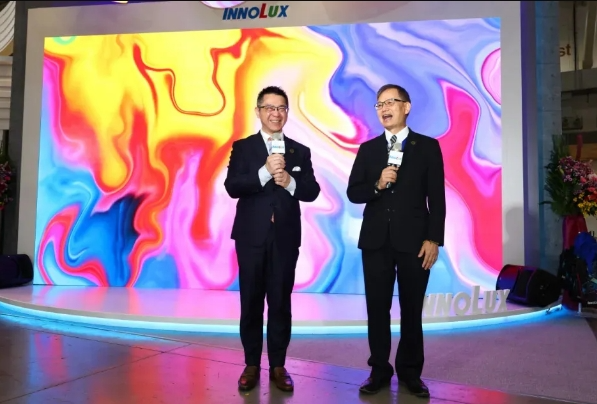
Profits Expected to Reach Double Digits This Year
The two panel giants showcased diverse applications, bringing good news for the industry. Yang Zhu-Xiang reiterated that “spring has arrived,” with a recovery in demand for large-size TVs, good performance in automotive products, and a glimmer of hope for AI PCs. Automotive revenue and profits are expected to grow by double digits this year, with order visibility extending to 2028.
Apple has halted MicroLED development, and Hong Jin-Yang stated that Apple’s pause has led to a flourishing of various applications, no longer defining a single path. Various parties are more willing to explore different applications, and many manufacturers are now in contact with Innolux, recognizing their technology.
Pang Shuang-Liang also believes that the overall market situation will reach its lowest point in the first quarter and gradually improve each quarter. There are signs of gradual recovery in the TV and IT markets, returning to a healthy state with stable supply and demand.
(Source: Business Weekly, Mirror Weekly)

 News is more than just the news itself,Display Information DisplayTimestakes you deep into the stories behind the news!

 Click the original text for more details!