
Exciting

News
In the 2025 62nd ACM/IEEE Design Automation Conference (DAC) System Design Competition, the student team guided by Assistant Professor Li Meng from Peking University’s Integrated Circuit College and the Artificial Intelligence Research Institute won the championship. The participating students include three PhD students from the Department of Design Automation and Computing Systems of the Integrated Circuit College: Wei Linye, Zeng Wenxuan, and Yu Jiangrui, along with three undergraduate students from the Electronic Information Science Experimental Class of the School of Information Science and Technology: Fu Zizhuo, Tang Ziyu, and Yang Tianjian. The DAC System Design Competition is sponsored by the ACM Special Interest Group on Design Automation (SIGDA), with organizers from George Mason University, the University of North Carolina at Chapel Hill, and the University of Electronic Science and Technology of China. This competition addressed scientific questions on how to deploy multimodal generative AI algorithms on low-power edge devices, attracting teams from around the world, including the USA, China, Germany, and the Netherlands.
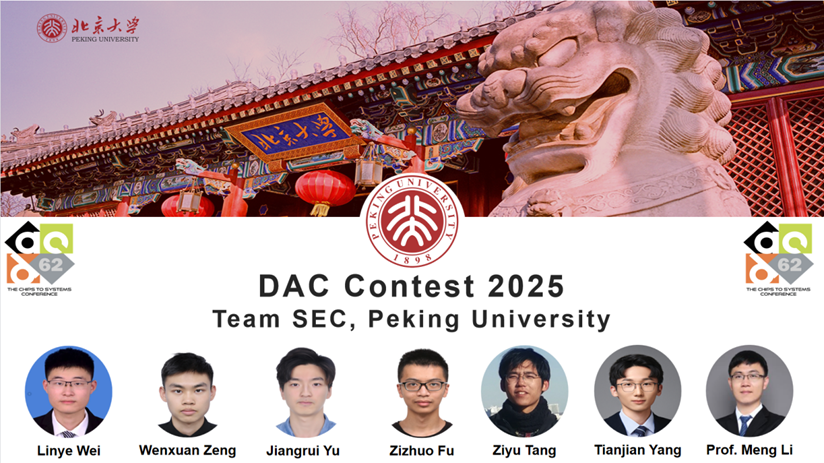
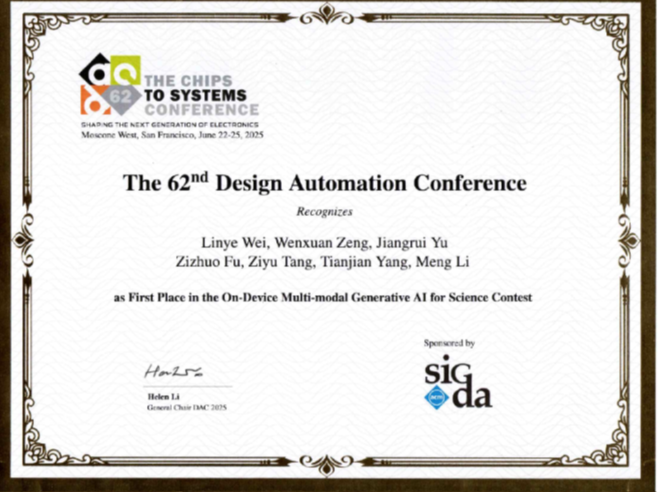

Image: Group photo of the award-winning teams (from left to right: representatives of the first, second, and third place teams)
Background Link 1
The DAC System Design Competition has been held since 2018, open to teams from around the world, focusing on the field of AI-accelerated microsystem design, and addressing algorithm design and deployment issues on resource- and power-constrained edge devices. The DAC 2025 System Design Competition, titled On-Device Multi-modal Generative AI for Science, focuses on the geophysical science domain, targeting the representative task of data-driven full-waveform inversion (FWI) with data scarcity and seismic wave-velocity model data modality imbalance, aiming to explore the application of generative AI in resource-constrained embedded systems to meet the scientific community’s demand for efficient, real-time data generation and analysis. The goal of the competition is to achieve optimal performance in the quality and latency of multimodal (seismic wave and velocity model) generation.
Background Link 2
The Department of Design Automation and Computing Systems at Peking University’s Integrated Circuit College is the first department in domestic universities focusing on EDA technology. The curriculum covers the complete EDA technology chain from device level, chip level to system level; research areas include key technologies such as full-process EDA tools and autonomous standards, domain-specific computing system architectures and toolchains, with some results already successfully applied. The related technologies are currently the only solutions in the industry; relying on the department, the Wuxi Peking University EDA Research Institute and several corporate joint laboratories have been established, participating in the co-construction of the National EDA Technology Innovation Center and jointly initiating a national-level EDA industry-university-research alliance, forming a layout of collaborative development in education, research, and talent.
Background Link 3
The Electronic Information Science Experimental Class is an experimental class established by the School of Information Science and Technology at Peking University to promote the construction of new engineering disciplines, based on the experience of building experimental classes in computer and intelligent directions, aimed at the electronic information category and applied physics major. Based on the understanding that information permeates the technology innovation chain, from foundational levels to top-level applications, the class has constructed a curriculum system with an architecture of “physical layer – component layer – system layer” and a training feature that emphasizes both theory and practice. The class is dedicated to cultivating technical innovators and entrepreneurial leaders in the fields of microelectronics, integrated circuits, communications, and electronic science.