Summarizing practical experiences in work and sharing discussions in social circles, creating the most grounded public account.
In a default configuration of an EtherCAT network, the slave devices cannot be plugged or unplugged at will while running, as this may lead to serious consequences. According to the EtherCAT transmission mechanism, the master station identifies slave addresses in the order they appear on the network. For example, the first slave that receives a data packet from the master has the address 1001, the second has 1002, and so on. Even in a star topology, there is an internal chain structure with a specific order. For instance, the two RJ45 ports of the EK1122 have a defined order; if the network cables are reversed, the addresses of the connected EtherCAT slaves will be swapped. Similarly, the CU1128 has 8 RJ45 ports, and the internal principle is the same. The IN port must come from the master station, and the other 7 ports also have a specific order. Network cables cannot be plugged or unplugged arbitrarily; otherwise, the addresses of the EtherCAT slaves in the network will become disordered. In extreme cases, for example, if two slave devices connected to the EK1122 are identical and the ports are reversed, the master will directly identify the device connected to the upper port as the one connected to the lower port, leading to misalignment of input and output channels, which may result in serious consequences.
In some cases, users want to ensure that the power loss of one slave does not affect the operation of other slaves. Therefore, using the EK1122 or CU1128 to form a star network allows one branch to lose power while others continue to operate normally. In fact, to achieve the functionality of “one station losing power without affecting other stations”, it is not enough to simply ensure physical network connectivity; it is also necessary to set up a “Hot Connect Group”. Once successfully configured, the entire group of slaves can be connected or disconnected at any time without affecting other slaves on the network, and there is no longer a restriction that the input network cable must be plugged into a specific port.
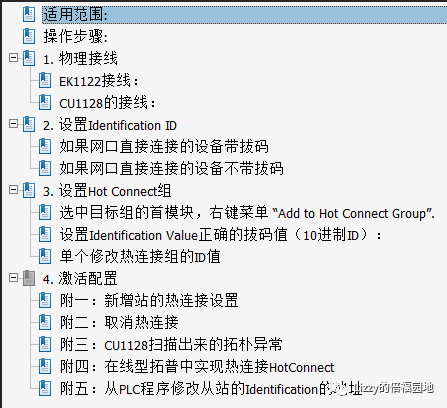
This article describes various settings to implement the hot connect functionality in an EtherCAT star network formed by CU1128 or EK1122. Software version: TwinCAT 2.11 build 2254.
(******************************)

If you like this article, scan the QR code to follow our public account.
Supporting documents for this public account: ftp://116.255.232.235:21
Anonymous access supported, IE access supported.
-Technical Area
Lizzy Chen’s series of teaching materials.
Differences between TwinCAT and Step 7 programming.
Beckhoff’s CAN 2.0 communication solutions.
My reading of the white paper on EtherCAT and TSN.
PageFault, a story that must be told.
Nine layers of TwinCAT program updates.
TwinCAT DB Server: Direct database operations from PLC.
Several possible reasons for ADS not connecting to the router (3rd edition).
Testing PLC code execution time and influencing factors.
Small program: Writing to the registry from PLC.