
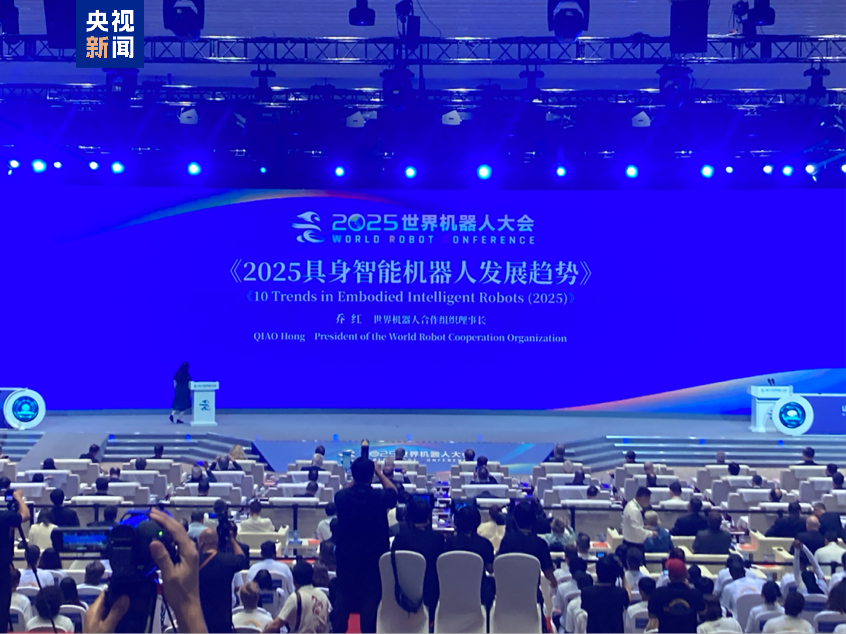
At the opening of the 2025 World Robot Conference on August 8, the ten major development trends of embodied intelligent robots were released.
First, the collaborative driving of embodied cognition through physical practice, physical simulators, and world models. Physical practice is the essence of embodied intelligence, while physical simulators can create high-fidelity training environments, and world models can provide essential internal features of the environment. The integration of these three can ensure a rich, effective, and realistic environment, and can be used to train embodied intelligent robots in both contact and non-contact interactions with the environment, laying the foundation for their decision-making and control.
Second, multi-level end-to-end embodied decision-making, inspired by multimodal large models, with a mathematical foundation for cognitive and planning research, integrated with the achievements of life scientists, and combined with real-time control modules, can significantly enhance the generalization and practicality of embodied intelligent robots in unstructured environments.
Third, from a control perspective, the integration of model prediction, reinforcement learning, and life sciences for embodied intelligent control. On one hand, it can merge the dynamic optimization capabilities of model predictive control with the adaptive decision-making of reinforcement learning, further integrating with the redundant multi-loop control mechanisms of life sciences. This way, embodied intelligent robots can develop towards human-like capabilities, achieving new control for embodied intelligence and enhancing their adaptability and performance in new environments.
Fourth, the design of embodied intelligent robots driven by generative artificial intelligence. By optimizing motors, reducers, drivers, structures, connectors, and materials in a unified manner, and combining with scientific achievements in the field of materials, it is possible to achieve collaborative optimization of hardware and control strategies in physical simulators, automatically exploring optimal designs for embodied intelligent robots in tasks.
Fifth, highly coordinated and dynamically adaptive consistency between embodied intelligent hardware and software. Embodied intelligent robots require consistency between hardware and software, necessitating the pre-setting of interface specifications for adaptive algorithms during hardware development, while physical constraints are embedded in algorithm design, ensuring a blend of soft and hard elements. Through joint simulation verification, the system can maintain consistency, bringing software modules closer to hardware and aligning the overall system with our expectations for hardware-software consistency.
Sixth, the embodied intelligent robot factory, achieving natural language interaction, environment generation, robot design, decision-control algorithms, and hardware-software consistency algorithms in a simulation environment, allowing them to organically combine and evolve repeatedly. Such systems can achieve rapid design based on performance and requirements, creating high-quality embodied intelligent robot systems to serve society.
Seventh, large-scale high-quality datasets for embodied intelligence, constructed based on physical entity collection and simulation synthesis. Here, high quality is key, and regarding scale, the expectation in research is to reduce the size. This can significantly enhance the optimization of embodied intelligent robot configurations, multimodal training efficiency, and cross-scenario strategy transfer capabilities.
Eighth, the development of embodied intelligent robot clusters and collaboration with humans, integrating multi-agent collaborative mechanisms to build clusters of embodied intelligent robots. At the same time, continuously improving the safety of embodied intelligent robots and their empathy capabilities with humans, allowing embodied intelligent robots to truly approach us, becoming friends of humanity.
Ninth, an interdisciplinary open-source community for embodied intelligent robots. The development of embodied intelligent robots requires collaboration across information science, engineering and materials science, mathematical physics, and life sciences, gathering top scientists and engineers from various fields globally to promote technical discussions in the field of embodied intelligence, facilitating deep integration and collaborative development of the industry chain.
Tenth, focusing on safety assessment and ethical construction for embodied intelligent robots, ensuring the establishment of a safety assessment system and ethical norms through behavioral verification, decision interpretability analysis, and data security research. This ensures the reliability, interpretability, and safety of decisions in complex open environments, allowing embodied intelligent robots to serve in our service industries.
Source | CCTV News ClientEditor | Li Weimin Proofreader | Hu LihuaEditors | Wang Shu, Jiang Yinghua Supervisor | You Chengyong