Note: Free diagnosis is available; please leave comments or private messages for diagnosis.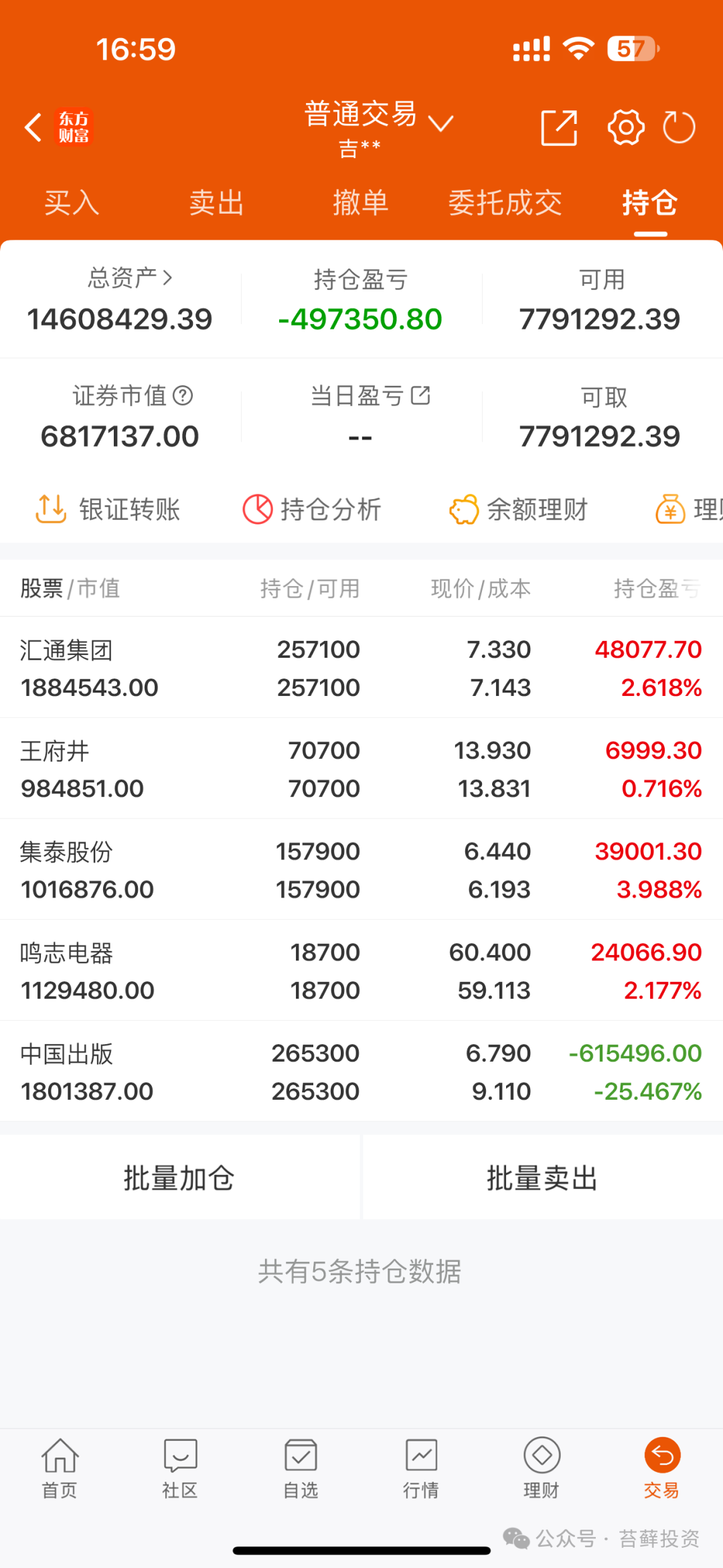 Today’s operations.Positions: China Publishing, Mingzhi Electric, Jitai Co., Wangfujing, Huitong Group; Sell: None.Current Development Status of Robotics 1. Technological Development: Integration of Intelligence and AI Leading Breakthroughs(1) Embodied Intelligence Technology as the Core Driving ForceEmbodied Intelligence is the core direction of current robotics technology development, essentially allowing robots to achieve a closed loop of perception, decision-making, and action through physical practice and interaction with the environment. Among the top ten trends released at the 2025 World Robotics Conference, embodied cognitive perception driven by physical practice, physical simulators, and world models is listed as a primary direction. For example, Woan Robotics has achieved precise operations and autonomous movement in home scenarios through three core technologies: AI machine vision control technology, robot positioning and environment construction technology, and distributed neural control network technology. Its AI machine vision control technology combines multimodal large models and vertical models, enabling robots to analyze visual data in real-time and integrate environmental information to complete high-precision task execution.(2) Significant Improvement in Multimodal Perception and Decision-Making CapabilitiesRobots are evolving from single-modal perception to multimodal integrated cognition. By integrating multidimensional information such as vision, hearing, and touch, robots can construct a holographic understanding of the physical world. For instance, Yushu Technology’s humanoid robot achieves millimeter-level positioning and dynamic environment modeling through multi-sensor fusion technology, allowing it to autonomously plan paths in complex scenarios. Additionally, multi-level end-to-end embodied decision-making technology significantly enhances robots’ generalization capabilities in unstructured environments by integrating multimodal large models and life science achievements. For example, Tesla’s Optimus humanoid robot combines reinforcement learning and model predictive control to achieve dynamic optimization and adaptive decision-making, enabling it to perform complex tasks such as handling and assembly.(3) Generative AI Driving Optimization in Robot DesignGenerative AI is reshaping the hardware design process of robots. By uniformly optimizing core components such as motors, reducers, and drivers, and combining physical simulators to achieve collaborative optimization of hardware and control strategies, the efficiency of robot design has significantly improved. For example, Woan Robotics launched the world’s first “human-machine confrontation level” AI tennis robot, Acemate, whose high-dynamic environment interaction algorithms and real-time strategy generation systems are based on generative AI technology, filling the market gap for adversarial tennis training robots. Furthermore, generative AI-driven embodied intelligent robot design has also promoted the diversified development of robot forms, expanding the technological boundaries from traditional industrial robotic arms to bionic robots and humanoid robots.2. Market Applications: Accelerated Penetration in Diverse Scenarios(1) Industrial Robots: The Core Carrier of Intelligent ManufacturingIndustrial robots remain the main force in the robotics market. By 2025, the market size of industrial robots in China will reach 78 billion yuan, accounting for 35% of the global market share, with installation exceeding 1 million units. The main application scenarios include automotive manufacturing, 3C electronics, and new energy, with a surge in demand for collaborative robots in the assembly lines of new energy vehicle battery packs. For instance, Estun has entered the top ten global industrial robot manufacturers through mergers and technological accumulation, with a market share exceeding 15% in welding and palletizing; Tuosda is deeply engaged in the 3C and new energy sectors, with collaborative robot sales expected to double by 2024. Additionally, the penetration rate of the RaaS (Robots as a Service) model in industrial scenarios has increased from 5% in 2020 to 28% in 2025, reducing initial customer investment costs by 60% and promoting the large-scale application of industrial robots.(2) Service Robots: From Home Services to Medical RehabilitationThe service robot market is experiencing explosive growth. By 2025, the market size of service robots in China will reach 57 billion yuan, with a penetration rate of 38% for home cleaning robots and a threefold increase in clinical usage of surgical robots compared to 2022. In home scenarios, subscription service models are emerging, such as a certain brand offering an annual fee package for “robot housekeepers” that includes cleaning, security, and companionship services, achieving a user retention rate of 70%. In the medical field, the domestic installation of the Da Vinci surgical robot has exceeded 500 units, with positioning accuracy reaching 0.02 mm and force feedback technology improving doctors’ operational efficiency by 40%. Additionally, in the education sector, UBTECH’s Walker series humanoid robots have entered 2,000 schools as interactive teaching tools to stimulate students’ interest in learning.(3) Special Robots: Key Tools in Extreme EnvironmentsSpecial robots are increasingly used in hazardous environments and extreme conditions. For example, XAG’s agricultural drones and picking robots have improved farming precision; Agility Robotics’ Digit robot has been commercially deployed through leasing, completing high-precision tasks such as wafer loading and consumable replacement in logistics warehousing. Moreover, humanoid robots are emerging in industrial inspections and home services, such as Yushu Technology’s R1 robot, which has seen its price drop to 39,900 yuan, promoting the formation of an ecosystem through large-scale shipments.3. Industry Chain Development: Parallel Progress of Localization and Globalization(1) Upstream Core Components: Accelerated Domestic SubstitutionThe process of domestic substitution for core components has significantly accelerated. By 2025, the localization rate of harmonic reducers will increase from 6.2% in 2020 to 40%, with the market share of Green Harmonic exceeding 25% and prices 40% lower than imported products; in the servo system field, Inovance Technology has launched EtherCAT bus servo drivers, with encoder resolution exceeding 23 bits, achieving positioning accuracy of 0.001 mm. Additionally, frameless torque motors have seen torque density increase to 15 Nm/kg, with costs reduced by 40%; CATL’s solid-state batteries have improved energy density by 50%, extending robot endurance.(2) Midstream Complete Machine Manufacturing: Transition to Modularization and IntelligenceMidstream complete machine manufacturing is transitioning towards modularization and intelligence. Tuosda has developed rapidly reconfigurable modular robots, reducing production line switching time by 70%; Siasun Robotics has established a full lifecycle digital model, with fault prediction accuracy improved to 92%. Furthermore, Huawei’s “Harmony + Motor” solution reduces robot energy consumption by 20% through real-time load prediction.(3) Downstream System Integration: From Equipment Sales to Service EcosystemDownstream system integration is evolving towards a service ecosystem. In industrial scenarios, the penetration rate of the RaaS model is increasing; in commercial scenarios, robot leasing services are becoming mainstream; in home scenarios, subscription service models are emerging. Additionally, China’s robot export value has grown from 1.5 billion USD in 2020 to 4.5 billion USD in 2025, increasing its global market share to 15%, with growth rates in Southeast Asia and the Middle East exceeding 30%.4. Future Trends: Coexistence of Technological Iteration and Ecological Competition(1) Technological Trends: Co-evolution of Embodied Intelligence and Collective IntelligenceIn the future, embodied intelligence will deepen towards multi-level end-to-end decision-making and generative design, while collective intelligence will achieve knowledge sharing and evolutionary learning through cloud-edge-end collaborative architectures. For example, distributed cloud-edge-end collaborative architectures leverage AI + 5G/6G + IoT technologies, with the cloud responsible for global strategy optimization, edge nodes handling real-time inference, and terminals executing specific tasks, forming an efficient computing power scheduling system.(2) Market Trends: Accelerated Commercialization of Humanoid RobotsThe humanoid robot market is experiencing explosive growth. Tesla’s Optimus plans to produce 1,000 units by 2025, while companies like Yushu and UBTECH are promoting the deployment of humanoid robots in performance and education scenarios through hardware iteration and AI large models. Wang Xingxing predicts that the time frame for humanoid robots to achieve large-scale operational capabilities may arrive within 2-5 years, at which point robots may be available for “free use” through taxation.(3) Industry Trends: From Technological Competition to Ecological CompetitionThe ecological competition in the intelligent robotics industry has evolved from a single technological contest to a competition of system architectures. An ecosystem of hardware modularization and software platformization is forming, with the market for technological foundations and capability components accelerating its construction. For example, Woan Robotics has formed virtual product teams by reallocating personnel across R&D functions to achieve efficient development and rapid deployment of new products; Yushu Technology has expanded its overseas market through global cooperation, with overseas performance accounting for an average of 50% since 2018.Important Note: Let us conquer the trading land like moss. Your encouragement is my motivation for creation. After reading the article, please remember to like, comment, and share promptly. After reading the article, please click the “Looking” button in the lower right corner and “like” it, and set the public account as a star mark so that the system can push articles to you in real-time.